Author / Naz

Appies

The Politics of Hummus in a Moody Kitchen

♪ Music we’re cooking to ♪

It’s deliciously liberating to not have any attachments.

Soak dried chickpeas in plenty of water over night.

To not feel the glare, pressure and judgment of those wiser than you, those that have come before you, searing your back.  Those mothers, grandmothers and great-grandmothers, that make a habit of pulling up a stool and comfortably perching themselves on your shoulders, watching your every move. Wagging their fingers at every sprinkle of sweet Spanish paprika.  Tisking and tasking as they watch the lemon juice trickle through you fingers – announcing its presence on what were forgotten cuts and scrapes. And perhaps – just perhaps – if these elders are in a giving mood they might grant you one and only one nod of approval as they watch you release the chick peas from the embrace of their skins.

Stir the chick peas with baking soda in a pot over high heat, add more water and watch as the skins rise to the top.  Magic.

You breathe a sigh of relief that you are not the carrier of this particular torch.  Your shoulders feel weightless – free.  This is your kitchen and your mood dictates your kitchen.  For better or for worse.

Give the lemon juice, garlic and spices a whirl in the food processor to combine.  I use sweet Spanish paprika because I also cook with the moods and taste buds of a five-year-old and eight-year-old in mind.  Use smoky paprika if you prefer – or even a sprinkle of cayenne if your taste buds have fully developed.  If you’re in the mood for a little more tang and general deliciousness (as I usually am), add the preserved lemons too.  If not – don’t.  Moody kitchen rules apply here.

Thousands of years of culture, debate and national pride cooly and casually bounce off of you and float off back into the ether.  Back towards their homeland.

This “region” that so graciously gave birth to civilization, yet has struggled so to gently cradle it in its arms.

This vast swath of land – where passions run high – extremely high.

Where laughter can echo across its borders without need of passports, papers, religion.

Where tears have flooded its rivers, lakes and seas for far too long – far too long.

Where food – a simple meal prepared over a fire and shared with family, friends, neighbors, and strangers alike – is revered, debated, united, and is more integral to existence than any arbitrary lines etched out on a map.

Where every tribe, every neighborhood, every home will tell you that their preparation for Hummus bi Tahini – chickpeas with tahini is the BEST way, THE authentic way, the ONLY way.

Add the tahini (on this particular day my mood dictates to go easy on the tahini – so I do) with the saved chickpea broth (the water you cooked the chickpeas in – because my taste buds inform me this adds more flavor to the finished product).  Give it another whirl.
But most of all, you are grateful that for once, your birth place – the very same land that for the first eight years of your life was the only home you knew – is not at the center of this particular regional discourse, debate, crisis. The politics of hummus might brush against the great peak of Mount Damavand, but it does not settle there.  It continues on its journey. Becoming one again with the dust, the sea, and mountain ranges of Egypt, Lebanon, Palestine, Syria, Israel, Jordan.

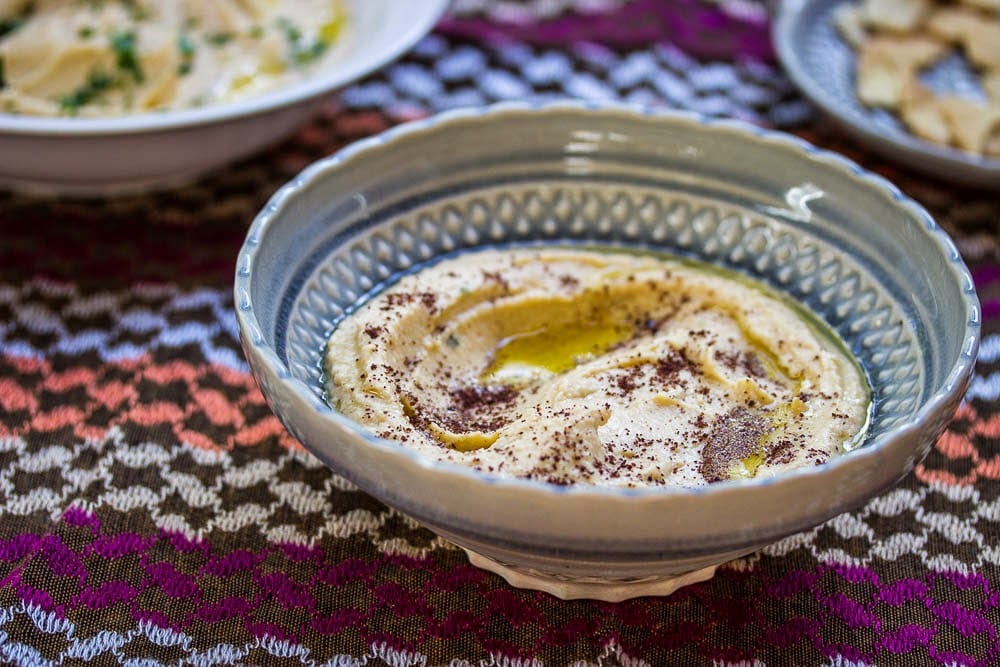
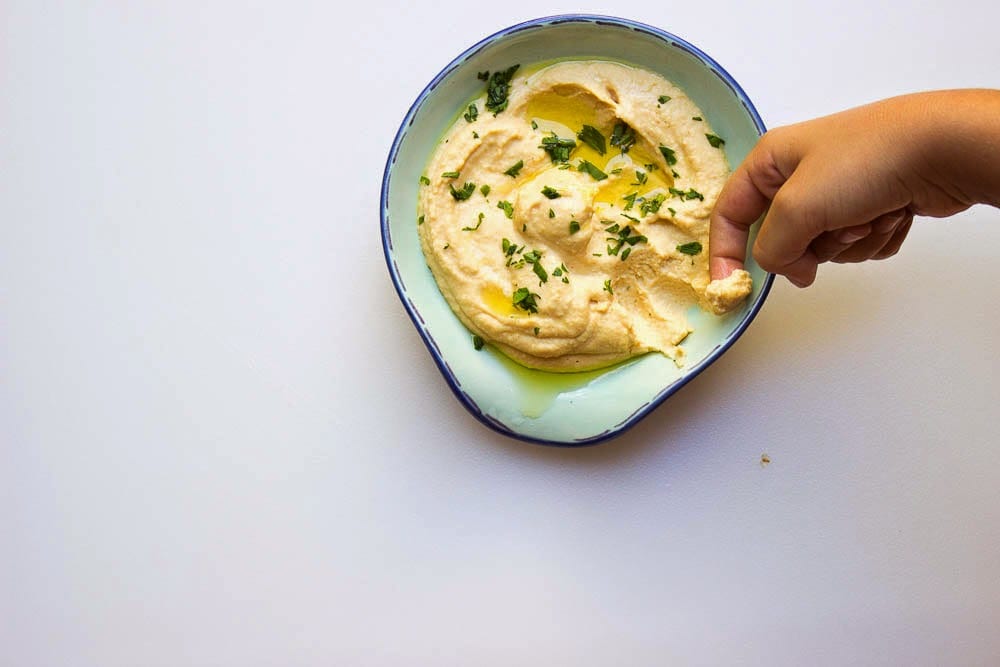
Drop in the chickpeas and blend until smooth and creamy.  Excersize patience.  This might take a few minutes. If needed add a little more broth to thin out.  Taste.  Listen – and I mean really listen – to your taste buds.  Add more of anything you think is lacking.  Let the hummus rest in the fridge for at least thirty minutes before serving – it’s been through a long journey, after all.   Bring to room temperature before serving (we can all use the time to acclimate) and drizzle liberally with olive oil. Serve as is or sprinkle top with anything your mood dictates.

You glance up and catch a legion of mothers, grandmothers, and great-grandmothers watching you from afar.  You respectfully nod and acknowledge their presence.  You are tempted to invite them to tea – but you don’t.  They have a long journey ahead of them and many more homes to visit.  They nod back and acknowledge that that they will not be staying today.  You watch them turn their backs and leave.

You freely sprinkle in the sweet Spanish paprika.
 A MOODY HUMMUS

Inspired by Melissa Clark’s Stupendous Hummus – Hyperion and  Yotam Ottolenghi and Sami Tamimi – Ten Speed Press

NOTES:

  • Make sure your dried chickpeas are not old.  I don’t recommend buying them from bulk bins as they are usually old and have gone rancid.  I purchase most of my organic legumes from here.
  • I really prefer using dried chickpeas over canned.  Especially because I use the cooking broth.
  • Keep any left over over broth and use as a base for soups!
  • I made my own preserved lemons last year (loosely following these recipes) and love them.  But you can also purchase them at Middle Eastern or specialty grocery stores  Give them a rinse under cold water before using.  And remember you are using only the rind.
  • Spanish paprika is also called pimenton.  Feel free to use any type you prefer.
  • I like to go easy on the tahini, but feel free to use as much as you like. Your kitchen – your mood – your taste buds!

Ingredients

1 1/4 cup dried chickpeas
1 teaspoon baking soda
Freshly squeezed juice of 2 lemons, plus additional if needed
1 teaspoon sea salt, if using preserved lemons, 1 1/2 teaspoons sea salt, if not using preserved lemons
1 fat garlic clove, chopped, or 2 or more (if your taste buds tell you so)
1/2 teaspoon cumin
1/4 teaspoon sweet Spanish paprika, or smoky paprika (depending on mood)
1/2 preserved lemon, chopped, (depending on mood)
1/3 cup tahini, (more if your mood dictate)
1/2 cup reserved chickpea broth, plus more as needed
Olive oil, as needed for drizzling
Sumac, as garnish, (if you’re in the mood)
chopped up parsley, as garnish,  (if you’re in the mood)

1- Put dried chickpeas in a large bowl and cover with plenty of water.  Soak overnight.

2- Drain the chickpeas.  Place in a medium pot over high heat and add baking soda.  Cook for about three minutes, stirring constantly.  Add 5 cups of water or enough to cover chickpeas by at least 1 inch and bring to a boil.  Turn heat down to medium/high and cook chickpeas.  Skimming off any foam and any skins that rise to the top.  Cook until the chickpeas are very tender but not mushy.  This will take anywhere between 20 mins-1 hour, depending on freshness of chickpeas.

3- Drain the chickpeas.  MAKE SURE YOU RESERVE THE BROTH, the cooking water.  Set aside.

4- In a food processor combine the lemon juice, salt, garlic, cumin, paprika, and preserved lemon, if using.  Pulse the mixture to combine.  Scrape down the sides.

5- Add the tahini with 1/2 cup of chickpea broth. Give it a whirl to combine.  Scrape down the sides.

6- Add the chickpeas and puree until smooth and creamy.  This can take a few minutes.  It took me about five minutes.  Scrape down the sides and taste.  With the motor running add more broth if necessary to make it nice and creamy.  I usually end up adding another 1/4 cup of broth.  Scrape down the sides.  Taste.  Listen to your taste buds.  Adjust any and all flavors as you like.

7- Transfer hummus to a bowl and cover, and let it rest in the fridge for at least 30 minutes.  Take it out of the fridge at least 30 minutes before serving.  Drizzle a nice olive oil on top, and garnish with any spices or herbs, or just serve as is.

Hummus will keep in the fridge for up to 3 days.  And it freezes beautifully for up to 3 months.

Dessert

Yellow Flame Pudding – A Saffron and Rose Chia Seed Pudding – Sholeh Zardeh Tokhmeh Sharbati – That Woman

I am that woman.

You know the one.

You’ve seen her around town.

On the 405 – the 101 – and the 10 sometimes going East – on market days going West.

You’ve waited patiently and sometimes not so patiently for her to pull out of “your” Whole Foods parking spot.

You’ve caught a glimpse of her in your rear view mirror at school drop offs and pick ups.

You’ve pulled up beside her at the stop light.

You know the one.

The one banging her hands determinedly, passionately against the steering wheel, tossing her hair with wild abandon from side to side. And if the windows are rolled down just enough you’ve heard her euphoric cries.

Yes, yes!  You’re killing it, Jason Bentley.

I am that woman.

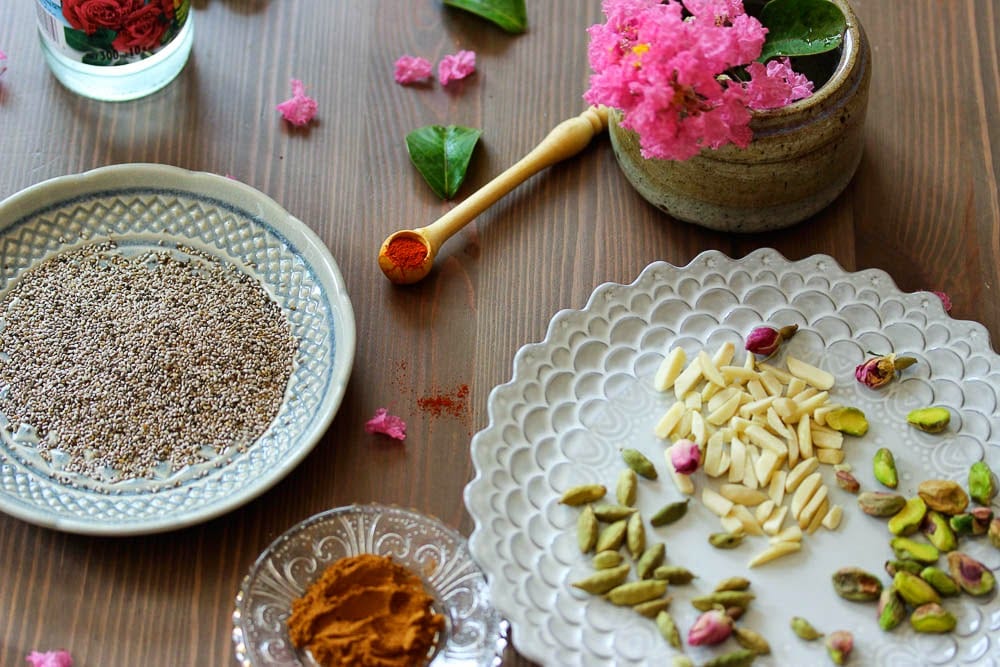
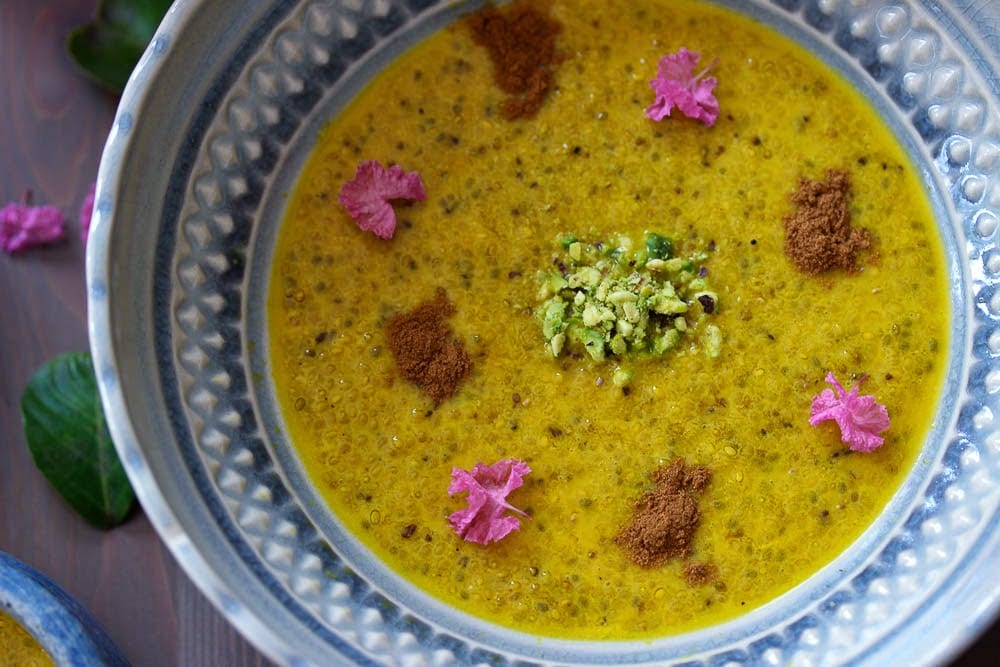
This chia seed pudding is inspired by one of my favorite childhood desserts: Sholeh Zard.  A very rich – vibrant yellow – saffron-infused rice pudding, scented with rosewater and spiced with cardamom and cinnamon.  The same scents and spices are used in this pudding. I’ve just traded in the rice for the more nutritious chia seeds and really cut back on the sugar content.

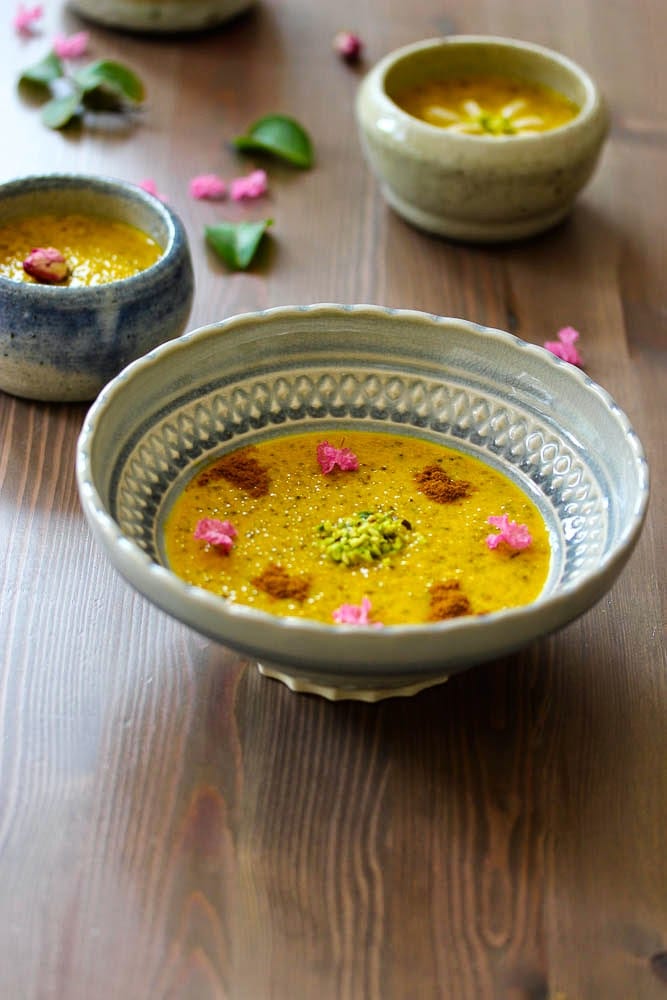
Chia seed puddings are one of our favorite go-to breakfasts.  It takes about five minutes to prepare and then you just let it set in the fridge overnight. The next morning you have a tasty, filling and nutritious breakfast, ready to go.  This pudding also makes an elegant dessert or after-school snack. The girls love their chocolate chia pudding made with raw cacao.  And now this saffron and rose-infused pudding has also become a staple and a favorite.  They call it Yellow Flame Pudding.

Chia seeds are an excellent source of omega-3 fatty acids, fibre, and make a great protein source.  They come in white or dark brown/black color and are both equally nutritious.  I like to use the white chia seeds for this pudding for a prettier presentation and to maintain the yellow flame of the saffron.  I find the black seeds tend to turn the color of the pudding to more of a light green.  But the taste is not altered, so feel free to use the black seeds if that’s what you have on hand – and if you don’t mind a slight color change.

I know saffron is quite expensive and not a spice that many have on hand.  But every once in a while it is worth the splurge.  I find it is also a spice very much like that prized dress or the special china that gets stashed away for that very special occasion that never comes.  And before you know it a whole year has gone by since you last used two strands of saffron for that recipe you came across. While the rest of your precious saffron is still waiting in vain in the back of the cupboard, or sharing long lost love stories with that hunk of parmesan rind you forgot you had stashed away in the freezer.  Don’t wait for that special occasion.  Tomorrow’s breakfast IS that special day.  This pudding IS that special dessert.  If you have a few strands stashed away somewhere, use them up.  And if not, go get some.  Your saffron and your taste buds will thank you.

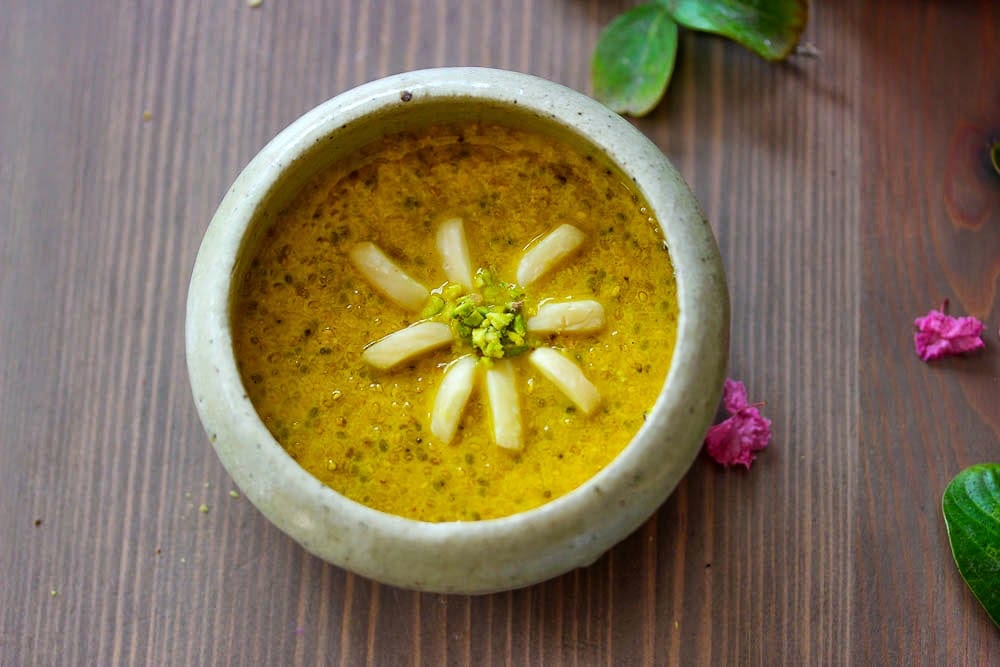
Sholeh Zard  is also known for its beautiful presentation.  The rice pudding is traditionally designed and garnished with cinnamon, ground up pistachios and slivered almonds.  Paisleys, flowers, sayings and patterns are intricately placed on top of the pudding using stencils.  I prefer to keep things simple (I am in no way a craftsy person nor do I aspire to be – much to my children’s disappointment) but feel free to get as creative as you like with the decorative garnishes.

I am that woman.

You know the one.

The one who will text her husband:

Are you listening?  Jason Bentley is on fire.

But more importantly my husband is that man who can confidently support and share in his wife’s sheer excitement over an amazing set of music played on the radio.

I am that woman.

You know the one.

The one standing at the kitchen counter on a hot late summers morning.  One hip leaning into the cool quartz surface ever so slightly.  Gently scooping up the last bits of the Yellow Flame Pudding.  Rose water, cardamom and cinnamon working their magic.  A brilliant yellow stain and scattered bits of ancient Aztec seeds reflecting back at me.  All senses on overload.  The beats of Gorgon City (a new find) pound through the speakers.  Then my old confidante Leonrad Cohen shares with me (and only me) that it was almost like the blues.  To be suddenly jolted by Town Called Malice.  And that’s when I completely lose it.  Jason Bentley – he has pushed me over the edge.  No longer able to contain it.  I peel myself away from the cool quartz, bounce around a few times (most likely off the rhythm, my husband would tell me) sing along (most definitely the wrong lyrics) and then instinctively reach for the chia seed bag, the spices, the bottle of rose water and frantically start whipping up another batch of Yellow Flame Pudding.

I am that woman.

The three smaller bowls pictured here are hand-made by my dear and super-talented friend Kim.  Check out her fantastic and always entertaining musings on life and more on her blog: Hold Your Horse.


SAFFRON AND ROSE CHIA SEED PUDDING – SHOLEH ZARDEH TOKHMEH SHARBATI

Notes:

  • * You can use white or black chia seeds.  I prefer white chia seeds here to maintain the color of the saffron and for a prettier presentation.
  • ** You can use any kind of sweetener you like here.  I’m partial to maple syrup or honey or dates.  If using dates blend them up with your almond milk first.

Ingredients:

Serves 2-4

1/4 cup white chia seeds*
1 1/4 cup plain almond milk (unsweetend and unflavored)
2 tablespoons grade A maple syrup, or honey, or 4 medjool dates**
1 tablespoon rose water
1/4 teaspoon ground cardamom
1/8 teaspoon ground saffron steeped in 1 tablespoon hot water
cinnamon, as garnish
slivered almonds, as garnish
chopped up pistachios, as garnish

1- Put the chia seeds in a medium sized bowl.  Add the almond milk.  Mix until the chia seeds are well incorporated into the almond milk (I like to use a small whisk).  Add the rest of the ingredients and mix to combine.  Cover and put in the fridge to set overnight (or at least 8 hours).  The pudding should have the consistency of a tapioca pudding.  You can thicken by adding more chia seeds or you can thin out by adding more almond milk.  Adjust sweetness to taste.  Sprinkle with cinnamon and garnish with nuts.

Will keep in the fridge for as long as your almond milk will keep fresh.  But best enjoyed within a day as the the rose scent will dissipate over time.

Dinner

Louisa’s Tempeh Kabas with Minty Cilantro Lime Sauce – Persian Hospitality

 ♪ Music we’re cooking to ♪

Much has been written, said, rumored, about Iran – about Persians.  By Persians and non-Persians alike.  Some true – some pure fiction – some thoughtful – some ignorant – some just plain uninformed.  But the one Persian quality that can be wholeheartedly agreed upon by everyone across time and borders is the generosity and excellence of Persian Hospitality.  It’s legendary.  (Check out Anthony Bourdain’s FB posts about his recent trip to Iran)  If you’ve ever been invited to a Persian home you know what I’m talking about.

It can’t be helped; it’s in our blood.  For better or for worse.

Act One
You are eight years old.  As directed you climb up on a stool to reach deep into the very back, dark crevices of the kitchen cabinet to fetch extra tea cups.  Clear ones of course, so the deep sunset hue of the tea can be collectively admired by all.  Perched on top of the kitchen counter – delicately handling the jingle-jangle of the cups – you watch your mother conduct a symphonic feast.  She frets about not having enough food prepared.  Your eyes dart back and forth from the Aash, to the 3 different kinds of Koresh, the Rice, the overflowing tray of Sabzi Khordan, and the Baghali Ghatogh.  Your brother marches through with all the confidence and pride of his assigned role – Spear Carrier #1.  He diligently gets to work placing tender, fragrant meat on very sharp and very long metal skewers.  Out of the corner of your eye you spy your father on the balcony fanning the burning coals with a piece of cardboard, with the command and authority of a general.  It is all a well-rehearsed and well-orchestrated operetta.  A typical Saturday night.

Act Two
You are now an adult with your own home and kitchen.  You get busy writing your own Saturday night libretto.  Commander General is what your husband lovingly calls you at times like this.  You wear the label with pride.  You begin your pas de deux with your rather brutish love interest – the stove – simply referred to as Viking in the program.  You fret about whether the rice is burning, the Tahdig crisping up properly, the 2 stews humming in pitch-perfect notes.  You should have made more food you say to no one in particular.  Your girls look at you incredulously as they reprise their roles as table-setters numbers 1 and 2.  Your husband walks through with the very sharp and very long metal skewers – he has fully embraced the role of Spear Carrier.  In one swift move you pass him the tray of kababs.  As the symphonic cacophony of sounds and aromas builds to a crescendo, you can’t wait to sink your teeth into your newest obsession – Louisa’s Tempeh Kababs.

I first met Louisa Shafia over a year ago.  She was hosting a dinner event at Cortez in Echo Park (sadly since closed) featuring dishes from her beautiful cook book The New Persian Kitchen.  Prior to the dinner Louisa and I had exchanged a couple of emails,  primarily me gushing about her book and she graciously taking the time to respond.  The first thing that that struck me when meeting Louisa was her genuine warmth and infectious smile: the very same qualities that radiate through The New Persian Kitchen.  In her book, Louisa graciously invites you on a journey and discovery of Persian food. Persian food for the modern kitchen – for the everyday kitchen – for my kitchen.  What I love about The New Persian Kitchen is how Louisa incorporates what she calls “new world” ingredients into the many tried-and-true dishes – a combination that speaks to the way I cook in my own kitchen.

Tempeh
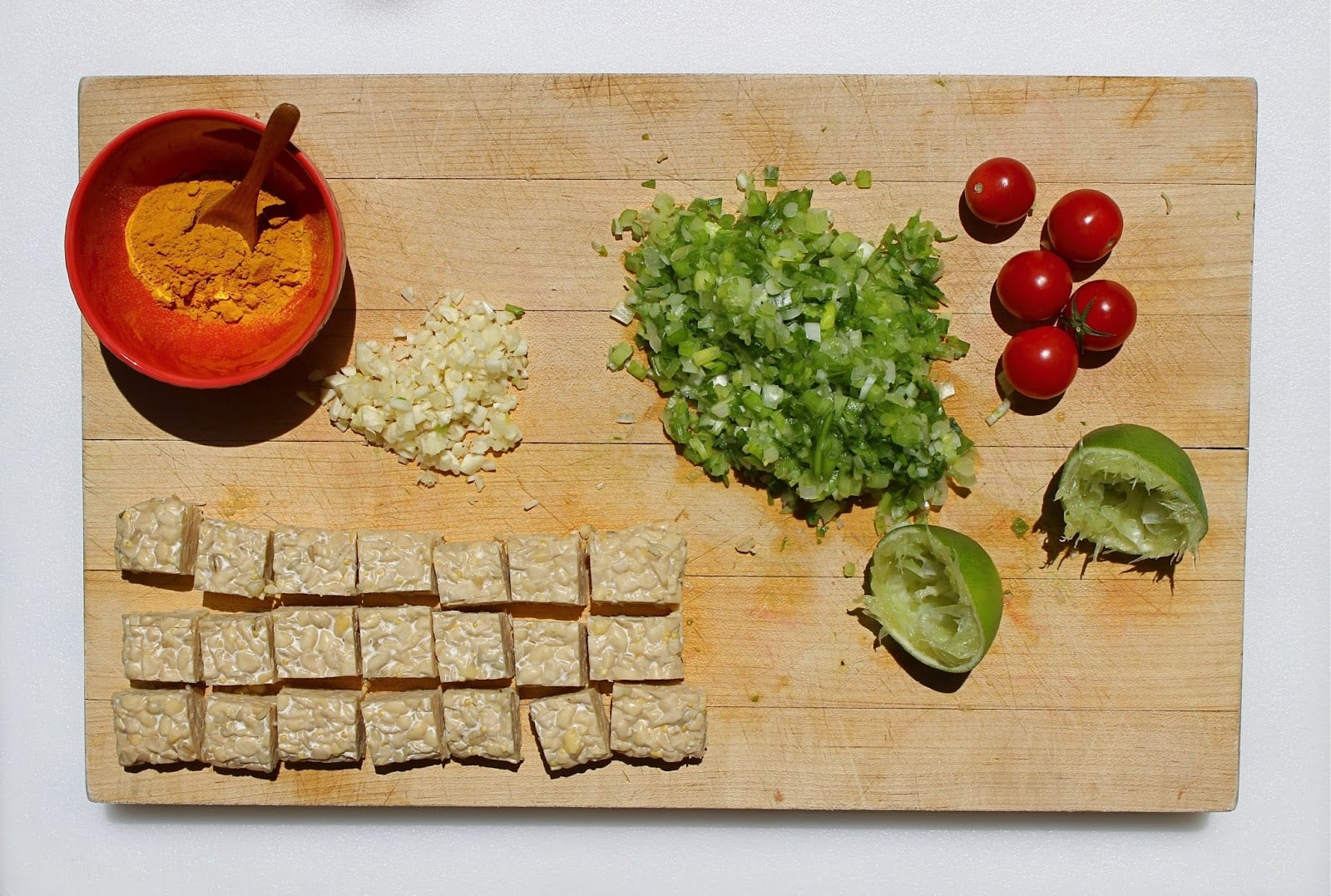
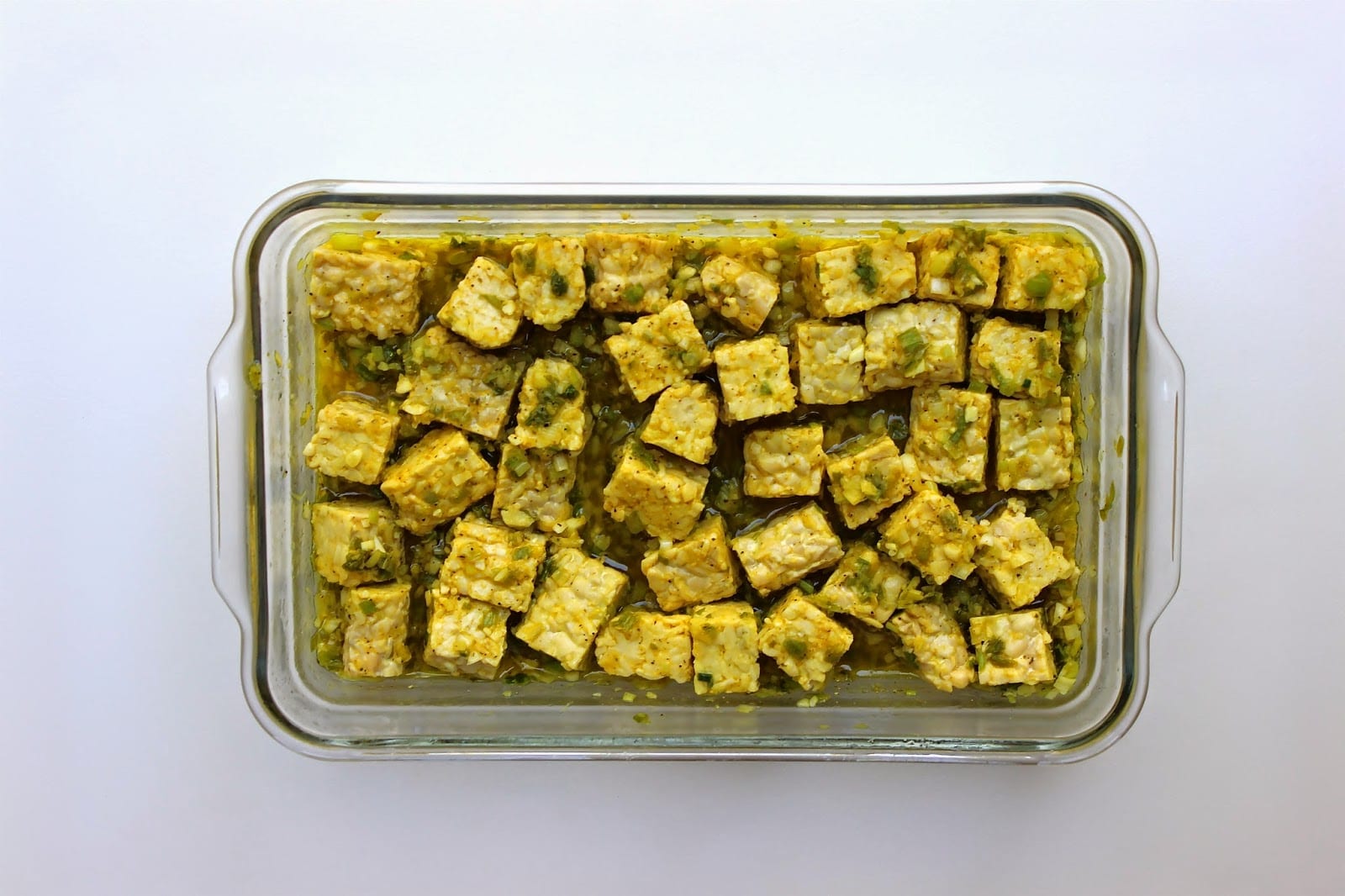
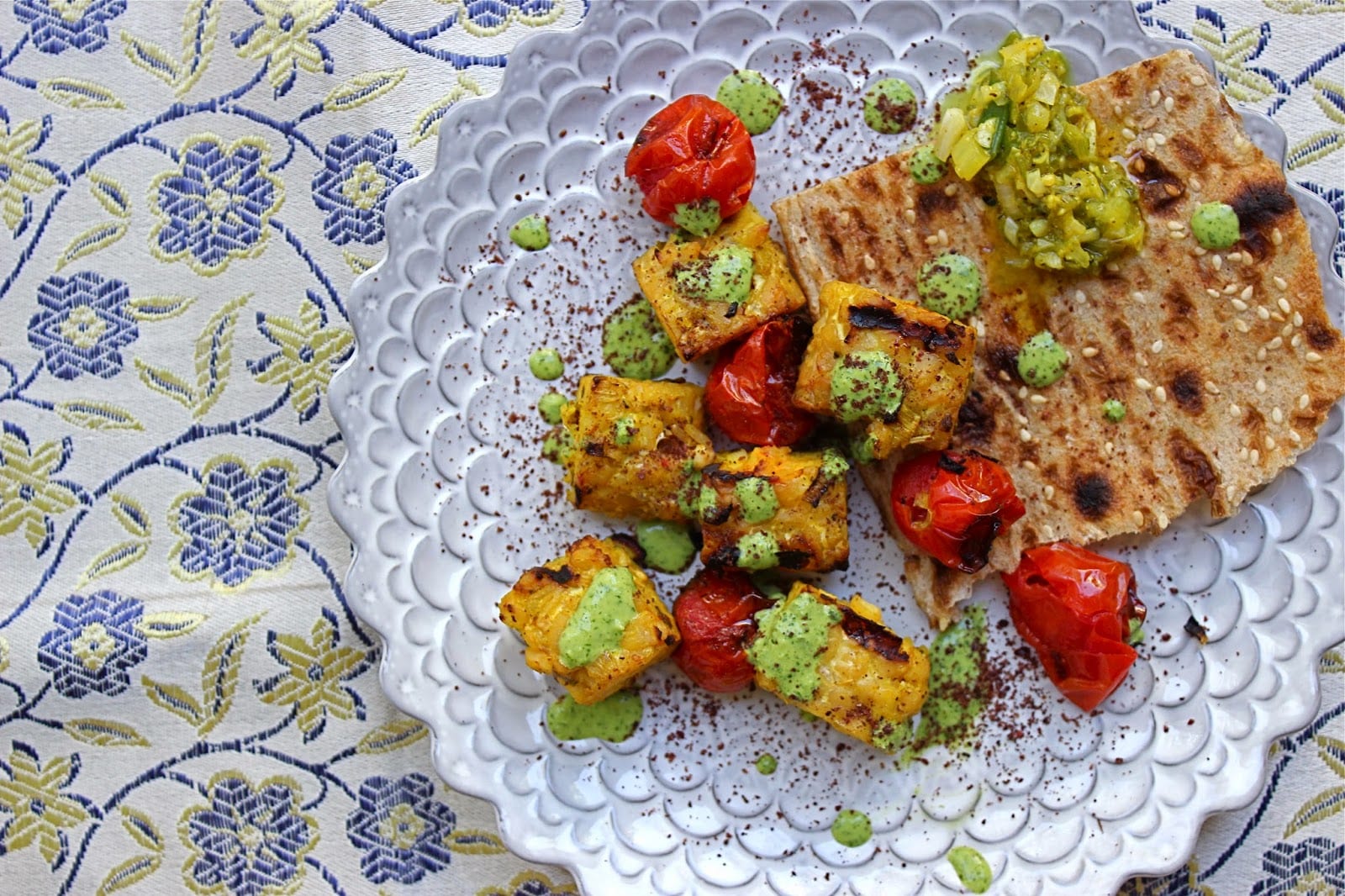
One of the many recipes I was intrigued and inspired by in The New Persian Kitchen is this Tempeh Kabab which has become a grilling staple in our house.  It has its own place right next to the Jujeh Kabab, Kabab Koobideh and Kabab Barg.  Although I have tried tempeh in restaurants before, this was my first time cooking with it at home.  And with this recipe I am now officially a tempeh convert.  Tempeh is fermented soy.  Because it is fermented it makes it a highly digestible food boasting many nutritional benefits.  And unlike most other soy products that are highly processed, tempeh is considered a “whole food.”  I buy my organic tempeh at Trader Joe’s or Whole Foods and prefer the one marked original (I’ve tried the 3 grains one and haven’t enjoyed it as much).  From my limited experience with tempeh I recommend marinating the kababs overnight for a full flavor impact (Louisa even recommends marinating for up to two days).  The simple marinade of turmeric, scallions, lime juice, garlic and pepper makes the otherwise bland tempeh burst with flavor.  These tempeh kababs shine all on their own for vegetarians and non-vegetarians alike.  Louisa suggests serving these kababs with a minty-cilantro sauce, which is delicious.  However, on occasion (because I was too lazy to make the sauce) I have served the tempeh kababs on their own with the scallion marinade on the side (since tempeh is plant based you can eat the marinade without cooking it).  And let me tell you – the slightly tart marinade is delicious and a hit every time we serve it.  It’s a perfect accompaniment to the kababs, like a salsa or torshi (Persian pickles).  I have even used  leftover marinade the next morning in our scrambled eggs or frittata.  You can serve Louisa’s Tempeh Kababs any which way you like – with some fragrant basmati rice, wrapped up in lavash or sangak bread, or with a side salad – for a perfect summer meal.  So get your grill going – time to serve up some Tempeh Kababs.

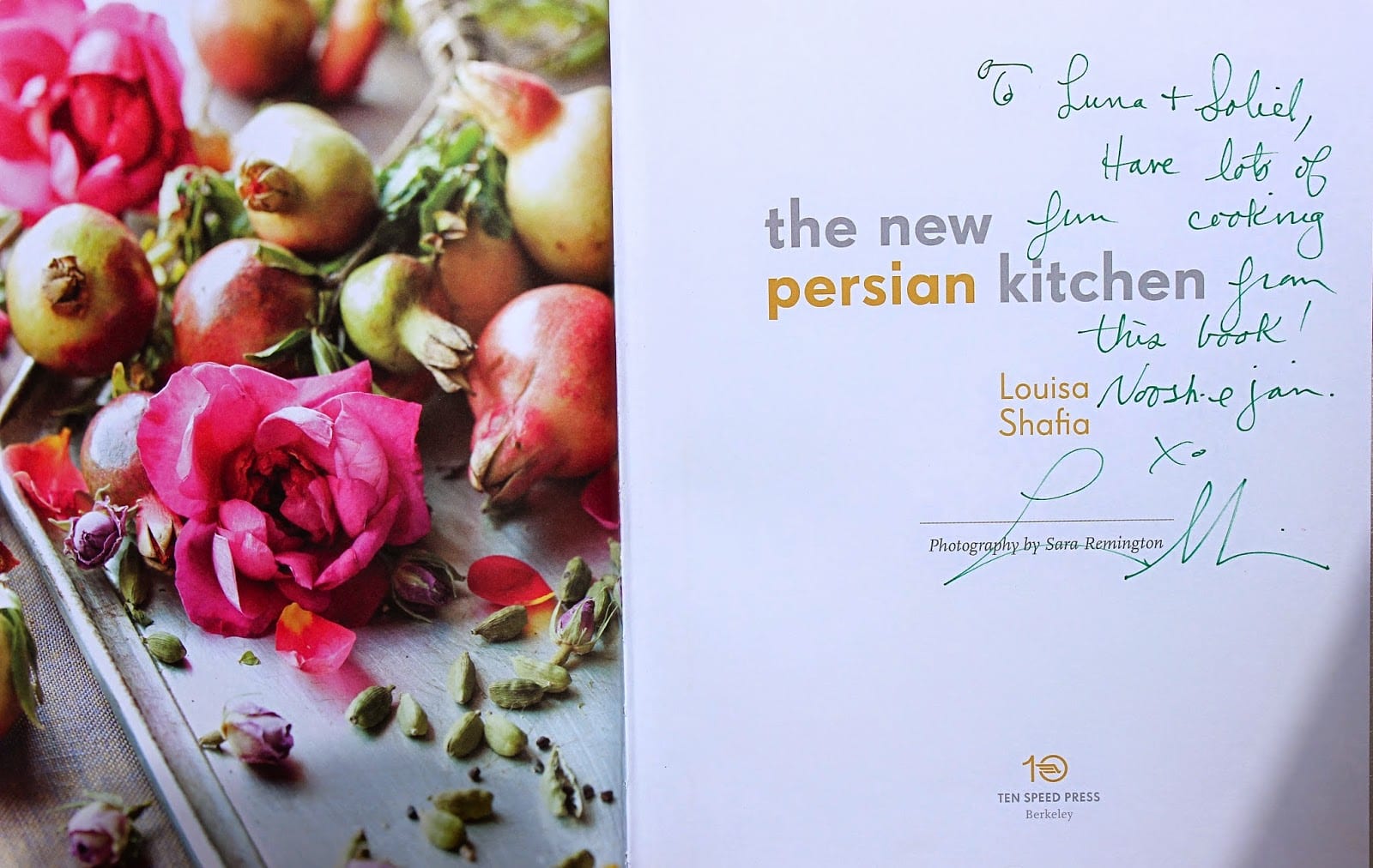
The New Persian Kitchen is one of those cook books that is timeless and sure to become a classic.  Drew and I had Louisa inscribe our copy to Luna and Soleil.  The perfect  heirloom to pass down from generation to generation.

Act Three
The curtain rises and you welcome your guests.  They remark on the delicious aromas coming from the kitchen.  You say you hope they like Persian food.  They compliment your rug – you are almost compelled to say that it means nothing to you and that it would make you happy if they took it.  Their eyes would widen with joy and bewilderment.  They would look back to the rug expectantly.  Are they really thinking of rolling it up??  Tarof, the Persian art of humbling oneself and putting your guests’ needs and comfort above your own, would be lost in translation.  You thank them kindly, gently steer them away from the rug and towards the dining room and the Tempeh Kababs.

CURTAIN


LOUISA’S TEMPEH KABABS WITH MINTY CILANTRO-LIME SAUCE

Very slightly adapted from The New Persian Kitchen – by Louisa Shafia – Ten Speed Press

I pretty much stick to Louisa’s recipe here with only minor adjustments.  I have reduced the amount of  pepper since the girls will bail on anything if they detect any heat.

Ingredients:

Makes about 10 (8-inch) skewers

TEMPEH KABAS
5 scallions, green and white parts, minced
1/2 cup olive oil
1/2 cup freshly squeezed lime juice (about 4 limes)
1/2 teaspoon ground turmeric
3 cloves garlic, minced
sea salt
black pepper
2 (8-ounce) packages tempeh, cut into 1 1/2 -inch cubes
1 pint cherry tomatoes
sumac, for garnish

MINTY  CILANTRO-LIME SAUCE
1 cup loosely packed fresh mint
1 cup loosely packed fresh cilantro
1/3 cup plain yogurt (not Greek Style)
marinade from the Tempeh Kababs

1- In a large bowl whisk together the scallions, oil, lime juice, turmeric and garlic with 1 tablespoon salt and 1 teaspoon pepper (Louisa uses 2 teaspoons pepper).  Add the tempeh and toss to coat well.  Transfer to a container with a lid and marinate in the refrigerator, for at least 1 hour or up to 2 days (I marinate overnight).

2- Thread the tempeh onto the skewers about 1/4 inch apart with a few tomatoes in between.  If you have any leftover tomatoes give them a quick toss in the marinade and skewer them separately.

3-If you will be serving the Minty Cilantro-Lime Sauce reserve 1/4 cup of the remaining marinade for basting and pour the rest into a blender.  Add the mint, cilantro, and yogurt.  Blend until smooth to make sauce, then season with salt.

4- Prepare a hot grill.  Grill the skewers, basting a few times with the marinade, 4 to 5 minutes per side, until the tempeh begins to char.  Transfer the tempeh skewers (and any tomato skewers) to a serving platter.  Spoon some of the sauce (if using) over the tempeh and put the rest in a bowl for dipping.  If not using the sauce put the marinade in a bowl and serve alongside the tempeh.  Serve the Tempeh Kababs hot and garnish with sumac to taste.

Dinner

Spaghetti Alle Vongole in Rosso – Spaghetti in a Red Clam Sauce – Forza Italia!

“Which of the cities visited did Your Highness enjoy the most?” – Reporter

“Each, in its own way, was unforgettable.  It would be difficult to…Rome!  By all means, Rome.  I will cherish my visit here in memory as long as I live.” – Princess Ann – Roman Holiday

The television set is perched precariously on a make-shift table.   Blankets – well-traveled and lovingly clung to across two continents – adorn the living room floor.  Each fold and crease meticulously smoothed out, more than making up for any lack of furnishings.  The dull brown sliding balcony door perfectly frames the lush green maples swaying rhythmically from side to side, sleepily whispering in hushed tones the arrival of an early Vancouver Summer.  Green – everywhere you look, it’s all green.  But none of this beauty registers.  We sit with our eyes affixed to the TV set.  Anticipation and expectations running high.  These are the years predating the domination of the World Wide Web.  But at the time this antiquated box of moving pictures and sound is our only link to the most important event of the summer – of the year.

World Cup Soccer 1982 Finals.

Italy vs. West Germany.

Growing up, a big pot of water was a permanent fixture on our stove. Always standing at attention  – ready to come up to a boil   On any given day this pot would either serve as the conduit for a fragrant platter of rice (with crunchy Tahdig of course) or a bowl of perfectly cooked al dente pasta.  And depending on which was being served  you could always find its lover – a companion pot lounging right next to it, slowly, dreamily simmering the day away.  A stew of some kind for the rice, or some type of sauce for the pasta.

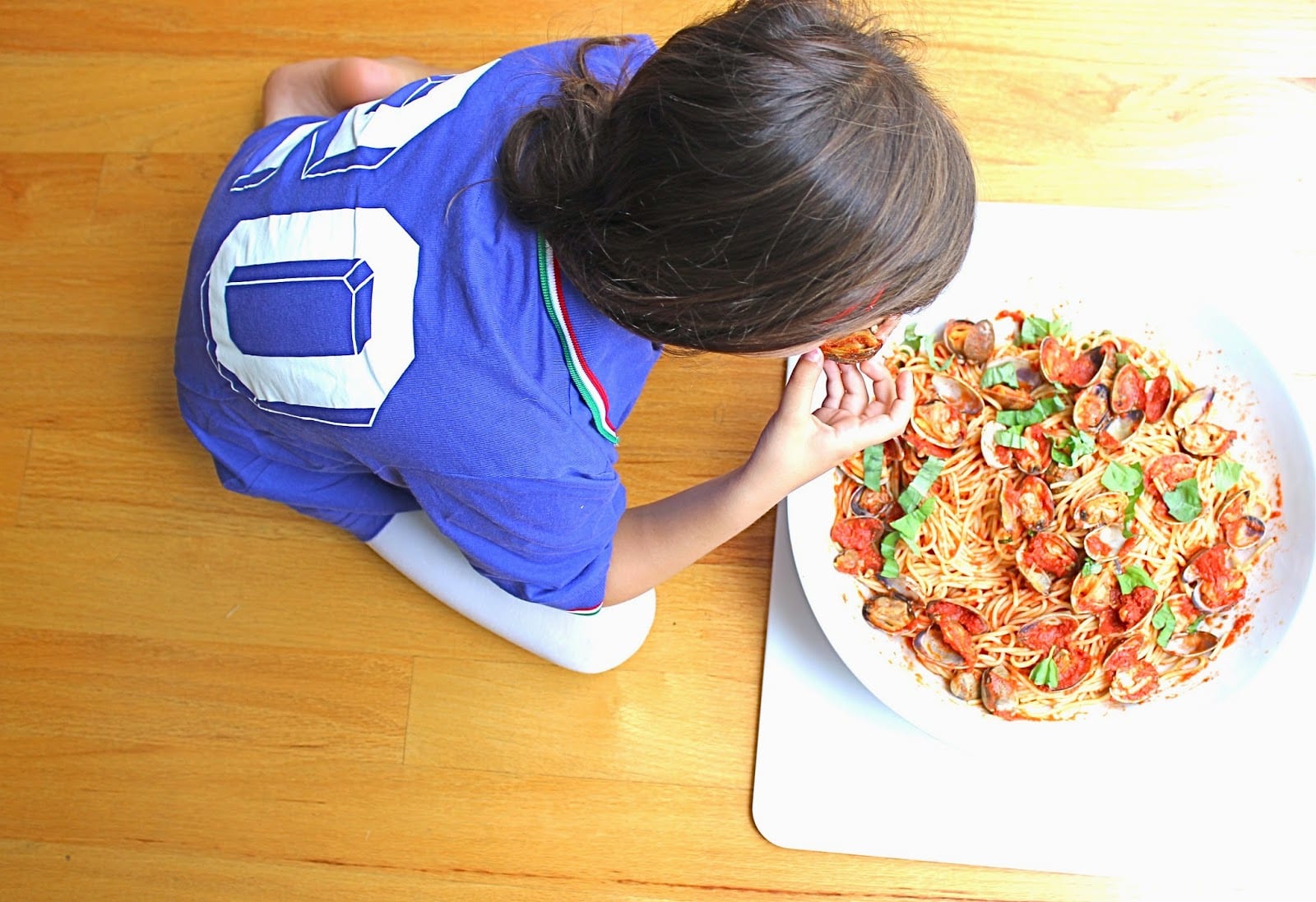
Spaghetti alle Vongole – Spaghetti with Clams is a staple and a favorite in our house.  Just the mention of it will send the girls and Drew into a spirited Vongole dance.  I prefer my Spaghetti alle Vongole in Rosso – in a red sauce.  Just like my Baba – my dad – does.  The best Spaghetti alle Vongole I’ve ever had was some years ago in San Remo.  Baba, my step-mother Kumi and I had just stepped off the train at about 10pm – ravenous.  A local at the train station recommended a small family-owned restaurant, and suffice to say it was one of those forever life-altering meals.  I have been trying to recreate that Spaghetti alle Vongole in Rosso ever since.

Vongole – Clams
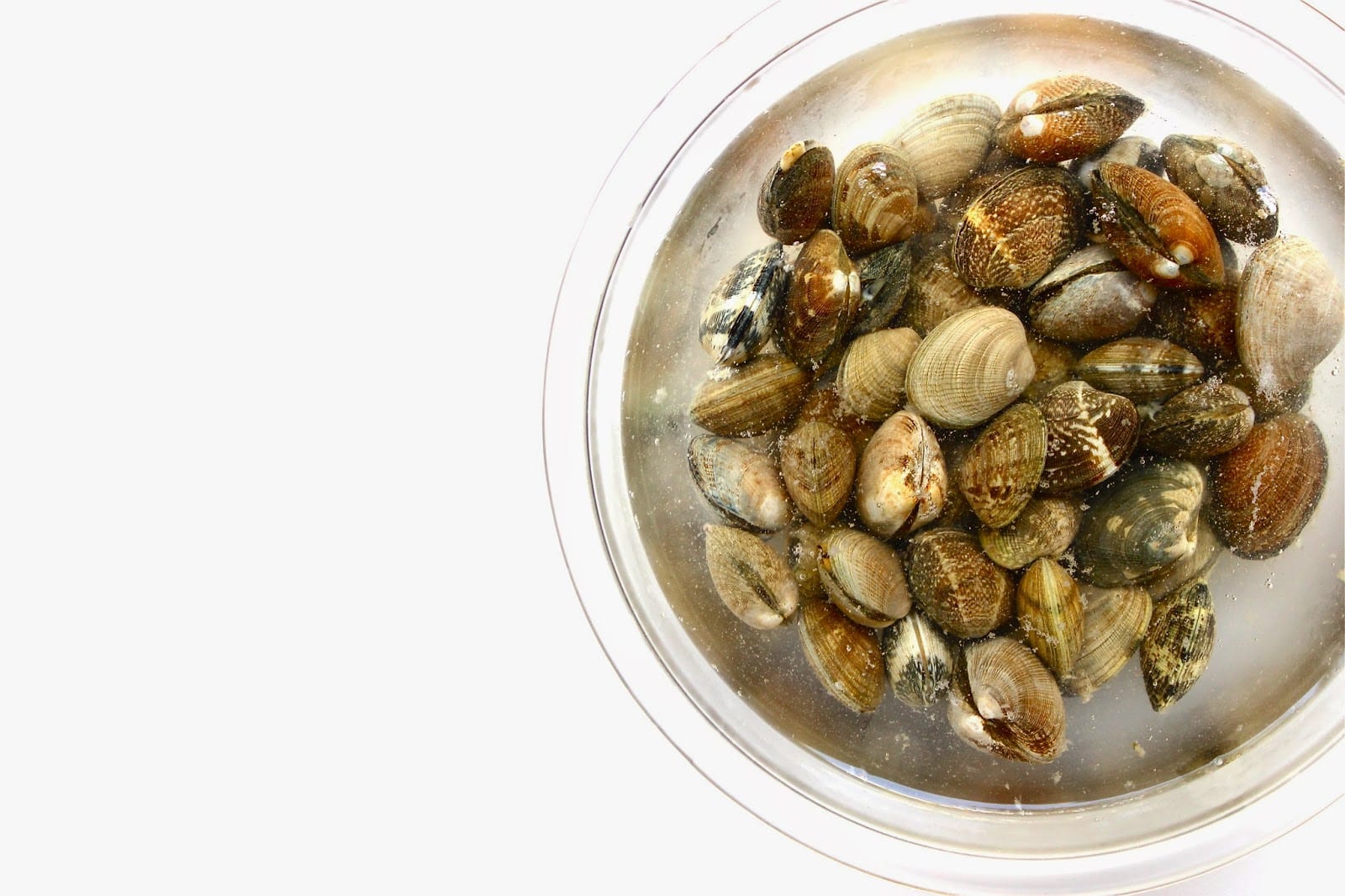
The clam sauce here is very basic with few ingredients.  So it goes without saying that the best quality ingredients will make all the difference.  Fresh clams being the most important.  I like to use small clams – manila clams or cockles.  I buy my clams at the market the day I am going to be preparing them and I make sure to ask for the ones that are closed tight (if they are open they are not alive and cannot be consumed).  Sometimes when you get home some may open up slightly – if so gently tap one clam against another.  If they close up they are ok to use, but if any stay open then discard them.  As soon as you get home gently put the clams in a large bowl and fill with fresh water and add salt to it.  You want to add enough salt to make it like seawater.  This process allows the clams to release the sand trapped in them.  Put the bowl of clams in the fridge (uncovered) for at least 30 mins or until you are ready to use.  When ready, gently lift the clams out of the water so you don’t disturb the sand that has settled at the bottom and give them a quick rinse.  Clams cook fairly quickly and over-cooking them turns them tough and rubbery, so make sure you scoop them out once they have opened up.  Discard any that don’t.

Tomato Sauce
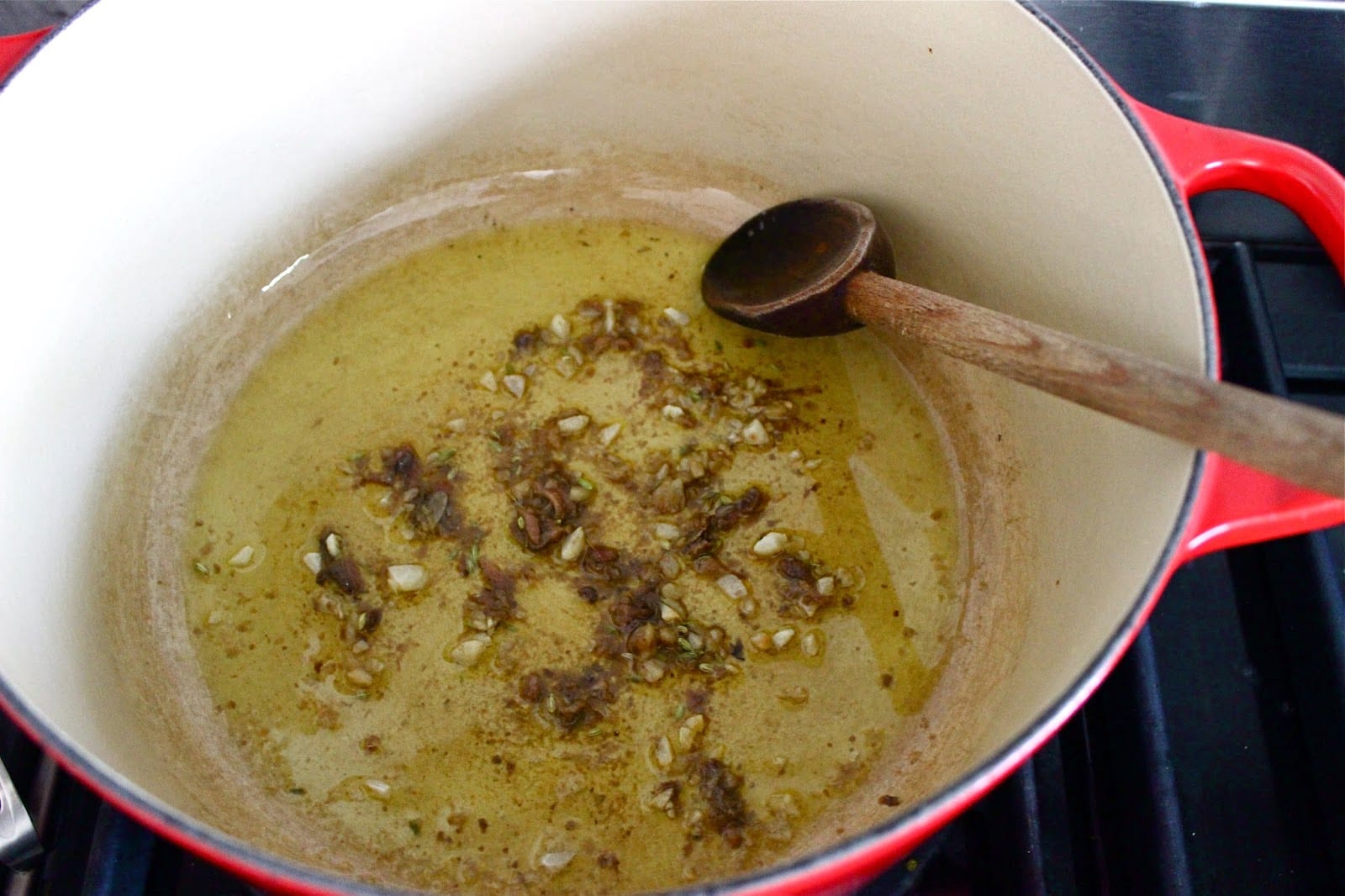
Typically this calm sauce is made with fresh, in-season tomatoes.  But I make mine with good quality jarred tomatoes like these, since in-season tomatoes are limited.  But more importantly since the girls like a smooth tomato sauce, no chunks of cooked tomato Mama!, I puree the tomatoes first.  But you can cook them whole and gently break them down as they simmer if you like.  And taking a cue from a beloved fish stew called Ciuppin I like to add plenty of garlic and anchovies to the sauce with a sprinkle of fennel seeds to liven it all up.  Please, please, please don’t skip the anchovies here.  The anchovies delicately break down and melt into the olive oil and become one with the garlic – creating a paste of sorts that adds a fantastic depth of flavor to the whole sauce.

Pasta
Over the years we have been much more mindful of how much white pasta we eat.  Most of the time trading it in for healthier alternatives.  There are so many options now beyond whole wheat – a variety of grains (spelt, einkorn, etc). One that we enjoy most is a quinoa based pasta which is gluten-free and which I feel comes the closest in replicating the texture and taste of a regular white pasta.  But as is the case with our white rice consumption there is a time and place for the “real” stuff.  And this dish is one of those times when we break out the tried and true to our hearts –  white semolina pasta.  You can use regular spaghetti. I usually like to use a thinner noodle like linguini or spaghettini – thin spaghetti.  Cheese (parmesan/pecorino) is not under any circumstances served with a seafood based pasta.  And now please avert your eyes momentarily if you are a traditionalist when it comes to this hard fast rule because – I like a sprinkling of parmesan on my Spaghetti alle Vongole.  There.  I said it.  Now let’s move on.

Dino Zoff – the team captain and goalie – runs the course of the stadium – the trophy held proudly high above his head.  Paolo Rossi and the rest of the team clad in their blue jerseys – Gli Azzurri – run right along with him.  The stadium sounds as if it’s about to burst – as do our hearts, an ocean away.  We storm our tiny balcony – wooden spoons, pots and pans in hand, loudly banging one against the other, confounding our very nice Canadian neighbors’ impression of us even more.  Adding to the general mystery of exactly where we have beamed down from – what with the enticing and exotic aromas always wafting down the hall.  Our cheers, hoots and hollers startle and shake up the maple trees.  World Cup fever has yet to catch in this corner of the world.  But on our little corner of the balcony – our makeshift Roman fountain – our hearts are alive and on fire.  And for the first time in two months since our plane took off from Fiumicino airport – that big lump that seemed eternally lodged deep in our throats is set free.  And the tears flow freely.

Do you have World Cup fever?  Who will you be cheering for?  And more importantly, what will you be cooking to celebrate?  Forza Italia!


SPAGHETTI ALLE VONGOLE IN ROSSO – SPAGHETTI IN A RED CLAM SAUCE


Ingredients:

Serves 4-6

3 tablespoons olive oil
3 large cloves garlic
5 anchovies packed in olive oil
1/8 teaspoon fennel seeds
2 – 18oz jar of whole peeled tomatoes with their juice, pureed in a blender or food mill (optional, for a smooth sauce)
sea salt
pepper
2 pounds live manila clams, rinsed scrubbed and soaked in salt water
1 pound spaghettini, or linguini

1- Heat the olive oil in a large pot over medium/low heat.  Add the garlic and anchovies.  Add the fennel seeds by crushing them between your hands.  Stir and cook until the anchovies start breaking down and melting into the oil.  Take care not to burn the garlic, turn heat down if necessary.  3-4 minutes.

2- Add the tomatoes and their juices.  If the tomatoes are not pureed gently break them down in the pot.  Add 1/2 teaspoon sea salt and pepper to taste.  Stir and cook uncovered at a gentle simmer for 35 minutes – 1 hour.  The longer it sits and simmers the more flavorful it will be.   Adjust seasoning as needed.

3- Bring a large pot of salted water to a boil.  Add the spaghettini and cook until al dente.  No mushy pasta please!

4- As soon as you start cooking the pasta add the clams to the sauce.  Gently lift the clams out of the bowl of salt water and rinse them.  Gently add them to the sauce.  Cover the pot and turn the heat up to medium.  Cook the clams until they open.  About 4-6 minutes.  Don’t overcook the clams.  Discard any clams that don’t open.  The clams will release a lot of their juices to the sauce.  Once the clams have cooked you can take them out of the sauce and turn up the heat on the sauce to reduce it until it is slightly thicker.  (I usually don’t have the patience for this though and find the sauce thickens up when I add it to the hot pasta.)

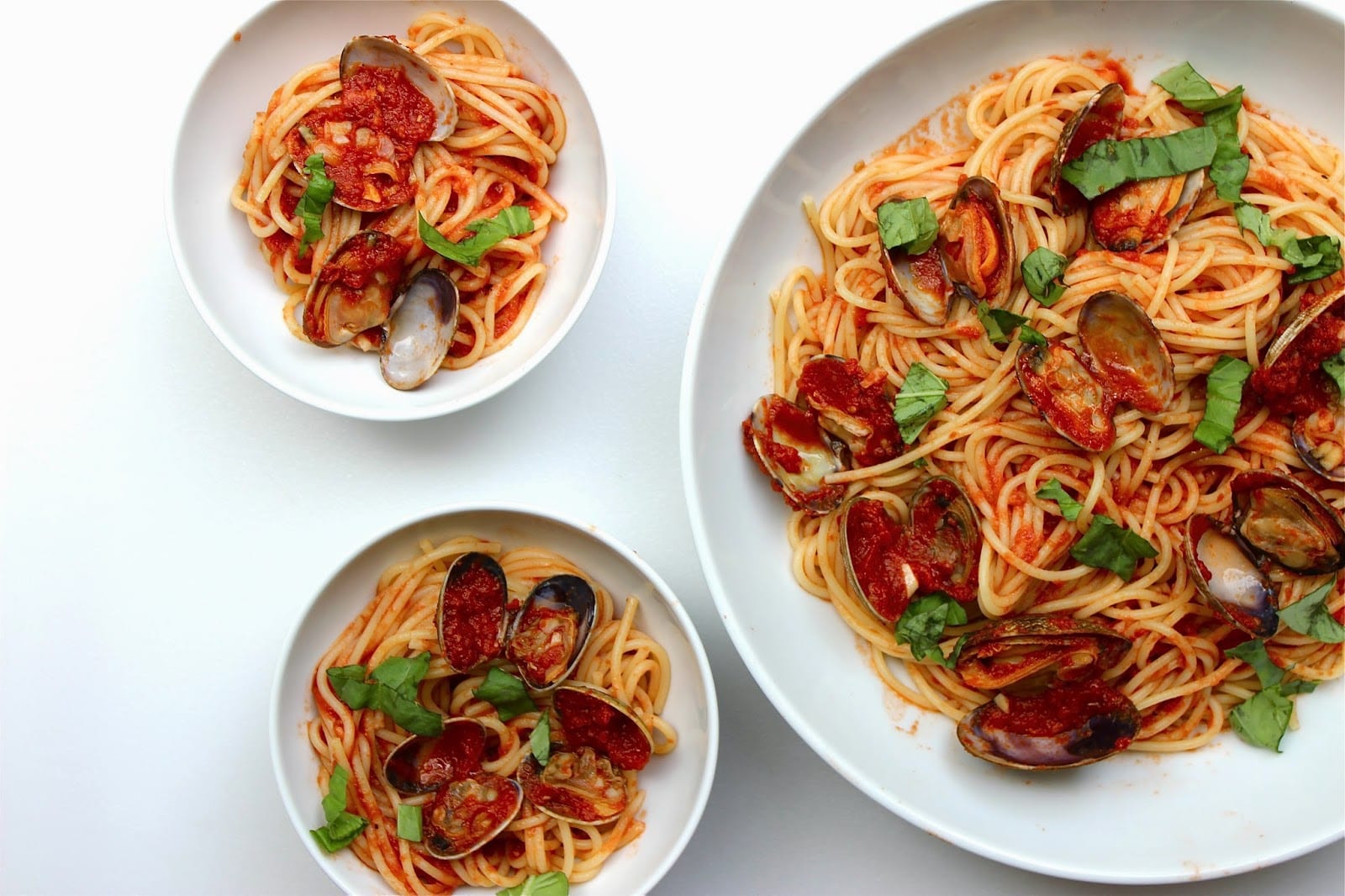
5- Drain the pasta and transfer to a large serving bowl.  Carefully add the sauce and mix until well combined.  Serve immediately.

Dessert

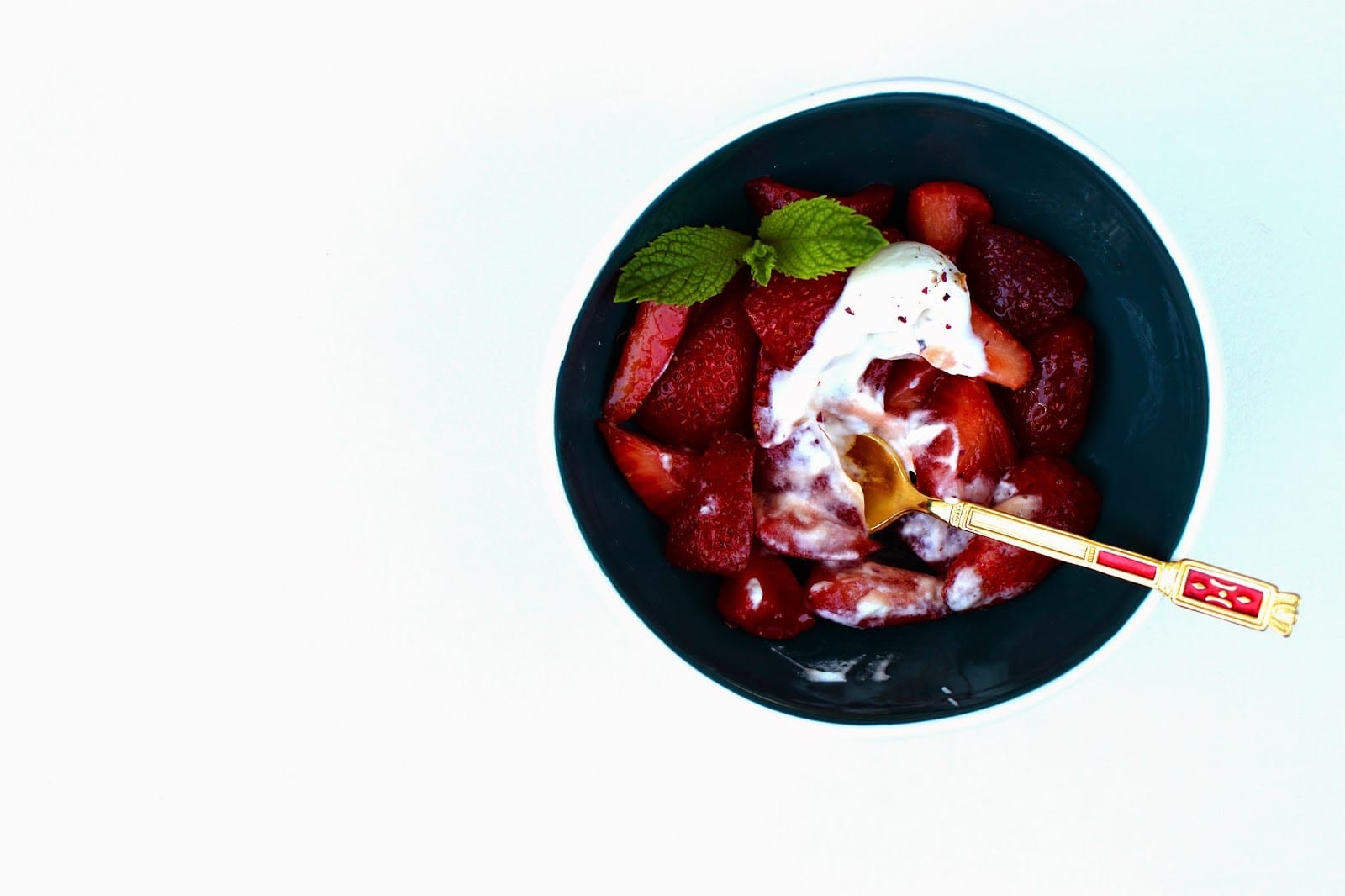
Mothers and Daughters – Strawberries Macerated in Pomegranate Molasses with Rose Water Cream

Once upon a time, a long, long, long time ago, there was a bang which wasn’t really a bang but more of a singular moment in time when all the matter in the universe came into laser-sharp focus and all that energy in there shook around and bounced off of each other and  contracted and contracted until there was no more room so it expanded and BANG! exploded into tiny particles forming protons, neutrons and electrons – forming The Universe.  Thousands of years passed and this universe kept expanding and expanding eventually forming stars and galaxies – forming The Moon and The Sun.  My Universe.

Every morning you wake up and vow that today you will be a better mother.

You will be more patient, more adventurous, worry less, play more, not yell, improve your Barbie voice,  run faster and harder when playing the monster game, get down on your hands and knees and inspect the dead slug.  You vow to try and stay out of their way when they have disagreements – let them figure it out on their own – because you read somewhere that’s what you’re supposed to do.  You promise not to let the “baby” and “puppy” voices grate on your nerves like nails down a chalkboard.  You swear to squeeze them harder, linger in their embrace longer, and commit to memory every inhale and exhale as you watch them fall asleep.  You vow that today will finally be the day that you don your Perfumier apron, and distill the warmth of their bodies, their sweet scent, in fine Venetian glass bottles.  Because you understand – you know – that these days are fleeting.

Every night you go to bed and vow that tomorrow you will be a better daughter.

You will be more patient, more agreeable, better natured – not so reactionary.  You will slow down and walk beside her – at the speed that frail and ravaged knees now dictate. You’ll listen patiently, enthusiastically to the stories you have heard many times before. You won’t pretend to know it all – because you don’t.  You’ll remind yourself to let her mother you – because that’s what mothers like to do.  You’ll remind yourself that these days  are fleeting – you are fully aware of the preciousness of time.  Time is insolent, it knows no do-overs, it is a dictator that can never be overthrown.  No revolution, no hunger strike can change its course.  It is expanding – continually expanding.  And so you long to curl up in her lap again – just like you did when you were a child. To have her smooth, always elegant hands run through your hair – just so – to have her gently sing you your favorite lullaby.  You’ll remind yourself that once upon a time you were her Universe – you still are her Universe.

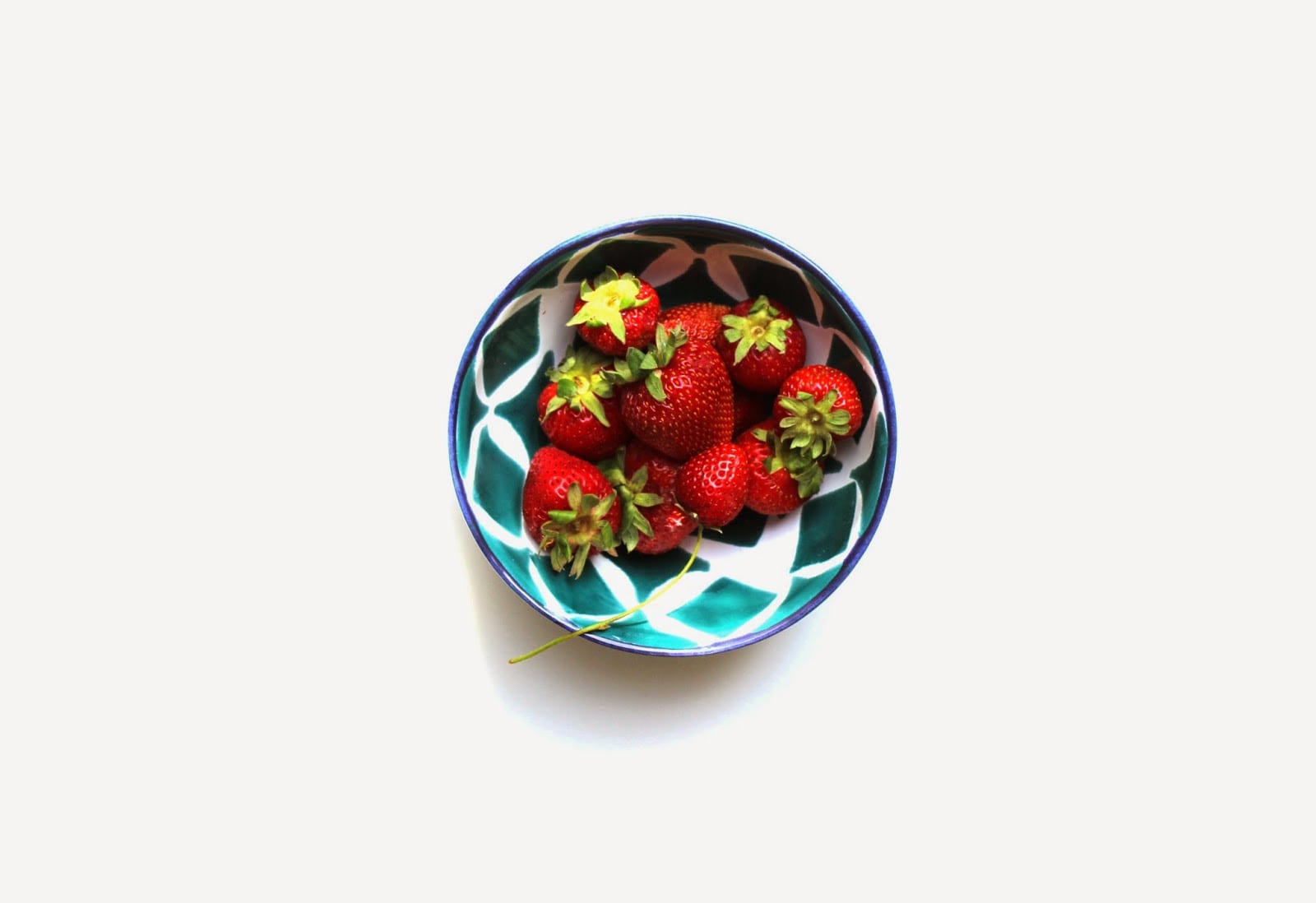
You stain your hands blood red from the fresh strawberries.   Many times you’ve had strawberries macerated in balsamic, but since you usually don’t have any balsamic around and you’re not willing to make a trip to the store, you reach for the bottle of pomegranate molasses you always have on hand.  You watch the syrup languidly ooze out of the bottle and bathe the strawberries.  You set the bowl aside and allow the flavors to meld and dance in perfect harmony.  You ask your girls – your taste testers – your shadows – your Moon and Sun – what else the macerated strawberries need.  They savor their bite, licking their lips with big smacking sounds, and confidently declare it needs salt.  It doesn’t need salt.  They always say it needs salt because that’s what you always say.  Your words, your opinions, still carry weight.  You are still their Universe.  You remind yourself it won’t be this way forever.  Time is fickle, time is irreverent.

You watch the cream slowly churn as you add the rose water and for a moment you are transported to your grandfather’s garden in Tabriz.  You were six years old chasing butterflies through the rose bushes.  You put the cap back on the bottle and just like that the memory fades.  Memories trapped in bottles. You turn to tend to the dinner simmering away on the stove.  You reach for the salt bowl.  You feel your mother’s observant gaze follow your every move.  Gently, she reminds you not to add too much salt.  You snap back saying you haven’t.  Instantly you regret it.  You taste the stew, it’s too salty.  She was right – she is always right.  Slowly, cautiously she makes her way over, puts a gentle hand on your shoulder and tells you not to worry.  She’ll fix it with a little more lemon juice.  She’ll fix it.  Because that’s what mothers do.

You serve the strawberries – tangy, sweet juices and all – and add a dollop of the rose cream to each bowl.  You instinctively extend your arm out to your mother.  She balances herself and gives her weight over to you.  Your other hand reaches for the Moon as the Sun clings to your apron.  The four of you make the slow, short walk from stove to kitchen table.  Mothers and daughters.  Protons, neutrons, electrons bouncing off of each other.  As you dig into your bowl of pomegranate molasses strawberries you look around you and marvel at it all.  The Universe – with all its mysteries and certainties is a beautiful thing to be a part of.  Your heart contracts and contracts and just when you think there is no more room BANG! it explodes and expands.

Mothers – daughters.  It’s beautiful – it’s complicated – it’s love.

Happy Mothers Day.


STRAWBERRIES MACERATED IN POMEGRANATE MOLASSES WITH ROSE WATER CREAM

*I don’t like my cream very sweet so I don’t add too much of a sweetener to it.  Feel free to adjust to satiate your personal sweet tooth.  You can also substitute the maple syrup for any sweetener of your choice.

Ingredients:

Serves 6

2 pints fresh strawberries, hulled and quartered or halved depending on size
2 tablespoons maple syrup (I use Grade A because it has a more subtle flavor)
1 tablespoon pomegranate molasses
1 cup very good quality heavy cream
*1 teaspoon powdered sugar, plus more as needed
1/4 teaspoon rose water, plus more to taste (I used 1/2 teaspoon)
ground up dried rose petals, as garnish (optional)
fresh mint leaves, as garnish (optional)

1-  Place strawberries in a medium sized bowl.  Add maple syrup and pomegrante molasses.  Stir to combine and set aside allowing all the flavors to meld, until the strawberries release their juices.  About one hour.

2- Chill the bowl and whisk of your stand mixer in the fridge or the freezer.  Once chilled add the cream, sugar and rose water to the bowl and whisk starting on a slow speed and increasing to a high speed until soft peaks form.  Adjust flavors as needed.

3- Serve the strawberries and their juices in a bowl with a dollop of rose water cream.  Garnish with a dusting of ground up dried rose petals and a couple of mint leaves.  Enjoy right away.  The strawberries are also fantastic over Greek yogurt or on your morning pancakes and waffles!

Dinner Stew

An Artichoke, Mushroom, and Sour Green Plum Stew – Khoresh Kangar-E-Farangi Ba Gojeh Sabz – An Official Dinner Invitation

 ♪ MUSIC WE’RE COOKING TO ♪

Mama!  The radio just said Air Force One landed at LAX.  Can the President come over for dinner?  Please?!

What’s Air Force One, Luna?

Air Force One is the President’s airplane, Soleil.  And he’s here!  If Mama says it’s ok then he can come over for dinner.  Can he Mama?  Please?!  You could make Polo with Tahdig.  I bet he would love it.  Let’s call him.  Mama please!!.

How do you know so much things, Luna?

Well, I’m a first-grader, Soleil.  First-graders know a lot.  And I’m going to be the president when I grow up.  And a pop-star.  First I’ll be a pop-star, then I’ll go to space and then I’ll be president.  If you want – when I’m president I can make you mayor or one of those people in a cabinet.

I don’t want to be mayor or a cabinet.  I’m going to be a mommy and a teacher when I grow up.

Isn’t it strange, Soleil – there haven’t been any girl presidents.  Like – at – all. How come, Mama?

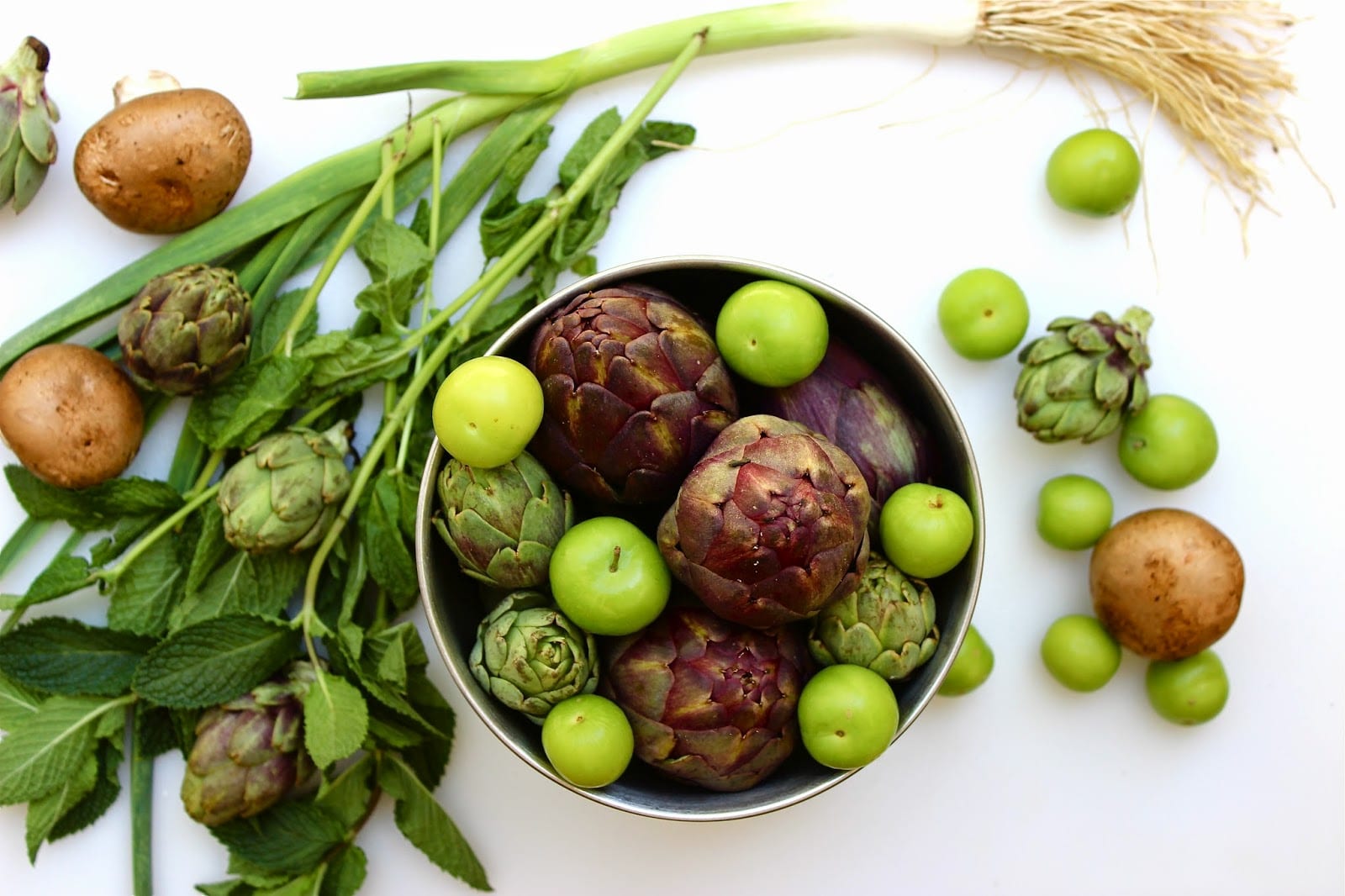
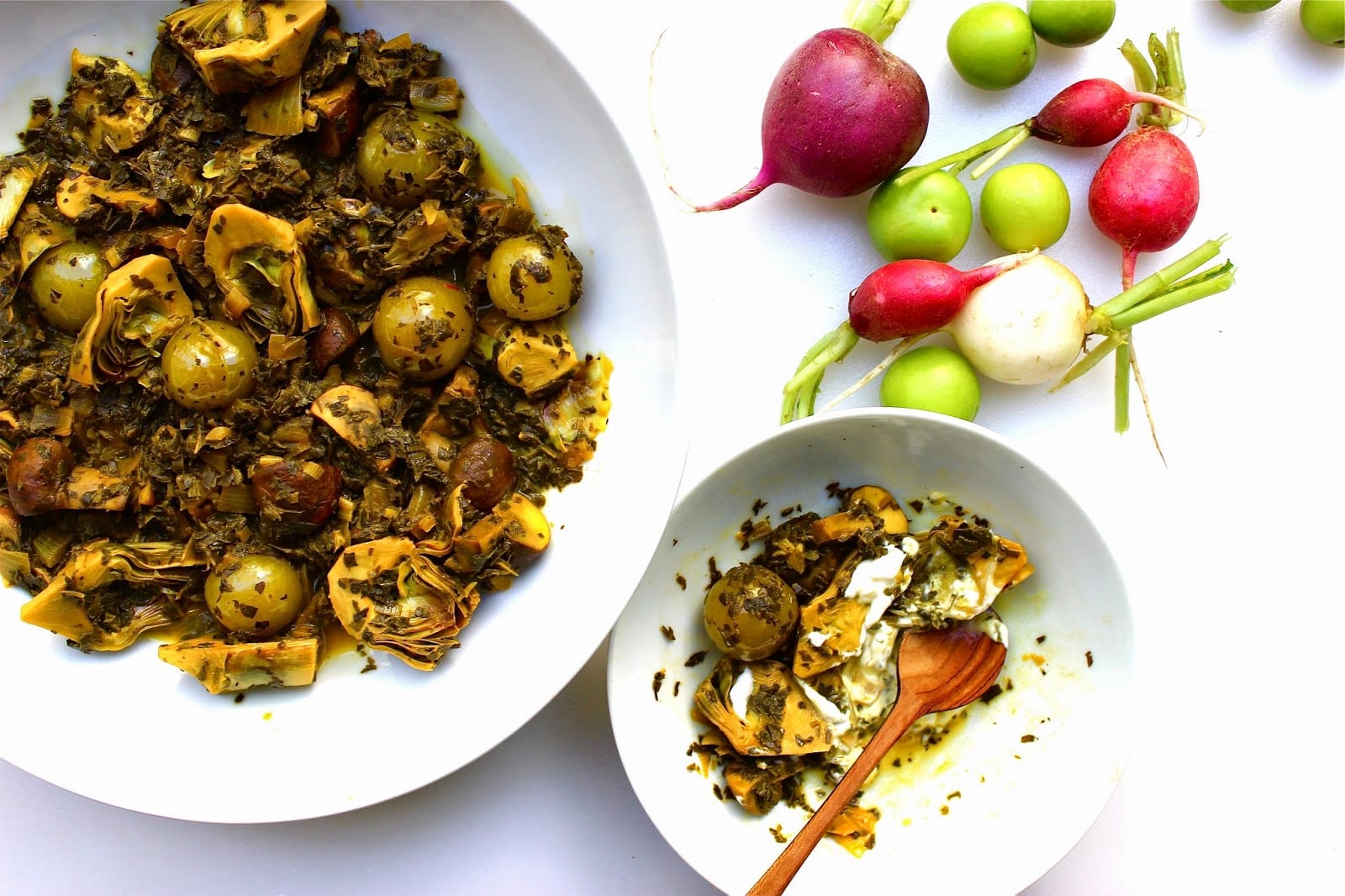
Food serendipity.  Or more like a food puzzle.  Sometimes that’s how a meal comes to life around here.  On this particular day it started with a bunch of fragrant mint we got from the overflowing garden at Soleil’s preschool.  The next piece easily fell into place with our farm box delivery: parsley, spinach, spring garlic.  Followed with a visit to the Farmers Market:  baskets upon baskets of baby artichokes.  A quick stop at the Persian grocery store and the fate of this evolving puzzle was sealed: sour green plums – gojeh sabz.  A Spring Stew.

Sour Green Plums – Gojeh Sabz

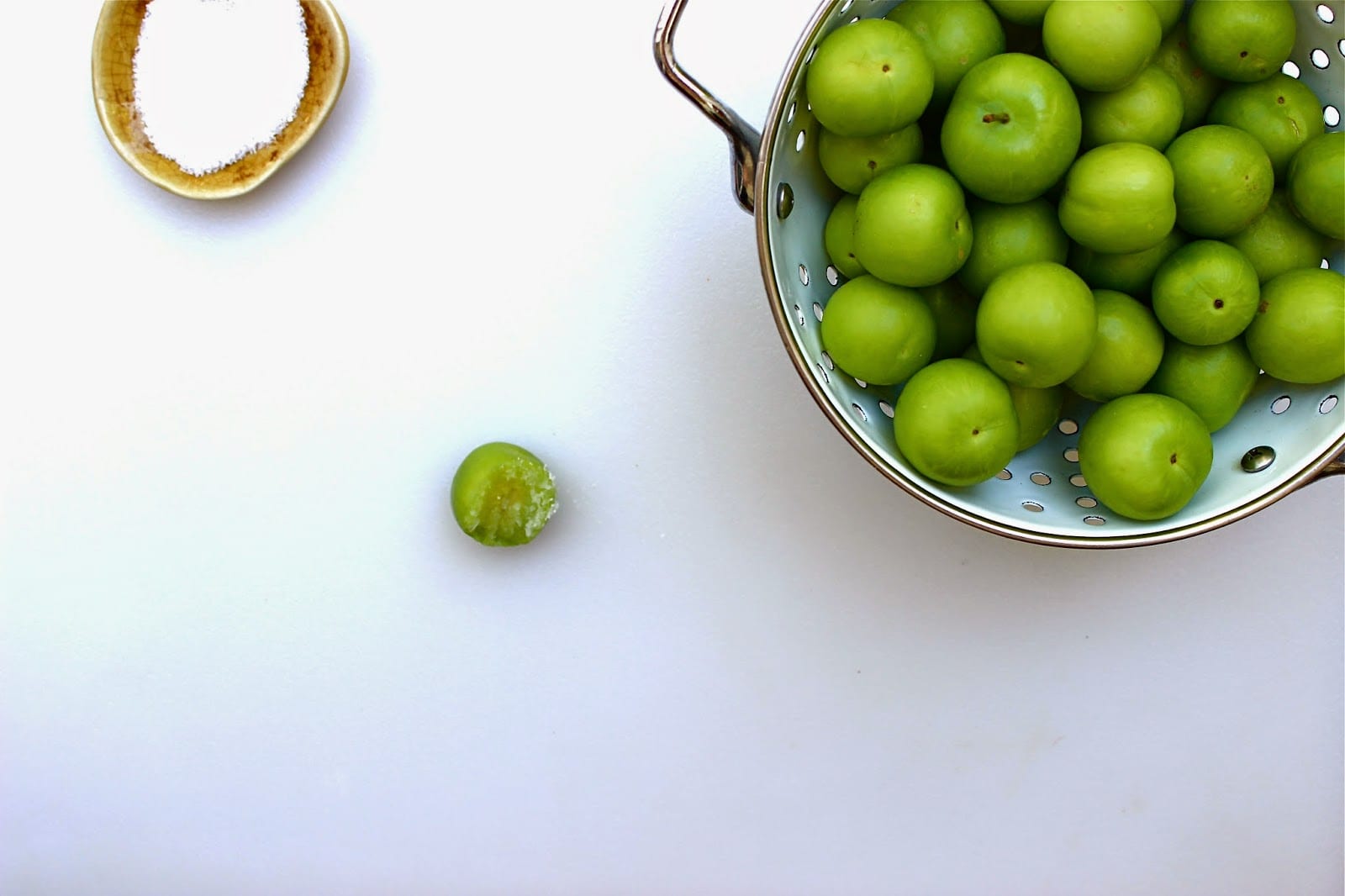
A sour green plum – also referred to as a green cherry plum – is essentially a plum that’s not yet ripe.  Biting into one of these is a delightful explosion of crunchy sourness, making this a highly coveted and sought-after fruit.  Typically it’s consumed raw as a snack – just as it is – with a pinch of salt. Take a bite – sprinkle some salt on it – take another glorious bite of spring – repeat process.  Try not to over-consume.  As a child, there was nothing better than to be greeted with a bowlful of Gojeh Sabz after school. Gojeh Sabz is also used in stews or also preserved to make a pickle.  Persians have an affinity for anything sour.  Which is why you will often find something sour or acidic added to a dish, not only to brighten up all the flavors but also to balance out the salt and sweet.  To bring all the flavors to life.  As the Gojeh Sabz slowly simmer away in this stew they soften up and release their tart juice.  I also think they add a nice visual texture to the stew.  Just be mindful of the pit.  If you can’t get your hands on sour plums you can always compensate by increasing the amount of lemon or lime juice used in the stew.  Sour green plums are only available for a very brief period in the spring time – before the plums ripen up. They can be found at Persian markets between April and May.  Make sure you ask for them as sometimes they are kept behind the cash register – in view but not within reach – as they were at my market.  They are a hot commodity!  I also spoke with a farmer at the Santa Monica Farmers Market and he said he’ll be bringing in sour plums in the next couple of weeks.  Worth asking around and keeping an eye out for them at farmers markets and Middle Eastern grocery stores.

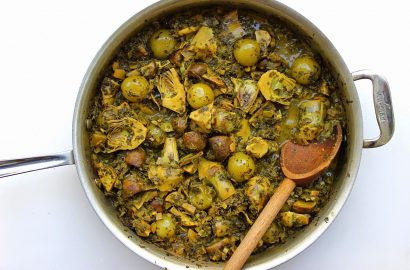
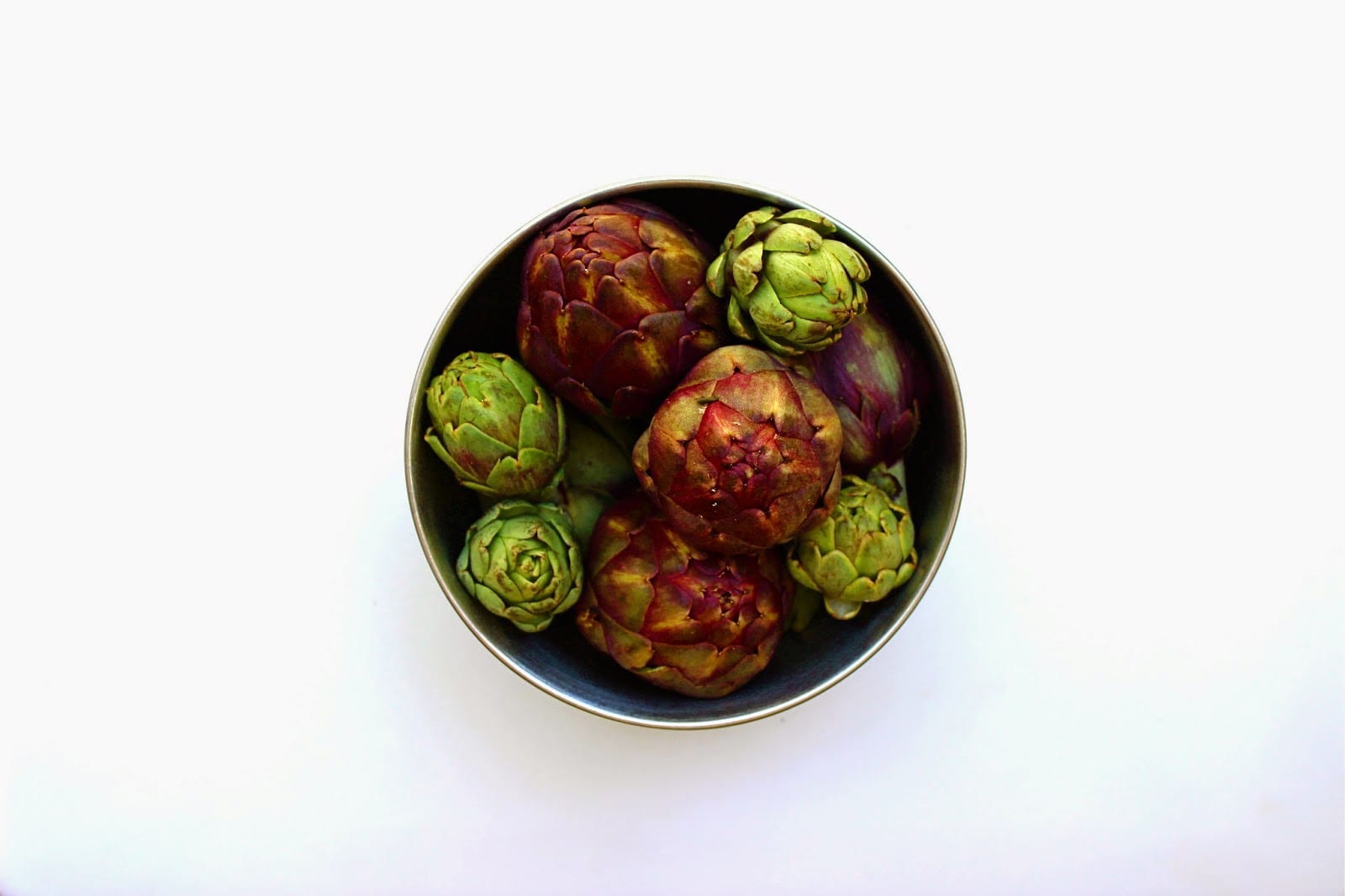
The Persian word for artichoke is Kangar-e-Farangi, which translates to foreign or European cardoon.  In our house we use either their Italian name – carciofi or their French name – artichaut.  Semantics.  Artichokes are very popular in our house.  Luna often claims two whole globe artichokes all to herself.  I was smitten by the baby artichokes at the market and knew they would make a perfect companion to the tart sour plums, the chopped up greens, and the meaty mushrooms in this stew.  But here’s the thing – prepping artichokes (much like shelling 4lbs of fava beans) – paring them down to the heart for a stew like this – takes some time and loving dedication.  And certainly not a job for a weekday.  But if you have the time or if you have little helpers that can assist in peeling away the outer leaves then it is well worth it – otherwise feel free to use frozen artichoke hearts.  They work great as well.   As in so many Persian stews, the greens are a necessity here.  Not only for flavor but also because the parsley and mint aid in offsetting the indigestion (read flatulence) that can occur with the use of the sour green plums and artichokes.  Just keep in mind that mint can burn very quickly and too much of it can turn the dish bitter.  This Artichoke and Sour Green Plum Stew is fantastic served over rice of course.  But I also like to serve it spooned over some crusty bread with a dollop of creme fraiche or Greek yogurt.  I’ve also reheated leftovers with a couple of eggs cracked over it for a quick and delicious lunch.

Dear Mr. President,
This is a long shot, I know.  But as the official Social Secretary to a certain seven-year-old I feel obliged to carry through her request (it has actually grown into a fever pitch command) to invite you and your family over to dinner next time you land at LAX.  Stopping by our house might actually be of assistance to you.  For reasons out of your control I’m sure – what with layovers, flight availability, weather delays, flight cancellations – you seem to have a penchant for braving the streets of our fair city at 6pm.  I understand – it cannot be helped.  But you see Sir, everyone and I mean EVERYONE is in their car and on the streets in Los Angeles at 6pm.  So it might not be such a bad idea to avoid this sea of humanity and machinery and join us for some Polo and Tahdig.  I’ll bet anything Polo and Tahdig will not be served at the dinner party you are scheduled to attend.  It is also my understanding that you do not enjoy beets.  Neither does my four-year-old.  Beets shall not be served.  With the weather warming up we can also grill some kababs to go along with the rice and enjoy it all with a side of Artichoke and Sour Green Plum Stew.  Not sure what your position is  where artichokes or sour green plums are concerned.  On this side – the seven-year-old loves it – the four-year-old not so much.  Much to discern, much to discuss.
Thank you for considering this invitation.
Yours Truly, A Mom

OK Luna I emailed The President inviting him over to dinner.

Mama – you should have called him.


ARTICHOKE, MUSHROOM AND SOUR GREEN PLUM STEW – KHORESH KANGAR-E-FARANGI BA GOJEH SABZ

*There are many resources online with step-by-step instruction on how to prepare artichokes.  Here are a couple: Food52 and theKitchn Keep in mind that the choke (the fuzzy stuff in the middle of the heart) is not fully developed in a baby artichoke so you can skip that part if using baby artichoke.  I also found it helpful to have all my other ingredients prepped before I started prepping the artichokes.  Because you want to get those hearts in the pan as quickly as possible so they don’t brown and oxidize.

** If you can’t find sour green plums just increase the lemon juice to taste.

Ingredients:

Serves 6

2 tablespoons olive oil
1 medium onion, chopped
1 spring garlic (green parts too) or 3 garlic cloves, chopped
1/2 lb cremini mushrooms, halved or quartered depending on size
*2 lbs baby artichokes, pared down to the heart, or 1 package frozen artichoke hearts, thawed
salt
pepper
1/2 teaspoon turmeric
2 cups chopped parsley (I used about 2 small bunches)
1/2 cup chopped fresh mint (I used about half a small bunch), or 2 tablespoons dried mint
1 cup chopped spinach (I used about half a large bunch)
1/4 teaspoon ground saffron steeped in 4 tablespoons hot water
2-4 tablespoons lemon juice, plus more to taste (have about 4 lemons ready to use both for the stew and for prepping the artichokes)
**14 sour green plums
water

1- Heat olive oil over medium heat in a large saute pan .  Add onion and saute until tender about 8 minutes.  Add the garlic and cook for 2-4 minutes.

2- Add the mushrooms and cook for about 5 minutes until they release all their liquid.  Drain the artichoke hearts (if using fresh ones that have been soaking in acidulated water) and add to the pan.  Add turmeric and season with salt and pepper.  Stir to combine and  saute for about 4 minutes.  Add the parsley, mint and spinach.  Give a quick stir to combine.  Add the saffron water, 2 tablespoons lemon juice (4 tablespoons if not using sour green plums), sour green plums, 1 1/2 teaspoons salt and 2 cups water.  Bring to a gentle boil.  Put lid on slightly ajar and turn down heat to medium-low.  Simmer gently for 20-25 minutes.

3- Adjust seasoning and lemon juice to taste. I added another 1/2 teaspoon salt and another 2 tablespoons lemon juice.  If there is not enough liquid add more water, if there is too much liquid remove lid and allow the liquid to evaporate to liking.  Simmer for about another 10-15 minutes until artichoke hearts are tender and sour green plums have softened (but not mushy!) and released their juices.

Serve over rice or grain of choice with a dollop of creme fraiche or Greek yogurt.  Also fantastic spooned over crusty bread.  Remind friends and guests (and children!) that sour plums have pits in them.

Will keep in the fridge for up to 3 days.

Appies

Grilled Halloumi with Barberries, Toasted Pine Nuts, and Preserved Lemons – A Dinner Party – A Nomination

♪ MUSIC WE’RE COOKING TO ♪

When your bucket is full you’re really happy.  And when your bucket is empty you’re really sad.  When a person dips into your bucket they’re making you sad and taking some good feelings out of your bucket. When a person says something nice to you or are nice to you, they fill your bucket.  – Luna

It always starts with a dinner party (and maybe some wine – and of course some Tahdig).  About a year ago we had our good friend Krista over for dinner.  Loobia PoloMast-o-Khiar – all the usual edible suspects.  Krista asked me about the preparation of Tahdig, which got me talking about this idea I had for starting a food blog; an idea that had been brewing in my head for quite some time.  There it sat comfortably – in its cozy home clothes – in the back recesses of my mind – composing itself – cooking itself – photographing itself.  In short – taking up some valuable real estate in my already cluttered mind.  After patiently listening to my meandering diatribe on sharing what I know about Tahdig making with friends and its relation to writing a blog – Krista gave me a straight-up talking to.  Time to get the Tahdig out of my head and onto the blogosphere.  The right friend – with the right words – at the right dinner party.

And so here I am one year later, absolutely humbled and honored to be nominated by SAVEUR MAGAZINE for their 2014 Best Food Blog Awards.  Bottom of the Pot is nominated in two separate categories:  Best Regional Cuisine Blog and Best New Blog.  If you would like to vote for me or any of the other amazing nominated blogs you can click on the link or on the SAVEUR awards badge on the side bar.  Voting closes on April 9th.  Thank you all for all your support, kind words, and encouragement.  But most of all thank you for joining me on this Persian food journey.

The idea for this Grilled Halloumi appetizer was also born out of a dinner party.  An impromptu dinner party – the best kind.  2pm on a Saturday afternoon. Phones start lighting up.  How about a casual dinner at our place – the kids can all play… 5 pm – same day. The house awakens from its lazy slumber and echos with laughter/shrieking/crying/stomping/dancing and delectable secretive whisperings of children.  Lillet, and Drew’s homemade kombucha flow freely (not in the same glass!) amongst the grown-ups.  Friends are put to work chopping the preserved lemons, assembling the salad, stirring the Kashki Bademjan (I had thankfully stored that away in the freezer – perfect for a last-minute dinner party dish).  Chairs are pulled out of every room of the house – the kitchen table far too small to seat all fifteen of us.  And yet, somehow we all manage to squeeze in.  Some sitting – some standing – a couple sharing the piano bench –  Drew crouched in the corner on the foot stool.  Baby Lilah is passed around the table like another delicious appetizer so her parents can have a moment to eat.  And the best part of all – the children are eating!  Some (not mine) have even dug into the sauteed mustard greens.  The children call out to “aunts ” and “uncles” – although technically no one is anyone’s aunt or uncle. These are friends with whom a night like this is possible.  Old friends with history.  Family.

Barberries – Zereshk

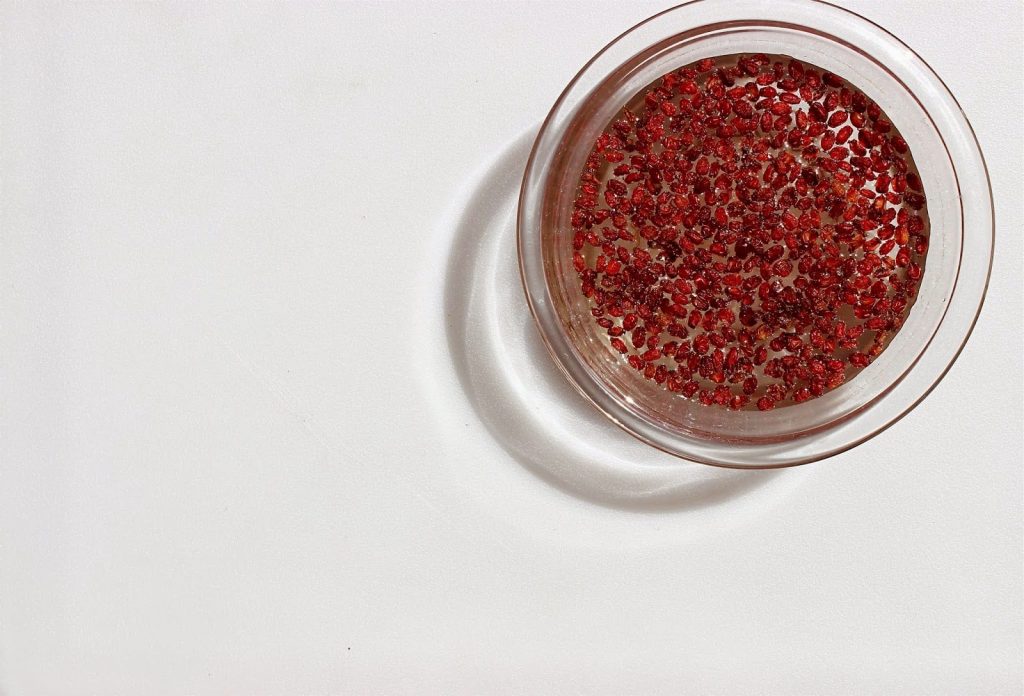
Dried barberries are typically used in any number of Persian dishes – mixed in with rice (Zereshk Polo) – used alongside other ingredients as stuffing for poultry or seafood – enjoyed as a stew – or turned into jam preserves.  The dried berries are small like a currant and have a distinct tart flavor. When cooked they release their bright red color and add a beautiful hue to the dish.  These little berries really liven up a dish both visually and with their tart pop of flavor.  Besides the traditional methods of preparing them I think these berries can really accentuate any number of dishes like salads, quinoa pilafs, eggs, even baked goods.  Barberries are also known for their medicinal qualities – such as aiding with indigestion and other digestive ailments.  I bet we will soon see these little berries lining up the shelves at Whole Foods touting their ancient medicinal powers – declaring them the next superfood.  In the meantime you can purchase dried barberries (for a very affordable price) at Iranian grocery stores or online here, here, or on Amazon.  A search for organic barberries online will also give you a few options.  What’s important is to use the freshest berries.  The ones that are bright red. The shriveled up darker ones are usually old and should be discarded.   It is also important to wash and soak the berries before use.  The berries contain a lot of sand so soaking them allows the sand to settle at the bottom.  Soaking also re-hydrates and plumps up the berries.

Preserved Lemons

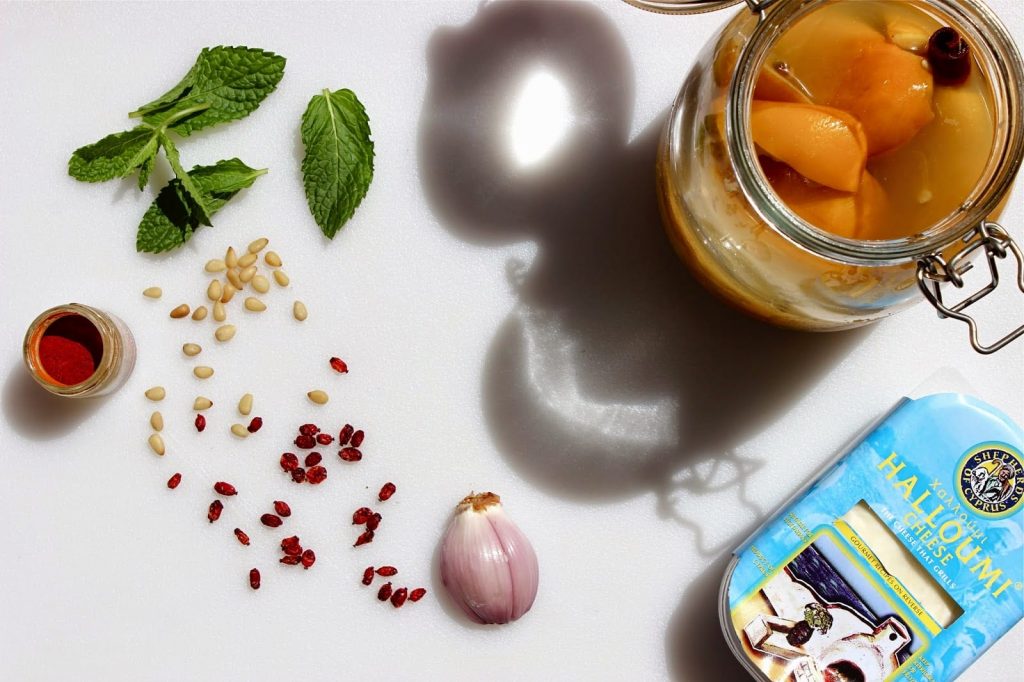
This past winter I made my first batch of preserved lemons with the abundance of Meyer Lemons that were popping up at every Farmer’s Market.  And I am so glad that I did because they are fantastic.  Salty and sour.  Once again – right up my alley. There really wasn’t much to it.  A bunch of good looking lemons, stuffed with sea salt and left to ferment in their own juices for a couple of months.  I also stuffed a couple of cinnamon sticks in there.  There are many sources online that can guide you through the process such as this post by David Lebovitz and this one from Nourished Kitchen.  You really can’t go wrong.  I already have so many plans for my preserved lemons.  The first of which was this topping.

Halloumi Cheese With Sunset Hued Toppings

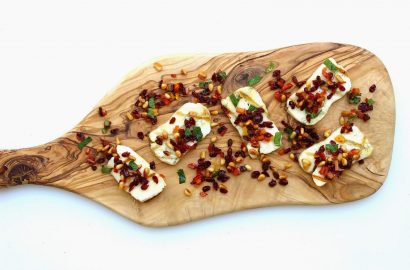
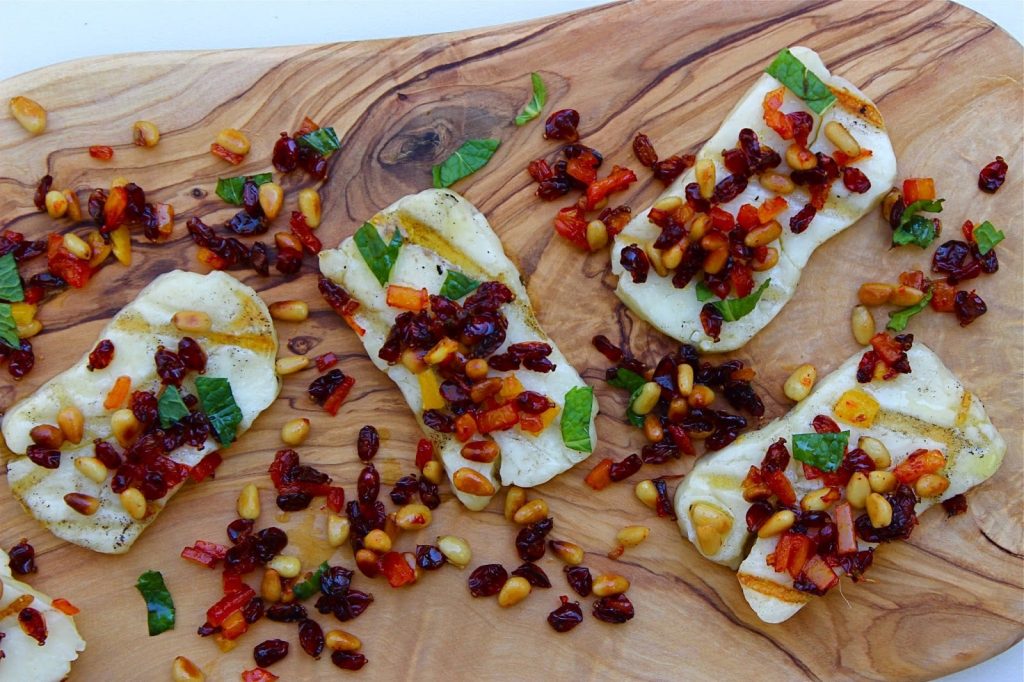
Halloumi is an unripened, brined cheese from Cypress.  It is typically made from a mixture of goat’s and sheep’s milk.  And because of its high melting point it’s great for grilling or frying.  It is somewhat similar to feta cheese in its salty, briny flavor.  This cheese is right up my alley.  It makes a great appetizer served with a salad or topped off with some delicious ingredients as I have used here. The tart pop of the barberries, the crunch and nutty flavor of the pine nuts and the intense, unexpected and lively bite of the preserved lemons really make for a delicious and beautiful topping for the grilled (or fried) Halloumi cheese.  A perfect appetizer for an impromptu or planned dinner party – or even a party of one!

Many years ago I made the decision to once again re-locate – to another city – another country- same continent this time.  Away from parents, family, and childhood friends.  In search of a new adventure, chasing old dreams and a California sunset.  That new city has now become home.  But with aging parents, and children who are growing much too quickly I more and more find myself longing for a place and time where we could all be together.  And it’s on these days that we throw an impromptu dinner party.  To celebrate everything and nothing in particular.  To celebrate good news and good friends who have become our surrogate family.  And we celebrate the only way I know how.  By sitting around a far too small kitchen table and sharing a meal.

Suffice to say my bucket is full.

GRILLED HALLOUMI WITH BARBERRIES, TOASTED PINE NUTS, AND PRESERVED LEMONS

* Cleaning the barberries:  Remove the stems from the barberries and pick through for any that look too dark and old.  Place barberries in a bowl and fill with cold water.  Allow to soak for 15-30 mins.  Lift barberries out of the water with a small mesh sieve or your hands so as not to disturb all the sand that has settled at the bottom of the bowl.  Give the barberries a quick rinse place on a paper towel or dish towel and pat dry.  Barberries are now ready to cook.

If you can’t find barberries you can substitute with dried cranberries, or cherries.  If they are sweet I would omit the maple syrup in the recipe.

Ingredients:

Serves 6 as an appetizer

1 tablespoon olive oil, plus more for drizzling
1 shallot, finely chopped
1/4 cup barberries, cleaned and soaked
1 tablespoon lemon preserves, finely chopped
1/2 teaspoon maple syrup, or sweetener of choice to taste
1/4 teaspoon ground saffron steeped in 2 teaspoons hot water
2 tablespoons toasted pine nuts
1 8.8 oz/250 g package Halloumi cheese
a handful fresh mint leaves, for garnish

Heat grill to medium/high heat

1- Heat oil in a small skillet over medium heat.  Add the shallot and saute until soft and fragrant, stirring constantly.  Take care not to burn.  About 2 minutes.

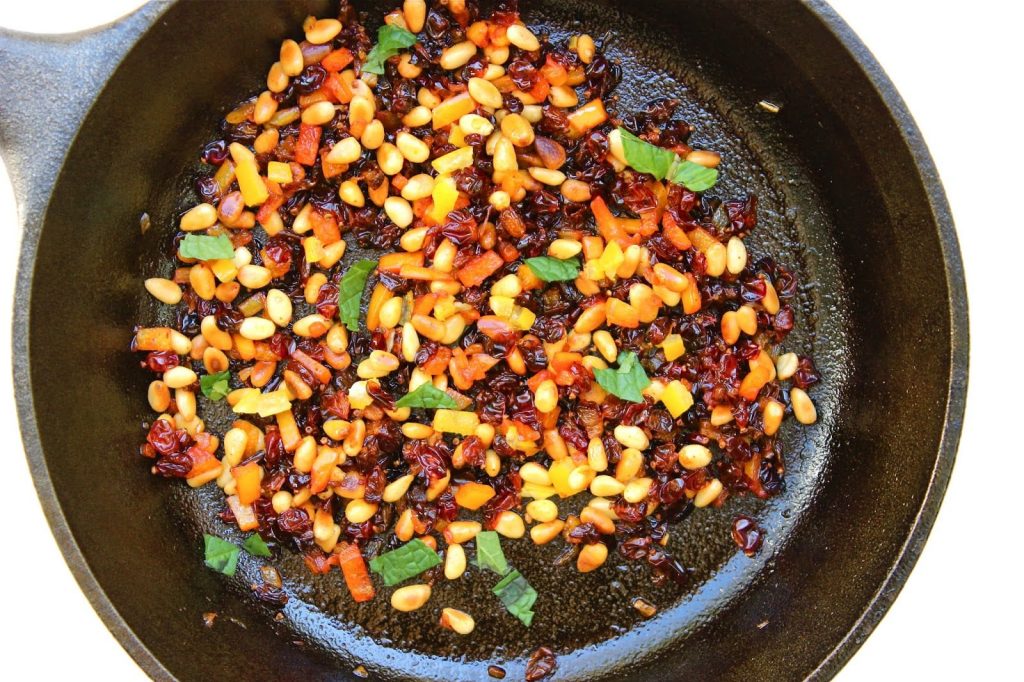
2- Add barberries, lemon preserves, maple syrup, and saffron water.  Turn down the heat to medium/low.  Saute for about 10 minutes until the barberries are tender.  Add the pine nuts and give a quick stir.  Turn off the heat and set aside.

3- Cut the Halloumi in about 1/4 inch thick pieces.  Place on the grill and grill each side for about 3 minutes.  Until golden around the edges and soft and melting on the inside.  Alternately you can also fry up the Halloumi on the stove top.

4- Place Halloumi on a serving dish and top with barberry mixture.  Drizzl with a little olive oil and tear up some pieces of fresh mint to garnish with.

Enjoy right away.  The Halloumi will get kind of tough and rubbery if it sits for too long.

Soup

A Fresh Herb, Bean, and Noodle Soup – Aash-E Reshteh – Azadi

Azadi?  What does Azadi mean, mama?

It means Freedom in Farsi, Luna.

The day before Nowruz – Persian New Year. We are at the Persian Bazaar – aka Westwood Blvd. – doing some last-minute shopping.  The girls pick out the sonbol – hyacinth – a purple one, of course.  Happily they crunch on the ajeel – the nut mix the store owners keep offering them. They marvel at the mounds of fresh green herbs everyone is sorting through – cilantro, parsley, dill, tarragon, chives, green onion, fenugreek.  With every inhale their noses fill with the inescapable aroma of Spring – a new day – tulips, cherry blossoms, rose water, seville oranges, hyacinth, hyacinth, hyacinth.  They practice snapping their fingers and swaying their hips to the joyful and celebratory music pouring out of every store.  At the bookstore Luna discovers a bookmark with Azadi written on it.

What does Freedom mean?

Three grown adults are momentarily left speechless.  Once we gather our thoughts – Drew, my mom and I try to convey what Freedom means to a five year old.  She listens quietly – head leaning to one side – chestnut brown eyes resting their soulful gaze on the haphazard chaotic world rushing past her car window.  Nothing more is said – or asked.

Aash (rhymes with wash) is a hearty, thick soup typically made with a variety of herbs, legumes and grains. There are many different varieties of aash.  Each bursting with flavor and satisfying enough to be served on its own as a meal or in a smaller portion to begin each meal. Most aash can also be prepared vegetarian/vegan and gluten-free.

Aash can be considered the foundation of Persian cooking.  The heart and soul of it.  In fact, the Persian word for kitchen is aash paz khaneh – the house (or room) where aash is made and the word for cook is aash paz – the maker of aash.  Different kinds of aash are traditionally eaten to celebrate or commemorate special occasions.

Aash-e Reshteh literally means aash with noodles.  Traditionally Aashe-e Reshteh also known as Aashe-e Chaharharshanbeh Suri is served on the last Tuesday night before Nowruz – shabeh Chaharshanbeh Suri.  The noodles in the aash are said to symbolize the many winding paths that life spreads before us.  It is fitting then, to enjoy this heart warming aash right before the New Year, perhaps in the hopes of embarking on the right path for the coming year.  This also reminds me of the Italian tradition of eating Lentil Soup for good luck in the New Year.

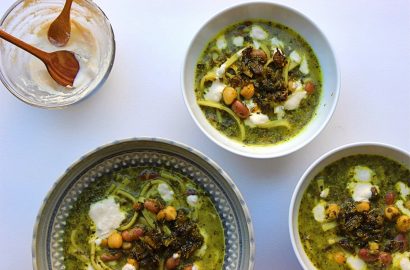
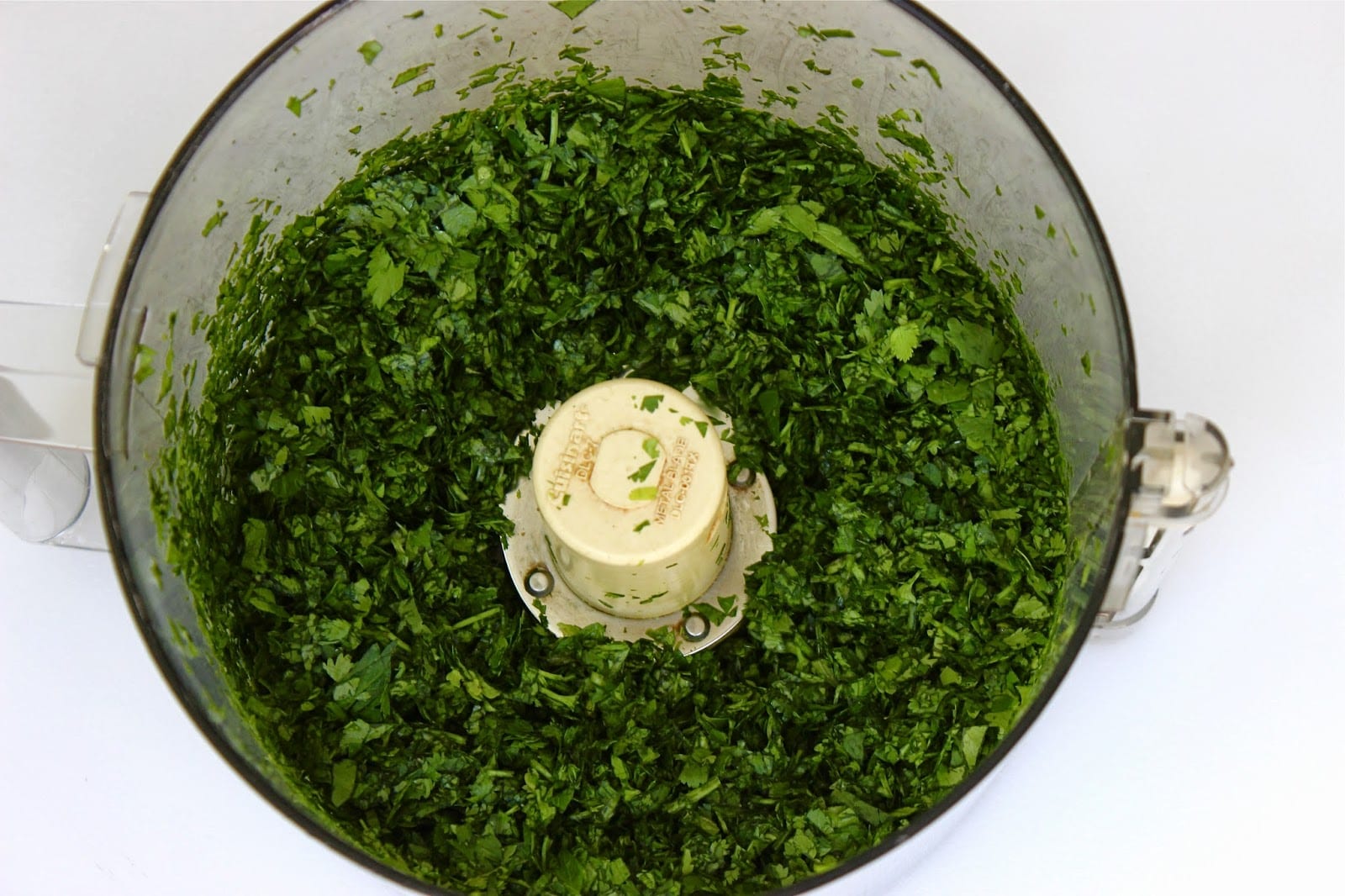
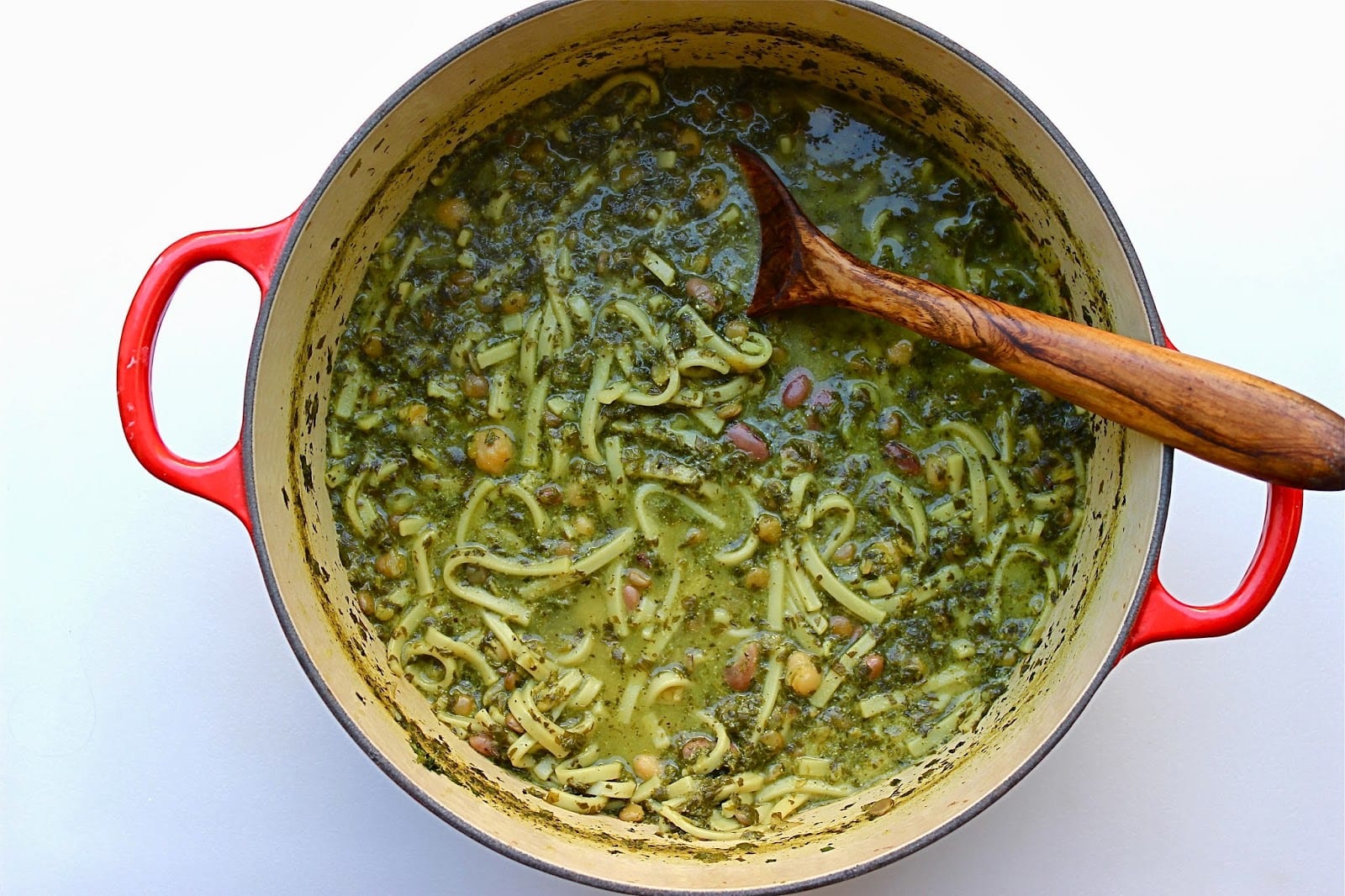
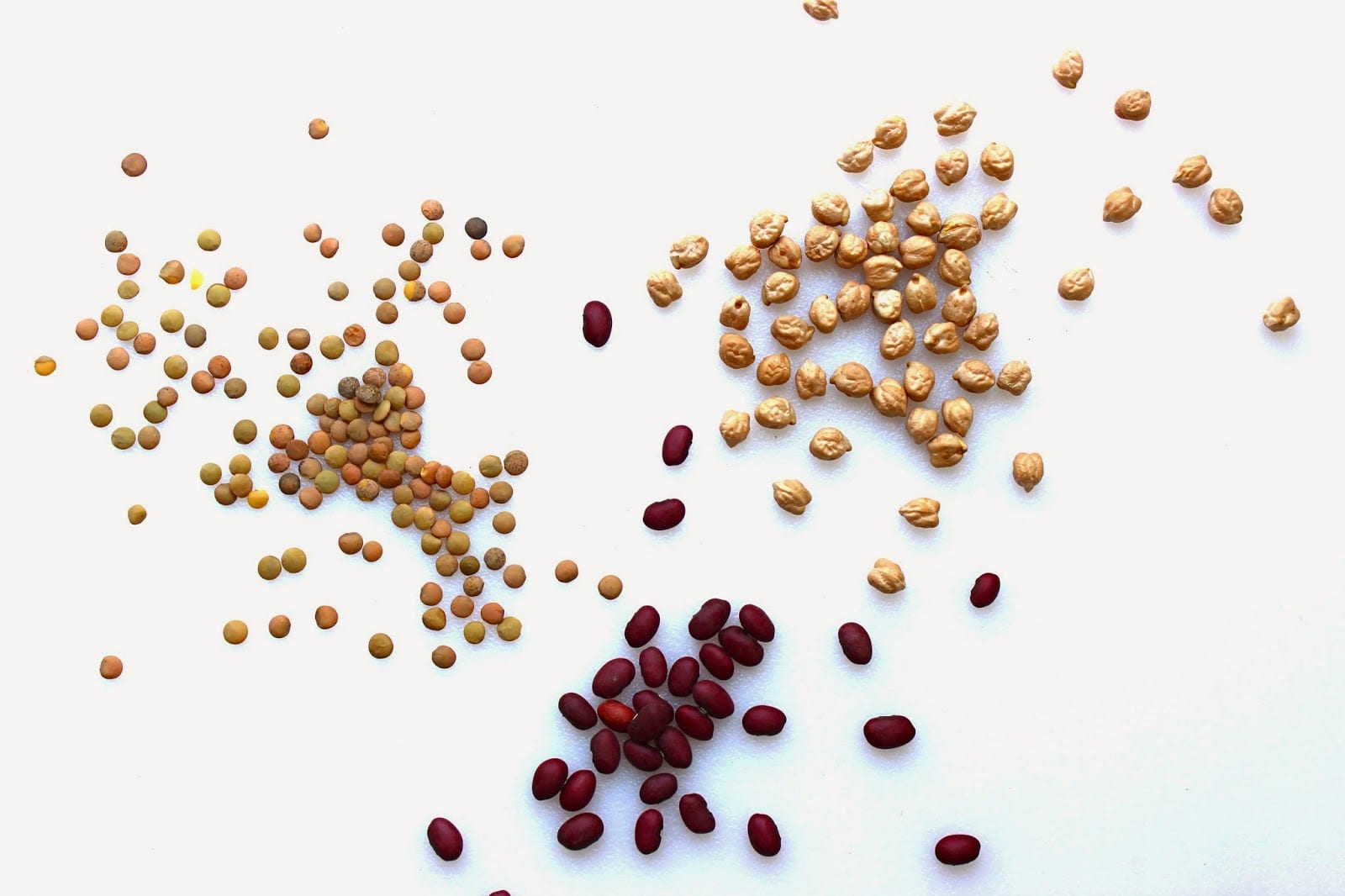
The preparation of Aash-e Reshteh is quite simple.  As with most Persian dishes that use an abundance of herbs, the most time consuming part is the washing and chopping of the fresh herbs.  A food processor can be of great help here.  And just like the preparation of Koo Koo Sabzi you don’t need to get too caught up with taking every parsley leaf off the stem.  I cut off the long stems (you can save the stems for stock) and then run my knife through the herbs (little stems and all) a couple of times and throw everything in the food processor.  I like to use dry beans which I first soak for a few hours or overnight.  But you can also use canned beans if that’s what you have on hand.  The combination I used here is chickpeas, red pearl beans (you can also use the slightly larger red kidney beans) and lentils.  Persian noodles -reshteh – can be found at Persian grocery stores or online, but linguini noodles work just as well.  And just like Kashki Bademjan, what really elevates this aash are the garnishes:  kashk and carmelized onion, mint and garlic.  If you can’t find any kashk (or are still unsure of starting a relationship with this handsome new stranger), a sour European-style yogurt, or strained Greek-style yogurt or creme fraiche will work just fine too.  But I really think you should give kashk a chance.

Be it a special occasion, a cold winter’s night, a new journey, or simply one of those days when you just need a big hug, and a big bowl of comforting goodness in a bowl – Aash-e Reshteh is sure to hit the spot.

The girls enthusiastically help me set up the Haft Seen table.  The hip-shimmying Persian music winds its way through the house.  Soleil and I debate the placement of the sonbol in relation to the goldfish – the goldfish like to be close to the sonbol so they can smell the sweetness too – two year old logic.  Luna runs up – out of breath – waving her Azadi bookmark.  She insists that we add it to the Haft Seen table.

It’s important Mama.

This year on Thursday, March 20, 2014 at precisely 9:57am PST – precisely the moment when the Earth’s axis tilts neither away nor toward the sun – when night and day are exactly the same length all around the world – we will welcome in a New Day – Nowruz.  And for the third year in a row Luna’s Azadi bookmark will have a place at our Haft Seen table.

Because it’s important.

Wishing you all a very Happy Nowruz and Peace and Freedom for everyone around the globe.

FRESH HERB, BEAN AND NOODLE SOUP – AASHE-E RESHTEH

Serves 6-8 as a starter or 4-6 as a main dish

Ingredients:

1/3 cup dried chickpeas, soaked  overnight
1/3 cup red pearl beans or red kidney beans, soaked overnight
1/2 cup lentils, rinsed and drained
1/3 cup caramelized onion, mint and garlic, plus more for garnish (recipe here)
1 large bunch cilantro, chopped
1 large bunch parsley, chopped
1 bunch green onion, finely chopped
1 bunch spinach, chopped
8oz linguini noodles or reshteh snapped off into 2 inch pieces
1-2 tablespoons kashk or Greek style yogurt or creme fraiche, plus more for garnish
fine grain sea salt
ground black pepper

1- Place chickpeas and 10 cups water in a large pot over medium/high heat and bring to a boil.  Turn down the heat to medium and simmer partially covered until chickpeas are slightly tender but not fully cooked through.  The amount of time depends on how fresh your beans are and if they were soaked or not.  Anywhere between 20-30 minutes.

2- Add the red beans.  Partially cover again and simmer over medium heat until the red beans are slightly tender.  About 10-20 minutes depending on your beans.

3- Add the lentils, cilantro, parsley, green onion, spinach, 1 tablespoon salt, 1/2 teaspoon black pepper and caramlized onion mixture.  Partially cover and simmer for 15-20 minutes until the lentils are tender but not mushy. (The aash can be made in advance until this point).

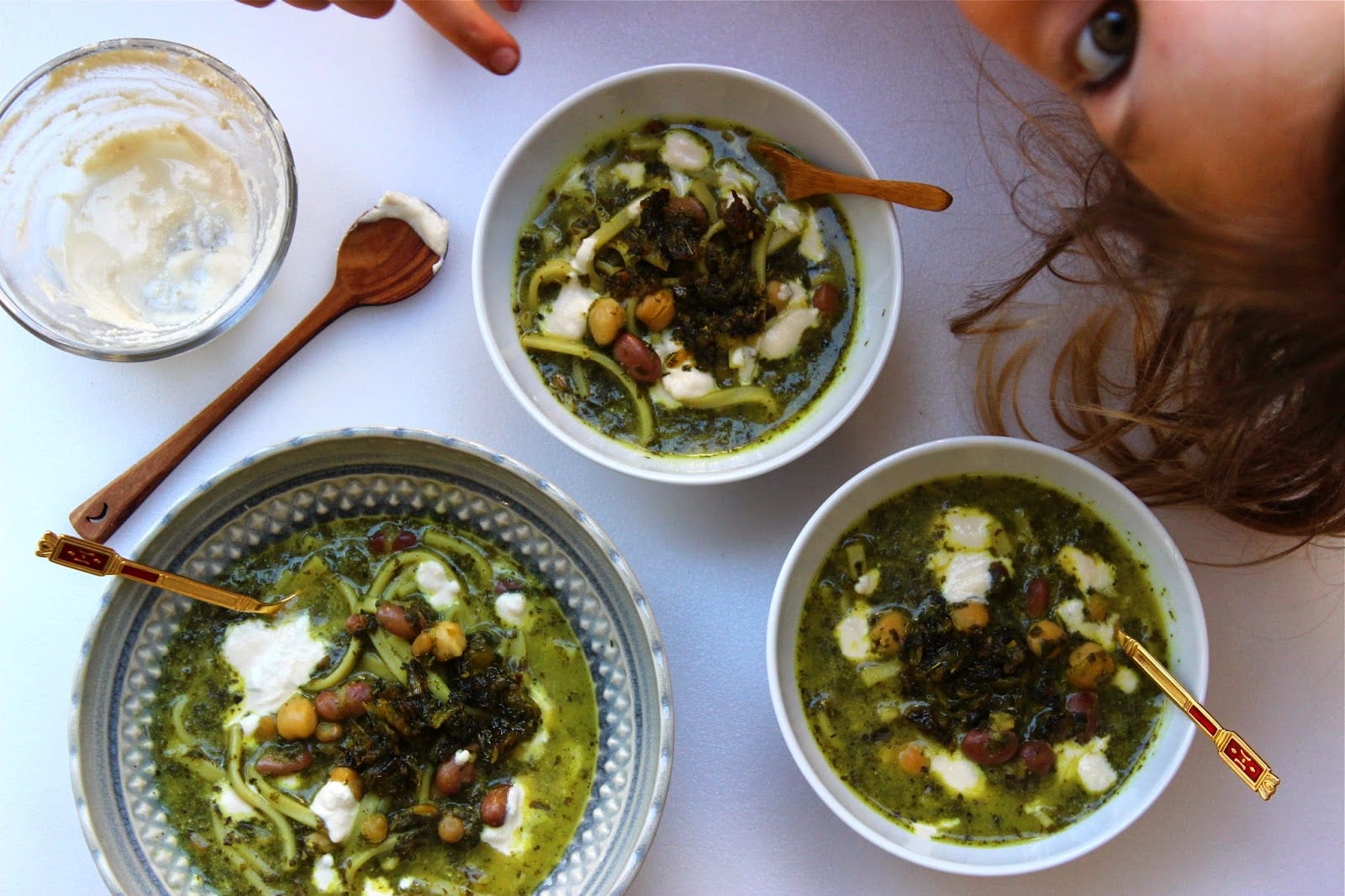
4- Add the noodles and more water if necessary, and simmer uncovered until the noodles are fully cooked through and all the flavors have melded.  This soup should be on the thicker side so adjust the amount of water accordingly. Stir in  the kashk or yogurt or creme fraiche 1 tablespoon at a time according to taste.  Simmer for a couple of minutes.  Taste and adjust seasoning.  (Taste for seasoning after you add the kashk).  Garnish with caramelized onion and dollops of kashk or yogurt or creme fraiche.

The aash tastes even better the next day.  You may need to add a little more water if reheating.

Will keep in the fridge up to 3 days and in the freezer up to 3 months.

Uncategorized

Homemade Kashk

I find the concept of an “acquired taste” a very interesting one.  Exactly when and how does one “acquire taste”?

Growing up in Vancouver, whenever kashk was supposed to be used in a dish my mom would replace it with either yogurt or sour cream –  if we were feeding our Canadian or American friends.  Kharejeeha- foreigners (said Canadians or Americans being the “foreigners” in this case) don’t like the taste of kashk, it’s an acquired taste is what we would always hear.  So substitutions were made.  But as a child I always felt kharejeeha were missing out.  What was not to like about this tangy – flavorful – creamy – dip-like – yogurt-like – ingredient.

Thanks to the advent of technology and globalization the world has become a smaller place – and simultaneously our palates have expanded and “acquired” a liking and curiosity for foods from all different parts of the globe.  Kimchi, miso, harissa, za’atar – foods and spices that were once deemed ethnic or exotic are now as common place as mayo and ketchup – well, almost.  So it is in this spirit of world food and expanded curious palates that I present you with Kashk.  I think kharejeeha are more than ready and willing to give it try and fall in love with it.

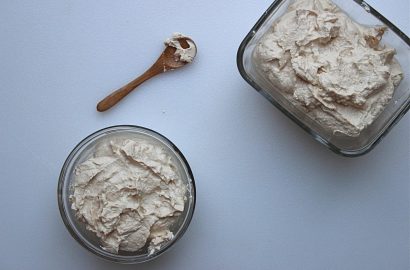
Of course I am not the first to praise the deliciousness that is kashk.  As I mentioned in this post Mr. Ottolenghi has been talking up kashk for some time now. Think of kashk as an added creamy-like ingredient that really adds a depth of flavor to soups, aash (thick Persian soups-recipe coming next)- dips – stews – eggs…Use it as you might use creme fraiche in a savory dish.  Kashk plays the same role as anchovies, tomato paste, and parmesan rind do to add depth of flavor to any given food.  To give it that extra kick of deliciousness.

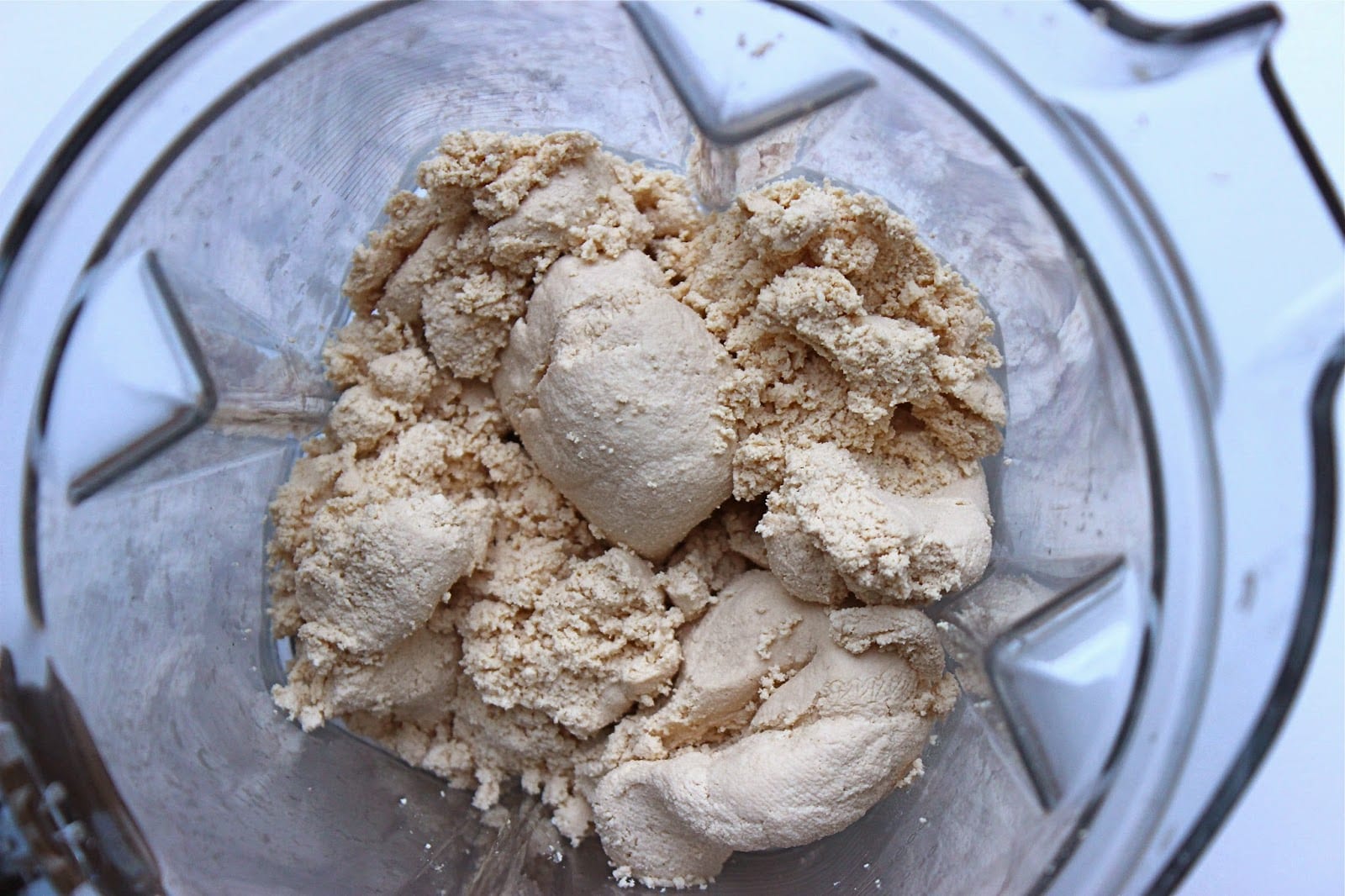
In a nutshell, kashk is fermented yogurt.  I recently tried my hand at making homemade kashk.  Yogurt is mixed with equal parts water and simmered for a couple of hours until all the liquid has evaporated and you are left with a loose pulp.

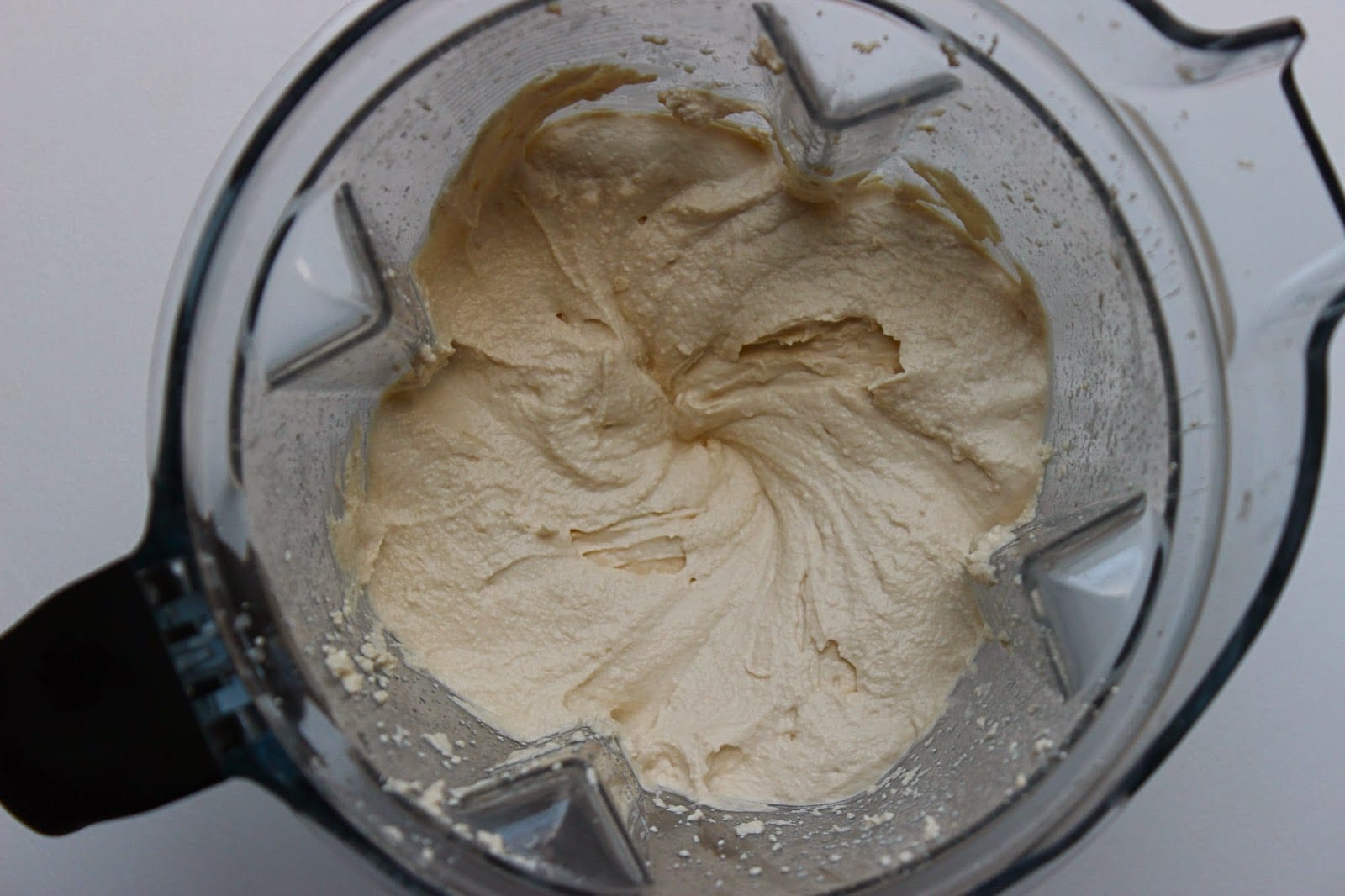
The dry pulp is then placed in a blender with some fresh water and salt.  Finally blend until you have a creamy consistency.

The pulp is then placed in a cheesecloth (I found using my nut milk bag worked great) and you squeeze as hard as you can to get rid of every last bit of the yellowish liquid (discard the liquid).  You want the pulp to be as dry as possible.

I like to divide the kashk into small containers and either use right away or freeze until needed.  Although it takes a couple of hours to simmer the yogurt, the active prep time in making kashk is minimal.  Of course, you can also purchase kashk from Persian grocery stores.  If you purchase the dried kind you will have to reconstitute it with water.  I recommend using the refrigerated liquid kind.  You may have to try a few different brands to find the best tasting one (of course nothing is like homemade kashk).  You can also purchase kashk here , here, and here.

And please do let me know if you “acquire” a taste for kashk.


HOMEMADE KASHK

Update:  01/04/15 Hi everyone! I realized that I did not previously specify the type of salt I use when making kashk.  Which can make a big difference in the taste.  I use fine grain sea salt.  I had written to use 1 tablespoon salt.  However, I now think you should start with 1/2 tablespoon sea salt (a little more if you are using kosher salt)  and increase to taste as needed.  If by any chance you find your kashk is too salty just decrease the amount of salt in the dish you will be using the kashk in.  The amount of salt in the recipe below now reflects this change. Enjoy!

Makes about 2 cups kashk

Ingredients:

2 32oz containers of full fat sour (European style) plain yogurt  (I use this kind)
water
sea salt

1- Place the yogurt from both containers in a large pot over medium heat.  Fill the empty containers up with water and add to the yogurt. Stir and bring to a gentle boil.  Turn down the heat slightly and let the mixture simmer for about 2 1/2 hours or until all the water evaporates and you are left with a pulp like ingredient.  Stir once in a while to make sure nothing is sticking to the bottom of your pot or burning.  Through this process the yogurt will separate and break down.  This is normal.  The color of the yogurt will also turn from creamy white to a pale beige.  There will also be a distinct tart smell.

2- Place the contents of the pot in a nut milk bag or 2 layers of cheese cloth and set over a large bowl.  Squeeze out as much liquid as you possibly can.  You want the pulp to be as dry as possible.  Discard the liquid.

3- Place the pulp in a blender and add 1 cup filtered water and 1/2 tablespoon salt.  Blend until you have a creamy consistency.  Add more water if necessary to thin it out.  Taste and add more salt as needed.  I usually end up using a little under 1 tablespoon salt total.

Divide kashk and place in small containers.  Ice cube tray works great too.  Will keep in the fridge for up to 3 days and the freezer for up to 3 months.

Dessert

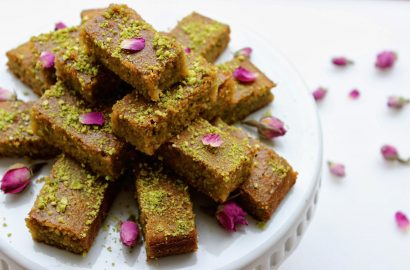
A Pistachio Bakhlava Cake – A Confessional – And an Icestorm

MUSIC WE’RE COOKING TO

Confession:  I meant to share this Pistachio Bakhlava Cake with you in time for Valentine’s Day.  It didn’t happen.

Confession:  I also had every intention of sharing another delicious bite of goodness with you in time for the start of the Olympics. But that required making paper-thin slices out of a big hunk of jicama.  Which in turn required getting the mandolin out of solitary confinement and declaring with it a temporary truce. You see, my history with said mandolin is a troubled one.  What once seemed so bright and promising a future quickly turned to failed experiments and useless chunks of vegetables.   But then I thought – who knows, this might be the start of a new era for us. Maybe this time, with better communication – mutual respect – some give-and-take on both our parts…But alas, tragedy once again.  What was supposed to be a graceful duet quickly turned into a wrestling match, concluding with my worst self rearing its ugly head as I hurled profanities and mangled pieces of jicama across the kitchen.  And the mandolin just sat there – lifeless –  sharp and indifferent, and perhaps a bit smug.

Confession:  The ice storm pictures are from this past December in Toronto.  It was a sight to behold – especially for those of us from water-deprived Southern California.  We were some of the lucky few who had power and heat, and simply got to marvel at the beauty and majesty of it all.  Frozen.  Some of the shots are mine, some are Ramin’s.

Confession:  I don’t really like to bake, nor do I have much of a sweet tooth.  Salty and sour is my late-night indulgence.

Confession:  I have been baking a lot lately.

Confession:  I have been enjoying baking as of late.  Much to my reluctance.

Confession:  I have been consuming more baked goods as of late.

Confession:  I have been enjoying consuming said baked goods.  Especially this Pistachio Bakhlava Cake.

Bakhlava cake is my mom’s go-to baked good.  She always has some on-hand in the freezer to serve with coffee or tea when unexpected company drops by.  The perfect little afternoon or after-dinner sweet treat.  Lately the girls have been enjoying it as an after-school snack with a cup of camomile tea.

Bakhlava cake has the same flavors as traditional bakhlava – nuts, fragrant rose water – but without all the work of turning out layers of flaky puff pastry (my newly found baking enthusiasm and patience does not encompass all that work). Traditional bakhlava is also quite rich and decadent.  This cake version is much lighter – much more satisfying to my reluctantly blooming sweet tooth. Typically, it is made with a combination of all-purpose flour and either almond meal or pistachio meal.  And it is then finished off with a healthy drizzle of a simple syrup glaze.  Of course, not one to leave a recipe alone (even when baking) I swapped out some ingredients with what I usually have in the pantry.  I used a whole grain pastry flour and traded the almond meal with raw, unsalted pistachios that I ground up into a fine meal.  Instead of using butter or vegetable oil I used coconut oil.  I like using coconut oil in certain recipes but am not a fan of infusing everything with a tropical island coconut flavor.  I didn’t want the cake to have a distinct coconut essence, and was quite pleased to discover that the coconut did not come through in this cake.  I also cut down on the regular sugar and used coconut palm sugar.  I have only recently discovered coconut palm sugar.  What I’ve learned so far is it is not as processed as regular sugar, and is low in the glycemic index with a high mineral content.  All of which sounds great but just to keep things in prespective – it is still a sweetener – so moderation is key.

This cake is intended to be moist so it really depends on being covered in a simple syrup glaze once it’s out of the oven.  I made my simple syrup with a honey/water/rose water combination.  Make sure you use a good quality mild flavored honey – I used a clover honey – orange blossom would be nice too.  You don’t want the honey flavor to take over.  The flavor and aroma that should subtly awaken and envelop your senses here is rose water – golab.  Rose water is a staple in Persian baking, ice creams, sorbets and beyond.  It is always present on our New Year Haft Seen Table and our Wedding Sofreh Aghd to literally and symbolically purify and perfume the air.  It is believed to be medicinal, cosmetic with numerous healing properties, and lest we forget, also an aphrodisiac.  The aroma alone can make you drunk with love.  If you are new to the scent and flavor of rose water I suggest starting with small amounts.  Food grade rose water is available at Middle Eastern grocery stores and can also be found online – like here or here.  Unfortunately, organic food grade rose water is not that readily available.  If you have tried any, please share with me your thoughts.  Also check out the lovely Shiva Rose’s tutorial on how to make your own rose water for cosmetic use.  It’s beautiful.

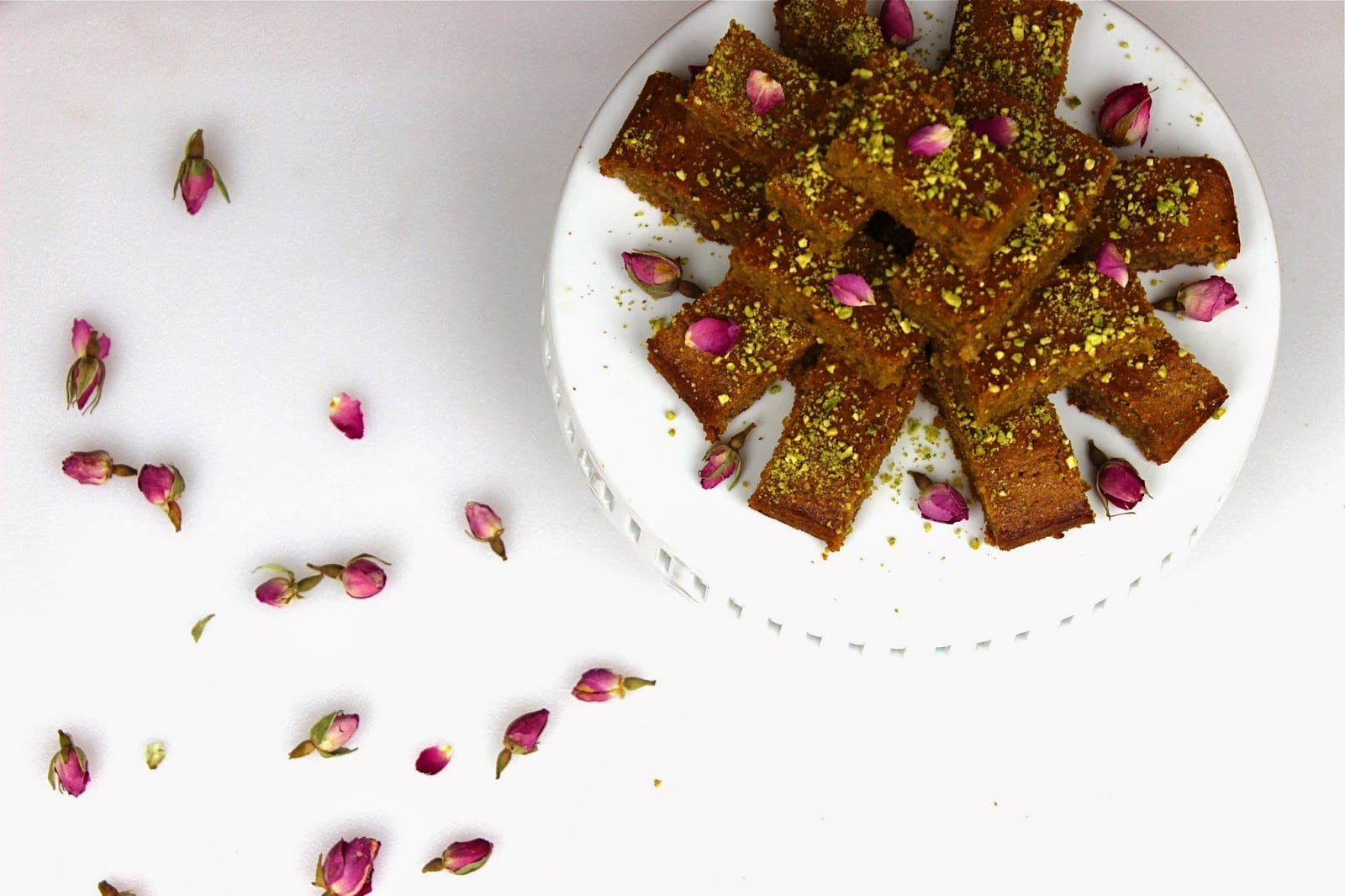
The great thing about this Pistachio Bakhlava Cake is that it easily freezes for months.  I like to serve it cut into small rectangles – cold out of the fridge or thawed out of the freezer.  A little bite of rosey sweetness with an afternoon or after-dinner tea.
Confession: Our freezer is packed with containers of Pistachio Bakhlava Cake.  Just in time for Toronto’s frozen castles to melt (or in our case – the draught to ease – and for Spring to once again rejuvanate us.  Just in time to share with friends and family for Nowruz.

PISTACHIO BAKHLAVA CAKE

Inspired by Maman’s recipe and Najmieh Batmanglij’s

Makes:  One 9×13 cake

Ingredients for the cake:

2 cups raw unsalted whole shelled pistachios
1 cup whole grain pastry flour – I used this
1 1/2 teaspoons baking powder
1/4 teaspoon salt
3 eggs
1/2 cup coconut palm sugar (or regular cane sugar) – I used this
1/2 cup coconut oil, melted and cooled to room temperature
1/2 cup almond milk or milk of choice
1/2 teaspoon cardamom
2 tablespoons rose water

Ingredients for the glaze:

3/4 cup mild flavored honey
1/2 cup water
1 tablespoon rose water

1- Preheat  oven to 350 degrees with rack  in the middle position.  Lightly grease the bottom of a 9×13 baking pan with any oil/butter of choice.  Line the pan with parchment paper with over hang so that you can easily lift the cake out.

2- Grind up the pistachios in a food processor into a fine meal.  You should have about 2 1/4 cups total meal.  Set aside 2 cups of pistachio meal.  Set aside the remaining 1/4 cup meal for sprinkling the top of the cake.

3- In a small bowl mix together the flour, baking powder and salt.  Set aside.

4- In a mixing bowl of an electrical mixer beat the eggs and sugar until creamy.  With the mixer on add in the oil, milk, cardamom and rose water.  Add the flour mixture and 2 cups pistachio meal to the wet ingredients.  Do this in batches.   Mix until just combined.

5- Spread the batter evenly into the prepared pan.  Bake until a toothpick inserted into the middle of the pan comes out clean.  About 35 – 40 minutes.

6- While the cake bakes prepare the glaze.  In a small pot over medium heat combine the honey and water.  Bring to a very gentle boil.  Stir and simmer for 5 minutes.  Remove from heat and add the rose water.  Stir to combine and set aside.

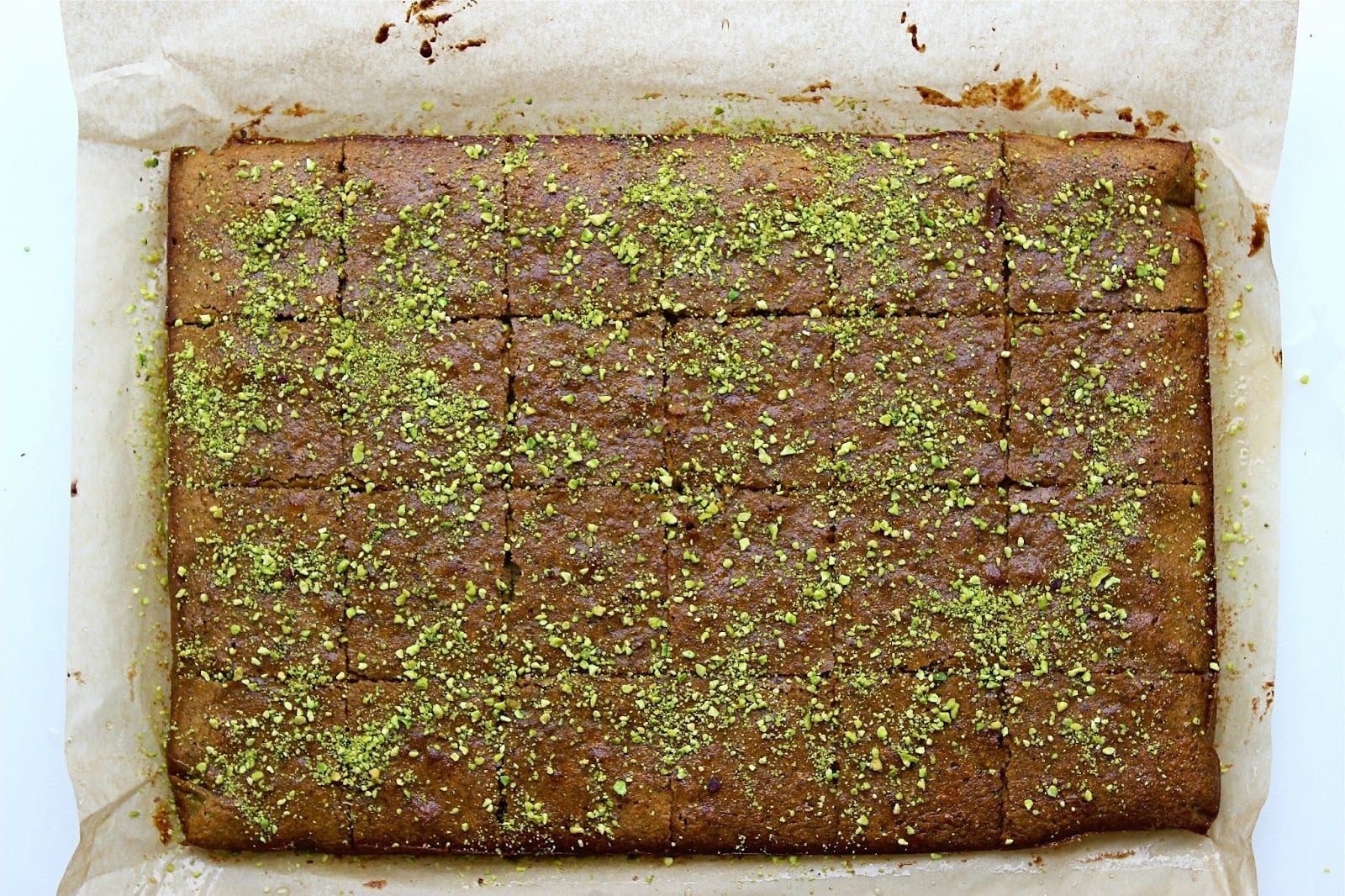
7- When the cake is ready remove from the oven and place on a cooling rack.  Pour half of the glaze over the cake.  Make sure to cover the entire cake with the glaze.  Allow the cake to absorb the glaze. About 10 minutes.  Using the parchment paper overhang GENTLY lift the cake out of the pan and place on a cutting board.  Cut the cake about every 2 inches.  5 vertical cuts and 3 horizontal cuts.  Pour the rest of the glaze over the cake.  Let the glaze get into the cuts.  Watch out the glaze doesn’t run off the cutting board!  Sprinkle the top with remaining 1/4 cup of ground up pistachios.  Allow the cake to cool.  At this point I like to cut even smaller pieces.  I make about 4 more cuts horizontally ending up with 1/2″x2″ rectangular pieces.

Serve right away or store in the fridge for up to 3 days.  I like this cake best cold out of the fridge.  It also freezes great for up to 3+ months.  If freezing make sure you line each layer with parchment paper.