Author / Naz

Drinks

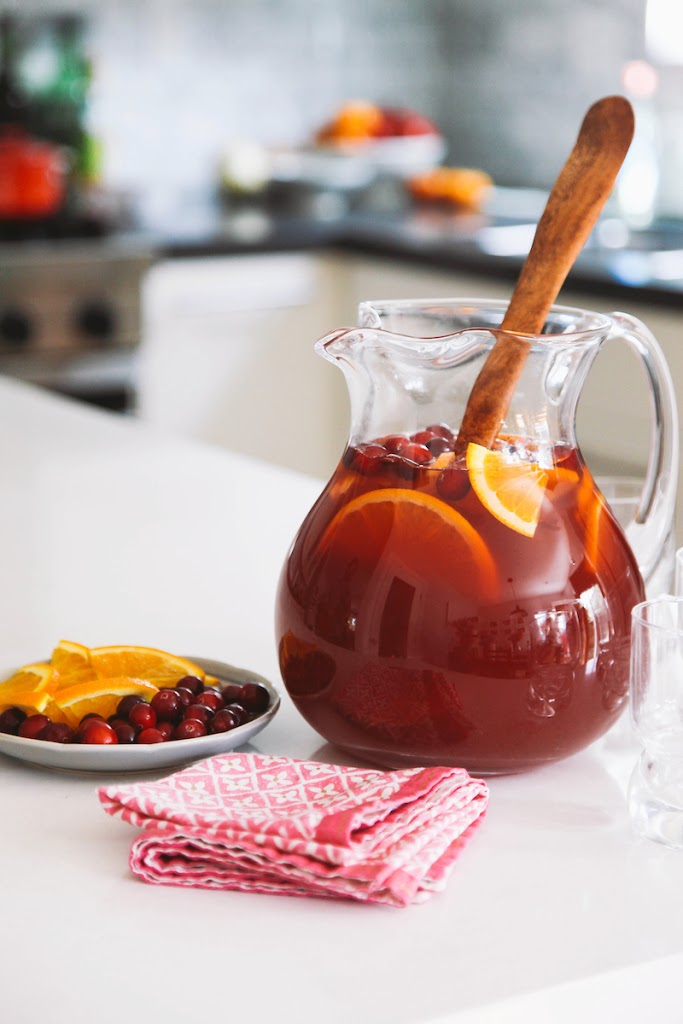
Yalda – Cranberry Orange Rose Sharbat – Fierce and Unrelenting

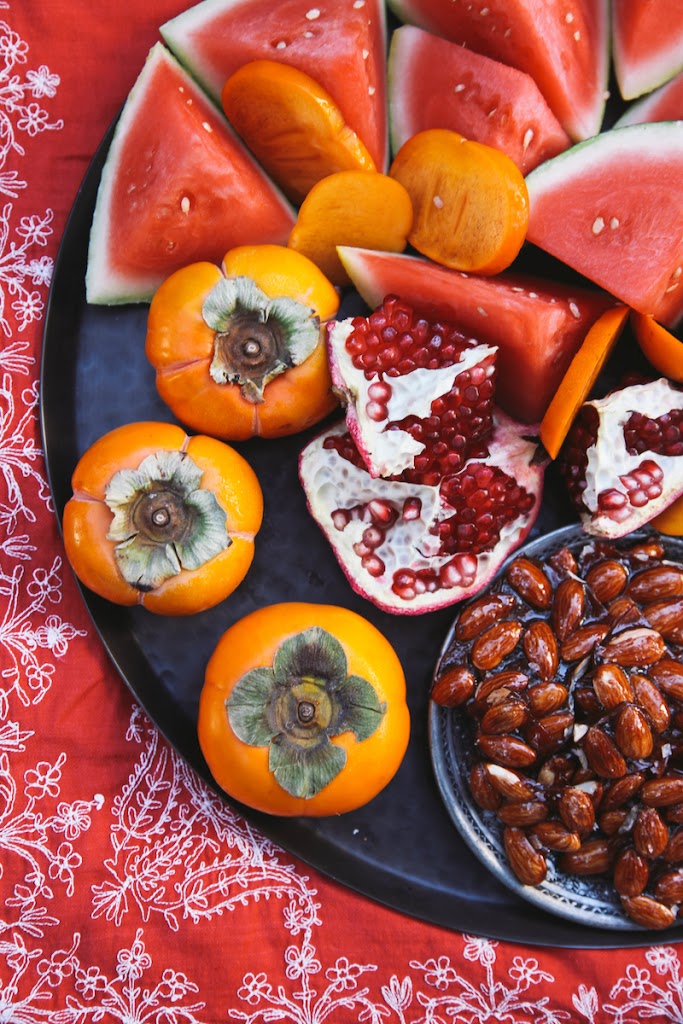
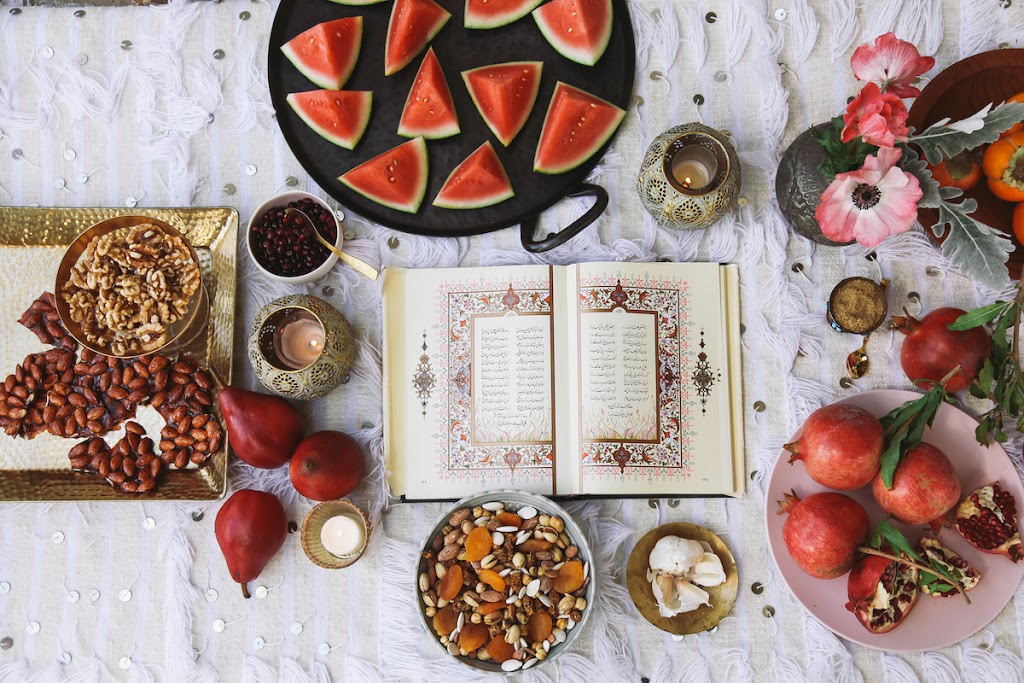
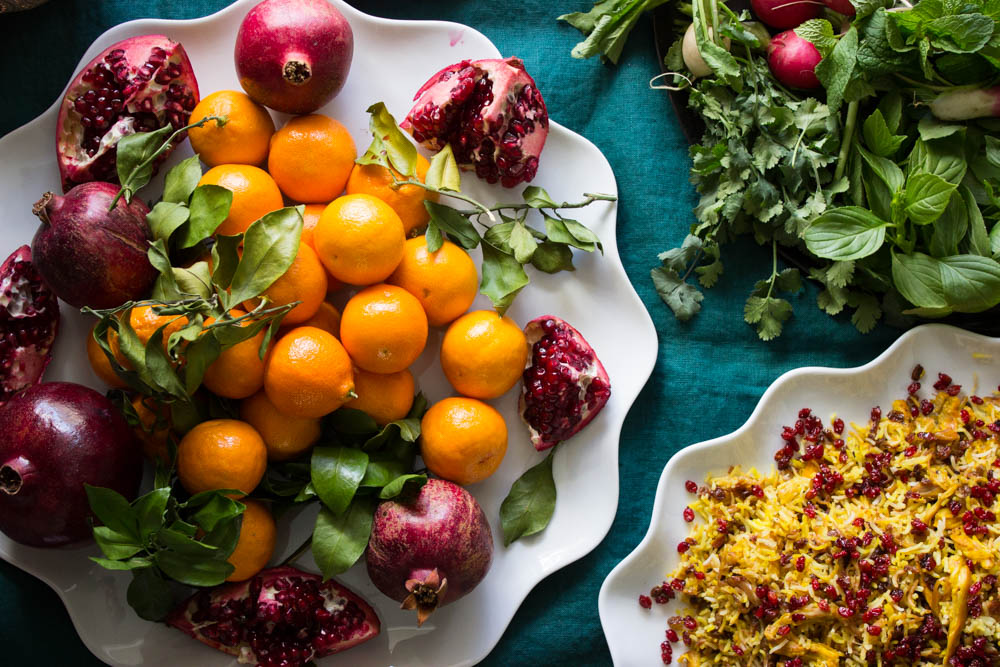
Dear friends, we had the pleasure of sharing our Yalda celebration in the December issue of Sunset Magazine. Thank you to everyone involved for making it such a bright and joyous evening.

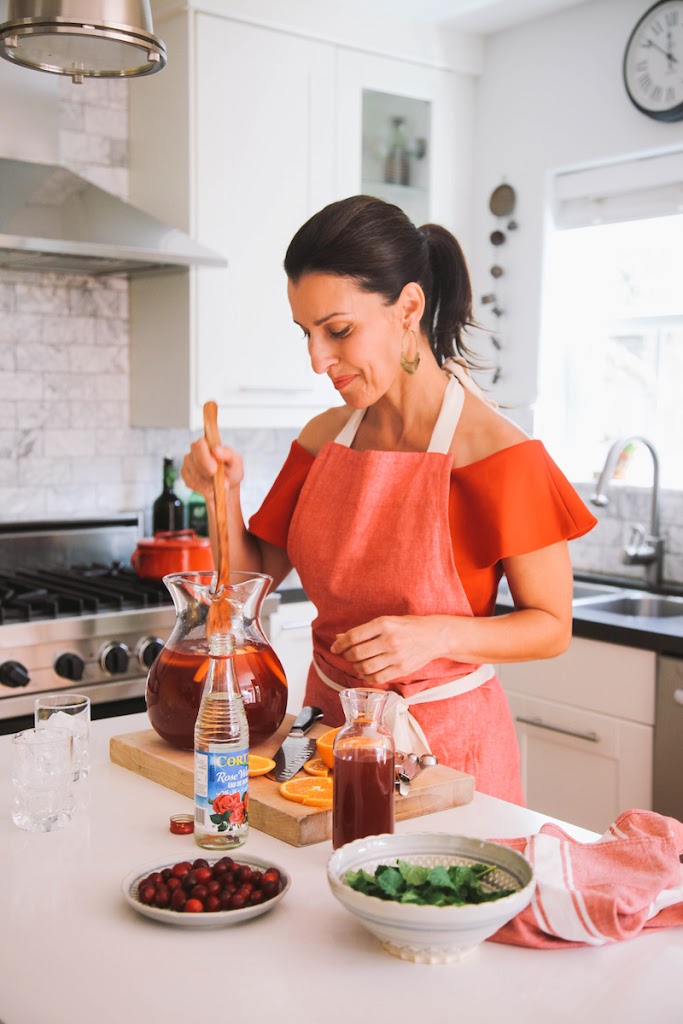
This Yalda I leave you with some of the images from our Sunset shoot and a bright, refreshing Cranberry Orange Rose Sharbat.

MUSIC WE’RE COOKING TO

Honey, the color of a California sunset.

Fierce and unrelenting.
Cinnamon and cardamom, for warmth.

To cut through the bitter bite of Jack Frost and all his generals.
Weavers of long tales. Casting shadows, fear, and hate.

From the silk road to the New World.

Rose water, for love.
Spun of silk and truth.

Fierce and unrelenting.

Oranges, a lantern to light the path.

All the way from the silk road to the New World.

Eviscerating the shadows, the dark and lonesome night.

Crimson cranberries, for Yalda.

For a new dawn.

For peace.

From the silk road to the New World.

Fierce and unrelenting.

Wishing you a happy Yalda night.

CRANBERRY ORANGE ROSE SHARBAT

Serves 8

Ingredients:

  • 1/2 cup mild honey, such as clover
  • 1/4 cup freshly squeezed orange juice
  • 3/4 cup unsweetened cranberry juice, divided
  • 1 tablespoon lemon juice
  • 2 cardamom pods, cracked open
  • 1 cinnamon stick (3 in.)
  • 1 to 3 teaspoon rose water
  • 1/2 orange, cut into half moons
  • 1/4 cup firm fresh or frozen cranberries

Put honey and 1/2 cup water in a small pot over medium-high heat and bring to a gentle boil. Reduce heat to medium-low and simmer 10 minutes, stirring occasionally. Stir in orange juice, 1/4 cup cranberry juice, the lemon juice, cardamom, and cinnamon. Simmer 20 minutes, uncovered, stirring occasionally. Strain into a small bowl and let cool.

  1. In a pitcher, combine syrup, remaining 1/2 cup cranberry juice, and the rose water (start with 1 teaspoon rosewater, add more to taste) with 4 1/2 cups cold water. Add orange slices and cranberries; stir. Chill at least 3 hours before serving.
  2. To serve, add a couple of ice cubes to each glass and pour in sharbat.


All photos in this post courtesy of Amy Dickerson. Copyright 2016.

Chicken

First Taste – Sour Cherry, Rosé Chicken Roast

Music We’re Cooking To

She leans over the edge of the world. Bold, beautiful and brave. The first light of day gently lays its lips on her saffron-hued cloak. A hushed whisper of a kiss, casting its golden reflection over Oceanus. Rippling triumphantly over seas, rivers and lakes. Lighting up the world. From East to West.

Eos, the goddess of the dawn, rosy fingered and perpetually in love with the first taste of a new day, rises.

Khanoum, we keep selling out of them. It’s not just Iranians. It’s everyone else. The Americans. I have no idea what they’re doing with the pounds upon pounds of albaloo they’re buying. They are fanatics about them.

I smile and nod politely at the grocer at my local Iranian market, as I fill my own bag with pounds upon pounds of fanaticism.

In the blink of an eye a single word turns on its head, claiming a new, delicious path. A path dripping with rosy red juices announcing the arrival of summer.

Albaloo – sour cherries – can turn the best of us into fanatics.

The Iranian love affair with sour cherries is hardly surprising. It speaks to and satiates the Persian palate and love for all things fruity and tart. A bright burst of early summer in every bite. Sour cherry season is maddeningly short (usually here between mid-June to early July). And when it arrives there is a frenzied rush to enjoy them as much, as quickly and fanatically as possible. The girls and I love picking at them just as they are on the stem, or sometimes sprinkled with a dash of salt. Savoring every bite, as if it’s the first, as if another season might somehow cruelly elude us.

Traditionally in the Persian kitchen sour cherries are enjoyed sweet, sour and savory. Be it in a thirst quenching and perpetual love inducing Sharbat-e Albaloo (sour cherry cordial), the crowd favorite savory rice dish Albaloo Polo, macerated with sugar and rose water for a sweet and sour preserve – Morabba-ye Albaloo (fantastic draped over yogurt), pickled – Torshi-ye Albaloo or reduced down to a syrup to be drizzled over sweet noodle sorbets (Paloudeh) for added tang and color.

Inspired by rosy fingered Eos and her saffron-hued cloak, I celebrate the arrival of summer with this Sour Cherry Chicken Rosé Roast. Whole chicken legs are marinated in saffron, cinnamon, honey and that other muse of summer: a crisp, dry rosé. A bottle that will dance with you straight from the kitchen to the table. twirling and dipping along the way. A wine that will inspire raising your glass to summer, sour cherries, and to Eos.

After briefly marinating the chicken legs I gently stuff a handful of pitted sour cherries under the skin. The natural acidity and juices of the cherries flavoring the chicken as it roasts. The rest of the cherries are cooked down on the stove, lightly sweetened with a hint of honey, cinnamon and another splash of rosé. Drape the sour cherries over the roast chicken when serving for a stunning feast for all senses.

Sour Cherries can be elusive to find. I can always count on my local Iranian grocers, or other Middle Eastern markets. You can also try Farmer’s Markets or online. If fresh sour cherries are not available you can use frozen, unthawed. Jarred cherries in light syrup is also another option. But, be sure to drain these well, and taste before adding honey. They might not need any sweetening at all.

It’s unexpected. And takes you by surprise.

Your first taste of a sour cherry.

Like your first kiss.

Not the sloppy first kiss where you’re just trying to find your bearings. But the one where the ground gives, making your head spin, and your heart drop. The first, that every other kiss will be measured up to, compared to, longed for, dreamed of. A young lovers’ whisper of a kiss, sitting atop abandoned train cars on a warm summer’s night. Leaning into each other, leaning over the edge of the world. Gazing over Oceanus.

In anticipation of Eos and the rising dawn.

In anticipation of love.

In anticipation of that first taste of albaloo.

When the ground gives, making your head spin, and your heart drop.

SOUR CHERRY ROSE CHICKEN ROAST

Serves 4

Ingredients:

  • 1/4 cup olive oil, plus more for drizzling the sheet pan
  • 4 large garlic cloves, crushed
  • juice of 1 large lemon, about 3 tablespoons
  • 1/4 cup dry rosé wine, plus 2 tablespoons
  • 4 tablespoons honey
  • 1/4 teaspoon ground saffron
  • 3/4 teaspoon cinnamon
  • 1 tablespoon kosher salt, plus more as needed
  • 3/4 teaspoon ground black pepper
  • 4 whole chicken legs, about 3lbs total
  • 1 large onion, cut into eighths
  • 1 pound sour cherries, pitted

Heat the oven to 425F.

In a small bowl make the marinade by combining the olive oil, garlic, lemon juice, wine, 2 tablespoons honey, saffron, 1/2 teaspoon cinnamon, salt (if not used earlier on chicken) and pepper. Place the chicken and the onions in a large bowl and cover well with the marinade. Marinate the chicken for 30 minutes.

Drizzle the sheet pan with a little olive oil. Place the chicken on the sheet pan without over lapping. Grab a handful of sour cherries and very gently run your finger under the skin of the chicken (without tearing the skin) and stuff each leg with 3 or 4 sour cherries. Pour the marinade and the onions over the chicken. Roast in the oven for 30-40 minutes until the chicken is cooked through.

While the chicken roasts place the remainder of the cherries in a small pan over medium-high heat. Sprinkle with a little a salt and stir in 2 tablespoons honey.  Bring to a very gentle boil, splash in 2 tablespoons rosé wine, and cook for about 2 minutes. Turn down the heat to medium-low and simmer for about 15 minutes , until the cherries soften and the syrup thickens slightly. Set aside.

Drape the chicken with sour cherries and its juices and serve with a crisp glass of rosé.

Drinks

Strawberry, Rose, and Mint Kombucha – Husband’s Brew

♪  Music husband is brewing to ♪

Please join me and fellow Persian food bloggers as we celebrate the Iranian midsummer festival Tirgan with a virtual picnic. I am also thrilled to have Drew, aka Mr. Husband take the reins on this post. Because a summer picnic is never complete without a bottle of Husband’s Kombucha.

Kombucha – Fun With Bacteria

Three years ago a good friend of mine pulled me aside with a proposition. “Have you heard about kombucha? I think you’d like brewing it.” Now, this sounded like an odd endeavor. I knew this was some sort of fermented drink, most likely with floating parts to it. But to make my own? Brewing my own beer was more up my alley. Still, I heard her out, all with yelling children in the background, demanding our attention. I say this because the process was so simple to understand and implement, I could even process it while my attention was divided! I said yes, and next thing I knew I was on my way home with a SCOBY, floating in a sweet tea mixture. Thus began a 3-year odyssey of kombucha home-brewing.

I think the best part of this hobby, apart from the delicious, naturally effervescent and healthy beverage I make for the family each week, is the bragging rights that I actually do it. This is a strange and fascinating concept to so many. Kombucha is a relatively new product in western grocery stores. Many have seen the store-bought bottles and wondered to themselves what it was about. Or perhaps they have tried it, loved it, and are now shelling out up to $8 a bottle for it. Everyone I’ve spoken to about this wants to know the process, and strongly considers taking it on themselves. In fact, as my SCOBY has grown, I’ve been able to hand off sections of it to others for their own brewing.

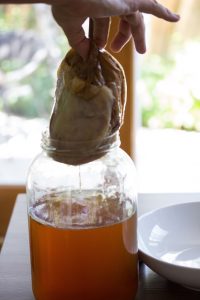
You might be wondering, what is this SCOBY he keeps talking about? SCOBY is an acronym for Symbiotic Culture Of Bacteria and Yeast. It can also be called “The Mother” as all the good stuff comes from it. The SCOBY will take the shape of its container, usually a jar. It will be round and disc-like, and as it grows it will form multiple discs, almost like floating pancakes. Eventually it will become too large, and you will need to separate some of these pancakes for giving away, or composting. I’m proud to say my SCOBY has many children now. I’ve given away extras to many friends for their own home brew, and have even auctioned off “kombucha starter kits” for our kids’ school!

Getting a SCOBY might have been the hardest part of getting started a few years back. You would need to know someone one who had one, or search the back-back pages of the classifieds. But nowadays they are all over the internet, and even big companies like Amazon and Williams-Sonoma are getting into the game. A simple search online for “buying a SCOBY” will yield many results, if you don’t have a personal connection.

As you read through this recipe, you will notice that 1 cup of sugar is used in the process. This may make one assume you’ll be consuming copious amounts of sugar. Not so! The sugar, when mixed with tea, serves as a food or fuel for the SCOBY, and the result is kombucha. By the time you drink it there is very little sugar left. Alcohol is another by-product of the brewing process. But again, no more than trace amounts.

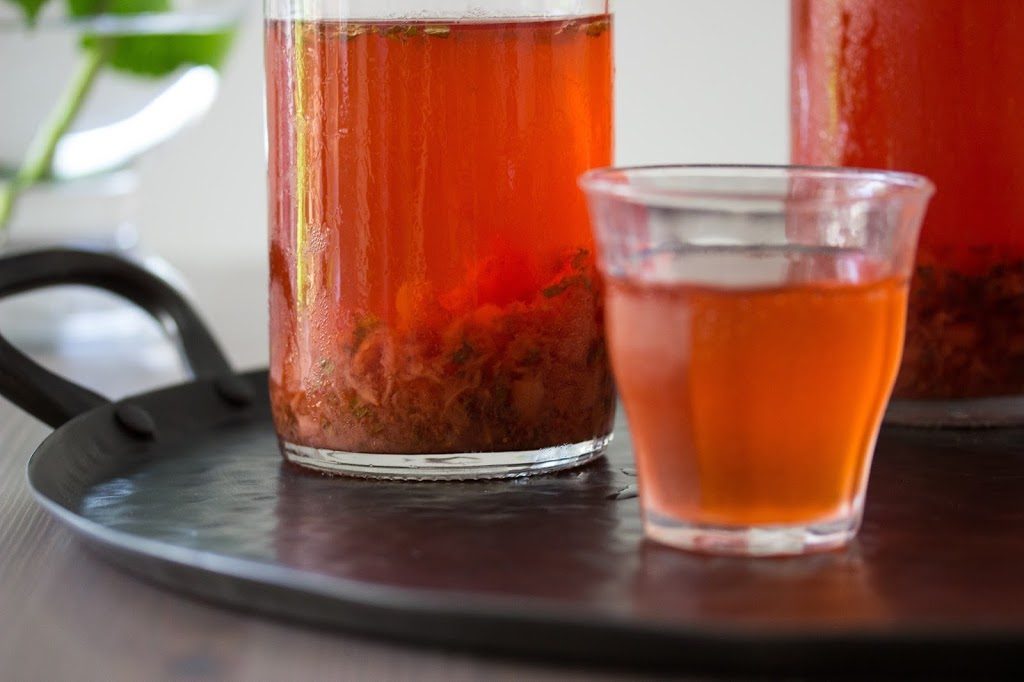
Another wonderful part of kombucha-making is the ability to customize. After your first fermentation process, you can add a couple more days with fruit (lemon and ginger is a great combination) or juice fermentation (pomegranate juice is always great), which will greatly increase the flavor and enjoyment. One of my favorite flavors, and the one I share with you today, was inspired by the ever present bottle of rose water during Nowruz – Persian New Year. Strawberries, rose water and mint. Huge hit in our house.

Once you are up and running, the process only takes about 20 minutes per week. I like to set reminders on my phone so I know when it’s time to boil water, when to transfer the kombucha, and when to refrigerate my bottles.

I can’t emphasize enough the rewards of this home brew: my kids love it, my wife really loves it (she drinks most of it usually!), and everyone who comes to the house loves it too. It’s refreshing, pairs well with any meal (particularly Persian stews with rice, like my all-time favorite Loobia Polo), and it helps to contribute to a healthy amount of good bacteria in the gut. In this day and age of antibiotics being prescribed for just about any ailment, the importance of good bacteria cannot be over stressed.

Fermenting from here? Naz has been after me to start a sourdough starter. In fact, she would like me to be the Resident Baker in our house. {editor’s interjection: Naz loves to delegate baking duties} And I’d certainly like to do that. Time is always an issue, of course. I’m very proud of Naz and her homemade batches of yogurt! But kombucha has proven to me that a very simple and enjoyable process can be slipped into an otherwise very busy lifestyle, and the benefits are tremendous.

Enjoy!

Sincerely,
Mr. Husband


STRAWBERRY, ROSE, AND MINT KOMBUCHA

What you need:

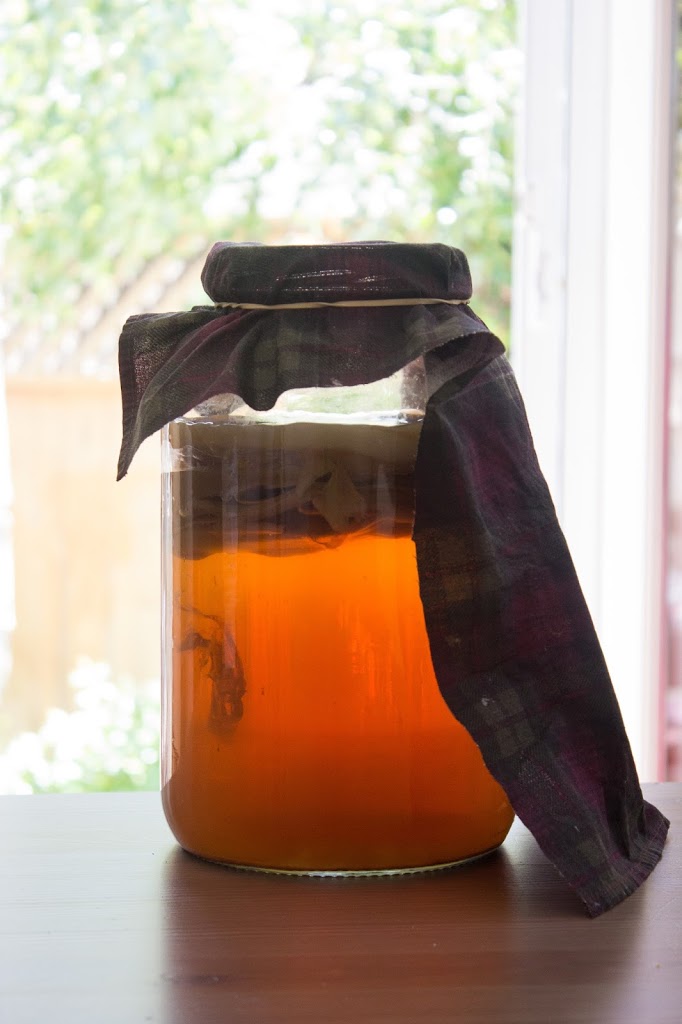
  • 1 gallon glass jar (pickle jars with a wide mouth are great for this)
  • Breathable Cloth to cover top, with rubber band to hold it in place
  • 1 SCOBY (an acronym for Symbiotic Culture OF Bacteria and Yeast)
  • 1 cup organic sugar (for your starter batch plus more to continue process)
  • 4 organic black tea bags (for your first batch plus more to continue process)
  •  3 sealable glass bottles
  • Funnel (to pour liquids into the sealable glass bottles)
  • Strainer (to separate any solids from your kombucha before drinking, although some people drink these too!)
  • 6 large strawberries
  • 2-4 fresh mint leaves
  • 1 teaspoon rose water
  • Organic juice of your choice, if you’re not using the strawberry, rose water, mint mix (or fresh fruits, or anything else you want to ferment with (ginger, lemon, etc))

Step 1:

  • Boil 12 cups of water in a large pot.
  • Add 1 cup of organic sugar. Stir until dissolved, about 1 minute. Turn the heat off.
  • Add 4 tea bags of organic black tea
  • Let the tea mixture cool to room temperature. Doing this in the evening before you go to bed is a good time, as you can then do step 2 in the morning.
  • IMPORTANT NOTE: this sweet tea mixture is the food for your next batch of kombucha. Once you complete Step 2 below, you will use this mixture.

Step 2:

  • With clean hands or with the help of a clean kitchen spoon, pull out your SCOBY from the tea mixture (now kombucha) and set aside in a separate bowl.  Add a ½ cup of the kombucha to that bowl.
  • Using 3 sealable glass bottles, add a finger’s width of your favorite organic juice (or fresh fruit of your choice) to each bottle.  Use a funnel so you don’t spill. LESS IS MORE HERE! Stick to a finger’s width at the bottom of each jar, whether using juice or solids.
  • For our strawberry/rose water/mint flavor, in a mortar and pestle muddle 6  strawberries, 2-4 mint leaves, and 1/2 teaspoon of rose water per glass bottle. Vary this depending on taste.
  • Add the kombucha to each glass bottle, making it even between the three bottles.  Store these away to ferment.  Don’t put them in the fridge yet.  They should sit out for 2 ½ days.
  • Rinse out your now-empty kombucha jar with cold water. No soap, just a good rinse.
  • Add your room-temperature sweet tea (from Step 1!) to the kombucha jar.
  • Put your scoby and its ½ cup of kombucha back into the kombucha jar.  Give it a gentle stir.
  • Cover the jar with cloth and rubber band to hold it in place, and store in the dark for 7-10 days.

Step 3:

  • After 2 ½ days, put your 3 bottles of kombucha juice in the fridge to stop the fermenting process and to chill it for drinking.

Step 4:

  • Your kombucha juice is nicely chilled and ready for drinking!  You can use a strainer when pouring your kombucha in case you don’t want any of the floating bits of scoby in there.
  • The natural effervescence (bubbles) can vary from batch to batch; don’t be too concerned if one batch is a little more flat than another. It will come back! Some juices or fruit encourage this carbonation; some don’t.

Step 5:

  • Step 5 is actually Step 1! Start the process over again once your kombucha brew has sat in the dark for at least 7 days.

Some other helpful points:

  • If you’re going on vacation, don’t worry! Just brew your kombucha in the dark as you normally would. I’ve found that if it brews more than 14 days the taste is a little too vinegar-y for me. You can just start up the process again, as that scoby is pretty indestructible!
  • Always keep the scoby in a glass container. Metal and plastic don’t work well. Real glass, nothing with lead in it.
  • You will find that your scoby will increase in size, and separate! Once this happens you can either give an extra one to someone else, or compost it, or just throw it out. Some even eat it.
  • Please share any new and exciting flavor combinations!

Tips

A Sweet Secret – Tuckerman’s Farm Maple Syrup

For a few years now, some time around April we anxiously look forward to a very special package to land (hopefully very gently) on our doorstep. My father-in-law Steve’s home-tapped maple syrup. Directly from his farm in New Hampshire – Tuckerman’s Farm. I am so happy to have Steve share this beautiful story with us. Story and photos by Steve Bjerklie.  


In early March, the sugar maples still sleep in New Hampshire’s woodlands. Winter’s icy shackle clamps the landscape and everything in it with a hard grip. Snow muffles sound, buries life. Winter’s wind is like an archer who never misses the target, which happens to be you, if you’re out walking in the forest. Yet sometime around the middle of the month, a sliver of warmth from the sun sneaks past the cold fortress. A day later, another sliver. A couple days after that, another. One or two more bits of warmth, and the sugar maples shiver awake. Their sap, unseen beneath a coat of gray bark, begins to move.

Those slivers of warm sunlight in March or late February signal the beginning of sugaring season in New England. It’s time to tap the maples, time to stack the dry firewood, time to unlock the sugarhouse and fire up the evaporator. It’s time to make the purest, sweetest stuff God ever gave us from a tree.

It’s time to make maple syrup.

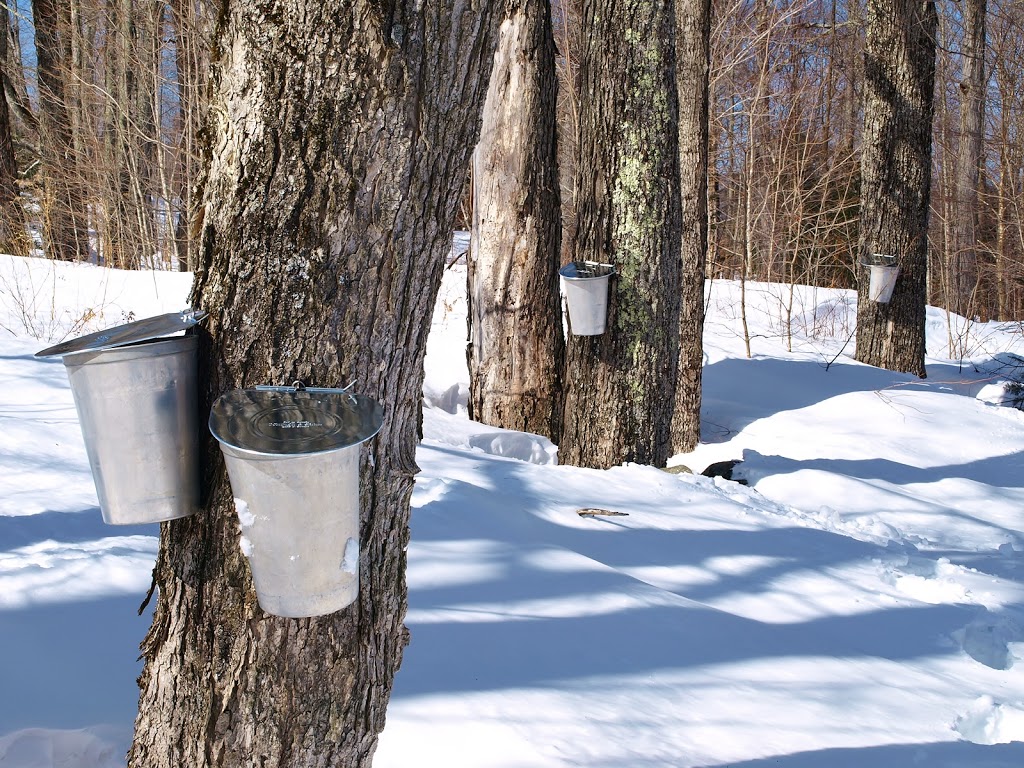
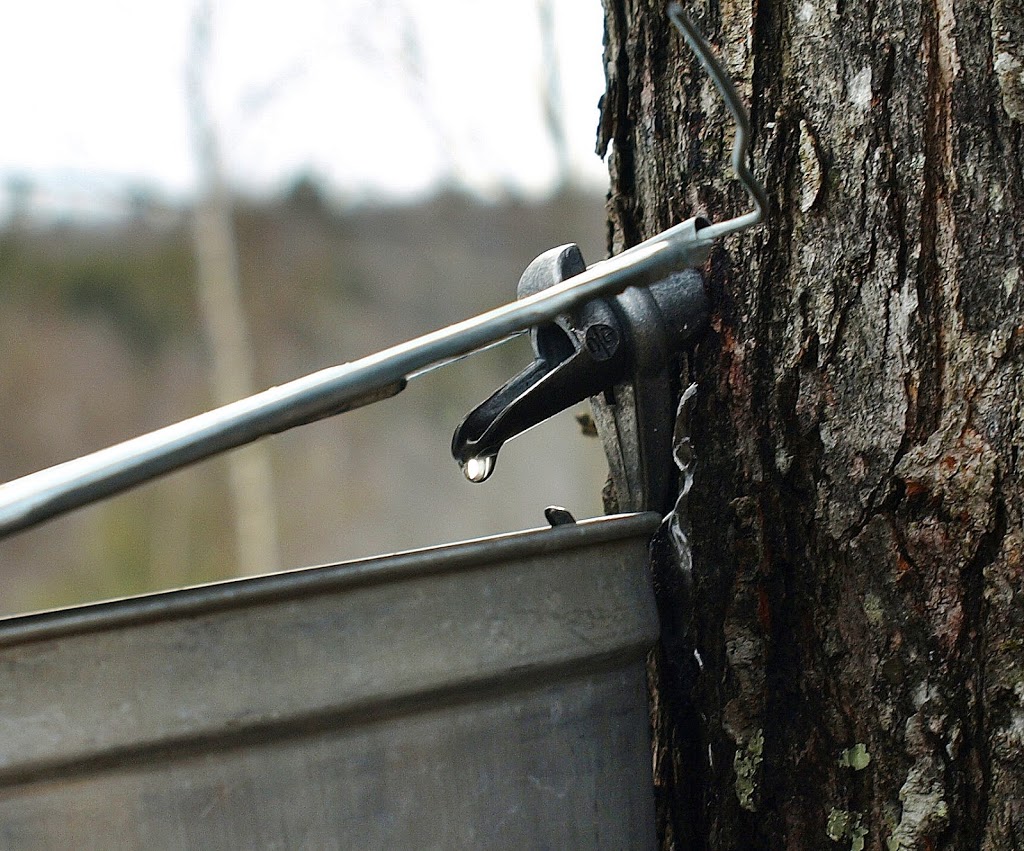
When the afternoon temperatures crawl up into the high 30s or low 40s (F), and the nights drop back below freezing, that’s when the maple sap moves. To reach it, drill a small hole a couple inches deep, insert a metal cone-shaped spout called a spile, and hang a sap bucket from the spile. For centuries, dating back to New England’s earliest settlers, who learned how to make maple sugar from the Micmac and Iroquois tribes, this is how the sap was collected. For many “sugarers,” as maple syrup makers are called, it’s still done this way — it’s how I do it. The snow is often deep, the sun is gray and low in the sky, a cold wind gusts just when a sap bucket is hung from a spile hook, but after the bitter months of January and February, going out into the woods to tap maple trees is one of early spring’s great pleasures. It signals the beginning of the end of winter. Sugaring is the bridge between New England’s merciless months and our more forgiving April and May.

Sugar maple sap right out of the tree is as clear and fluid as water, but it holds just a hint of sweetness. The old legend is that one day in the early spring an Iroquois chief named Woksis threw his tomahawk at a sugar maple tree and left it there. The next day, he pulled out the tomahawk, and as the day warmed up sap began to flow out of the cut in the tree and pool in a hollowed out log at the foot of the tree. Woksis’s wife needed some water for cooking, and on her way to the stream she found the pool of sap in the log. That night, she boiled the family’s meat in the sap. The village filled with the smell of maple, and the cooked meat was sweet and delicious. Every day after that, Woksis collected sugar maple sap for his wife to cook with.

There is a seed of truth in the legend, for Indians in what became the northeastern United States and southeastern Canada boiled sugar maple sap into syrup and maple sugar long before white settlers arrived. From the colonial period well into the 19thcentury, making sugar from sap was common. Maple sugar became a trade commodity, a source of rare sweetness on the frontier. Before the Civil War, abolitionists promoted maple sugar as an alternative to cane sugar, which was produced with slave labor. In 1884, the first patent for an evaporator to more efficiently boil maple sap was issued and production increased. But at the turn of the 20th century the price of maple sugar collapsed, and sugarers throughout New England refocused their efforts on making and marketing maple syrup, which requires less boiling than the sugar (and maple candy).

Whether you make pure maple syrup in high volume using the latest technology or whether you are just a backyard hobbyist like me, the process is fundamentally the same. Making syrup from sap involves removing most of the water from the sap to leave the sugar, and that means boiling – and boiling and boiling. The general rule of thumb is that it takes 40 gallons of sugar maple sap to make one gallon of syrup, and in my experience that’s pretty close to right. The residual sweet sap becomes syrup when its temperature reaches 7.2 degrees Fahrenheit above the local boiling point.

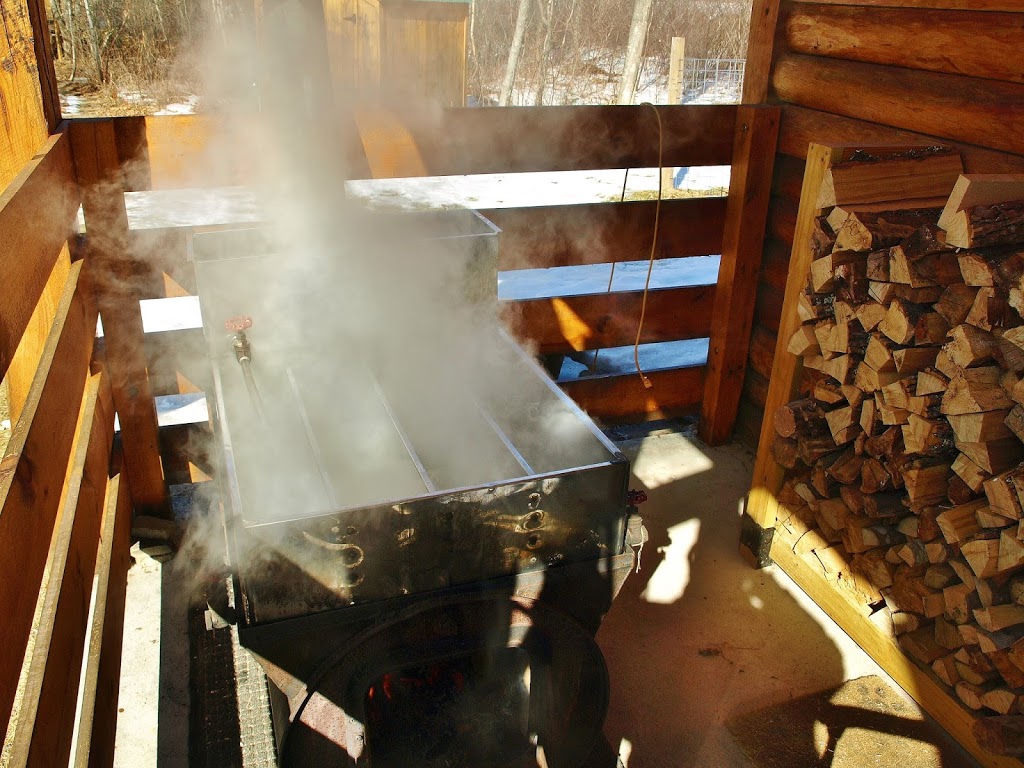
An evaporator is the essential tool for boiling sap to remove the water. It’s basically a wood stove topped with a shallow stainless steel pan that’s divided into channels. As the sap boils in the pan, it moves from channel to channel, becoming sweeter and sweeter with time and boiling. Fancy evaporators can cost thousands of dollars and will boil dozens of gallons of sap down to syrup in an hour or less, and there are evaporators available that are fueled by oil or wood pellets or even coal, but firewood, which is super-abundant in well-wooded New Hampshire, is the most commonly used fuel in evaporators. Some high-end sugarers run their sap through a reverse osmosis machine to remove a portion of the water before boiling it in the evaporator. These sugarers also typically use a system of tubes and vacuum pumps to collect sap by the hundreds of gallons rather than the old-fashioned, but labor-intensive, approach with spiles and buckets.

On the other end, some backyard sugarers build their own evaporators from cinder blocks and barbecue grates, and boil their sap in big metal pots. That’s how I started. It’s inefficient compared to boiling on an evaporator, but boiling the old way still carries the romance and history of long-ago sugar-making. The evaporator I use these days was made from a 55-gallon oil barrel sliced open down the side to create an opening to hold the boiling pan. The inside of the barrel is lined with fire brick, and a thick metal door on one end of the barrel gives me access to the firebox; the other end is cut for a smokestack. I can boil about three or four gallons of sap per hour on this rig, feeding the fire in the barrel almost constantly with dry wood. (Another rule of thumb: Depending on the efficiency of the evaporator, it takes about one full cord of firewood – that’s a stack of firewood four feet high, four feet wide, and eight feet long – to boil 400 gallons of sap.) One of these years I’ll upgrade to a more efficient evaporator, but for now the system I use works fine.


I’ve been asked: Why not just boil the sap on the stove in the kitchen? That could work, but most stove burners at home don’t get hot enough to boil sap quickly. Not only that, but boiling sap produces thick clouds of hot steam, so unless you want the wallpaper to peel and all the art on your walls and all the furniture in your rooms to get soaking wet, boiling in the kitchen is not a good idea.

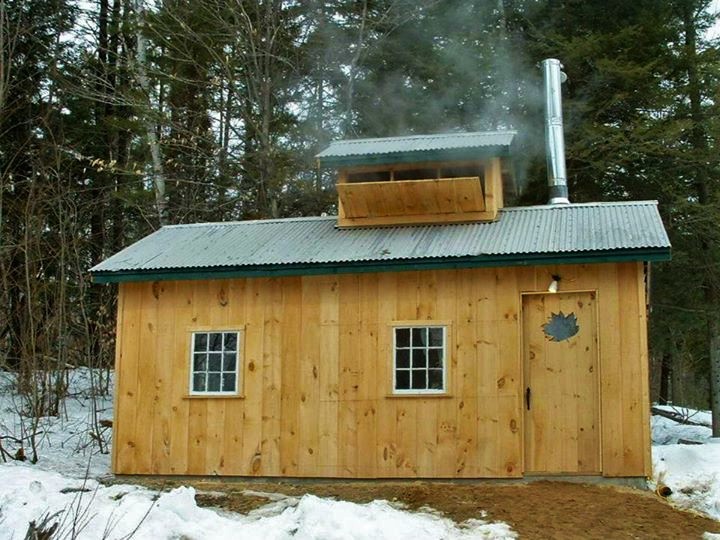
Where you want to boil is in a sugarhouse. A sugarhouse can look like almost anything – a garage, a log cabin, a barn or a shed – but they all share one thing in common: a roof that vents open to allow the steam from the evaporator to escape. A drive along the backroads of New England in March or early April will discover dozens of sugarhouses back among the trees or in backyards, big clouds of steam billowing from the vents. When sap is boiling, the quiet, woodsy countryside smells just like breakfast – like warm maple syrup being poured over pancakes.


Most of the sugar maples I tap for our syrup are more than 100 years old. They belonged to a commercial sugarbush (what a sugar maple farm is called) that was operated by a local family for decades. When we bought the property, now named Tuckerman’s Farm, several years ago, the old sugarhouse, which had huge, thick beams that had been hand-cut with an axe, was still standing, but then a heavy winter snow one year brought it down before the sugarhouse could be restored. The old maples hadn’t been tapped in decades, and when I drilled the first small tap holes one warm March afternoon a few years ago, the sap practically poured out. Tapping trees doesn’t hurt them, by the way; the tap holes are small and quickly grow over, and the amount of sap taken from a tree to make syrup is miniscule compared to all the sap a healthy maple tree holds.

Sugar season ends when nights become warmer than freezing and leaf buds begin to appear on sugar maple branches. The sap stops flowing, and to underscore that fact there’s one more sugarer’s rule of thumb: When the first chirps from the tiny frog called a spring peeper are heard, sugar season is over. Some years the season is weeks long, other years it’s just a few days. This year’s sugaring season arrived in two parts: first, one week of excellent conditions, then a three-day deep freeze, then three days of too much warmth, then another three days of great sap flow. After that, the peepers started singing.

Perhaps I’m being overly romantic or sentimental, but I feel like the beautiful, majestic old sugar maple trees on Tuckerman’s Farm and I are partners in our little syrup enterprise. The trees give me their sap in the early spring; in the summer, I keep them clear of pesky undergrowth. The wise old trees I tap seem to hold a story, a mystery, I can’t quite understand or unravel, and that’s okay. These trees have seen, browsing beside their sturdy trunks, moose and black bear, white-tail deer and silver foxes. They’ve seen cattle and sheep. They’ve seen wagons and then sedans and then flashy pick-up trucks and now my old red tractor. On a blustery early spring afternoon, when the sunlight slants like an arrow and I am tromping through the snow collecting sap from the buckets, the trees feel like old friends, but they still keep most of their secrets. The only secret of theirs I know for certain is the sweetest one, however.

Dessert

A New Day – Toot – Persian Marzipan

♪Music we’re cooking to♪

Propel. That’s a good word, Mama. – Luna

Turn up the music. The music we’re cooking to.

Turn it up loud.

I mean feel the rhythm surge through your entire being and bounce off your heart kind of loud.

Louder. Louder. Louder.

Push aside the curtains, throw open the doors and windows. Take off your shoes, grab your children’s hands, step out, throw your arms up to the sky and welcome a new day.

NOROOZ – Persian New Year.

Mute all devices that jingle, jangle, and make you twitch and tumble. Silence all the chatter floating through invisible wires, invisible messengers. Selling invisible dreams and schemes.

But, turn up the music.

Loud.

Throw some almond flour in a bowl, scoop in the powdered sugar, and sprinkle the cardamom.

Slowly drizzle in the rose water. Get your hands in there and make a soft dough.

Rose water again, Mama?

A little more, Soleil. Enough to make a dough.
 
We’ve been using a lot of rose water these days, Mama.

And we’ll be using more, Luna.

It smells like Norooz, Mama.  And I just want to swim in rose water. 

We’re gonna be swimming in rose water, cardamom, nuts, saffron, greens and more greens for the next few days, girls.

And SUGAR, Mama. Don’t forget about the sugar!

And sugar, girls. To sweeten our days and our hearts.

That’s silly. Sugar sweetens our taste buds, Mama!

Sit back. Close your eyes and press record. Record the rhythm of their giggles. Sisters. The cadence of each breath, the crescendo of the eventual disagreement. And repeat back to the giggles.

It’s like cookie dough, Mama. Are you sure we don’t have to cook it?

I’m sure, Soleil.

Can we shape them how we like, Mama? I want to make a bunny.

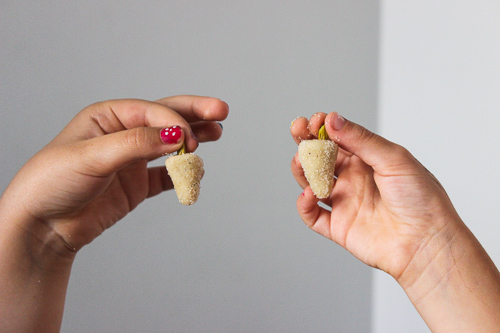
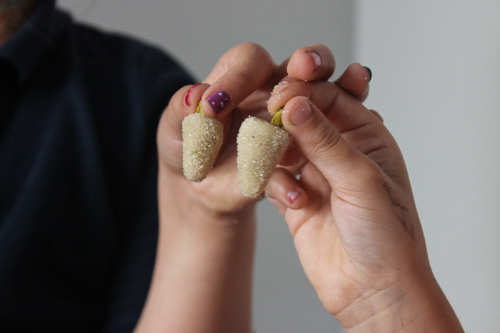
We call them toot because we make them look like the real toot we eat – mulberries. But you can shape them however you like, Luna. No rules for toot making.

Giggles, giggles, giggles.

Soleil, did you hear what Mama said? She said toot making! Toot! Toot!

Giggles, giggles, giggles.

Feel the rhythm of their laughter surge through your entire being and bounce off your heart.

Sliver a few pistachios. Stick them in the toot, like a stem. Or bunny paws. No rules.

Arrange the toot on a platter and set them on your Haft Seen Table. To sweeten your heart, your days and your taste buds.

Gather around your Haft Seen Table and light the candles. Watch as the flames reflect off the mirror and dance to the rhythm of the music, the rhythm of their giggles, the rhythm of your heart beat.

Turn up the music loud and let the beauty of it all propel you into a new day.

Propel into Norooz.

This we year we welcome spring and Norooz on Saturday March 19th at exactly 9:30pm PDT. I wish you all a very Happy Norooz!

And please make sure you also sweeten your taste buds with the following Norooz recipes from Persian food bloggers from around the globe.

TOOT – PERSIAN MARZIPAN

Toot is a very simple treat to prepare with few ingredients, and it tastes and smells like a mystical garden. Please make sure the almond flour you use is made with blanched almonds, I used this. I’ve also cut down on the sugar content, taste and adjust to the liking of your sweet tooth. Toot is traditionally served and enjoyed for Norooz.

Ingredients:

Makes about 30-40 toot

1 cup almond flour (from blanched almonds)
1/2 – 3/4 cup powdered sugar, depending on desired sweetness
1/2 teaspoon cardamom
1-2 tablespoons rose water, plus more if needed
1/4 cup granulated sugar
2 tablespoons raw pistachios, slivered to resemble stems

In a medium bowl combine the almond flour, powdered sugar and cardamom. Drizzle in the rose water 1 tablespoon at a time, gently knead until you form a soft dough that doesn’t stick to your hands. I used 2 tablespoons, plus a few extra drops. Taste and add more powdered sugar to you liking. You may need to adjust the rose water. Pinch off a little bit of dough, about a 1/2 teaspoon. Form a ball, then shape into a cone (like a mulberry), or any shape you like. No rules. Place a pistachio sliver on top and roll in granulated sugar.

Enjoy with a cup of Persian tea.

Soup

City fo Gold and a Farro, Mung Bean, Cannellini Aash

 ♪ Music We’re Cooking To ♪

I expected food, culture, and a unique culinary guide to the city – my adopted city.

I didn’t expect the tears.

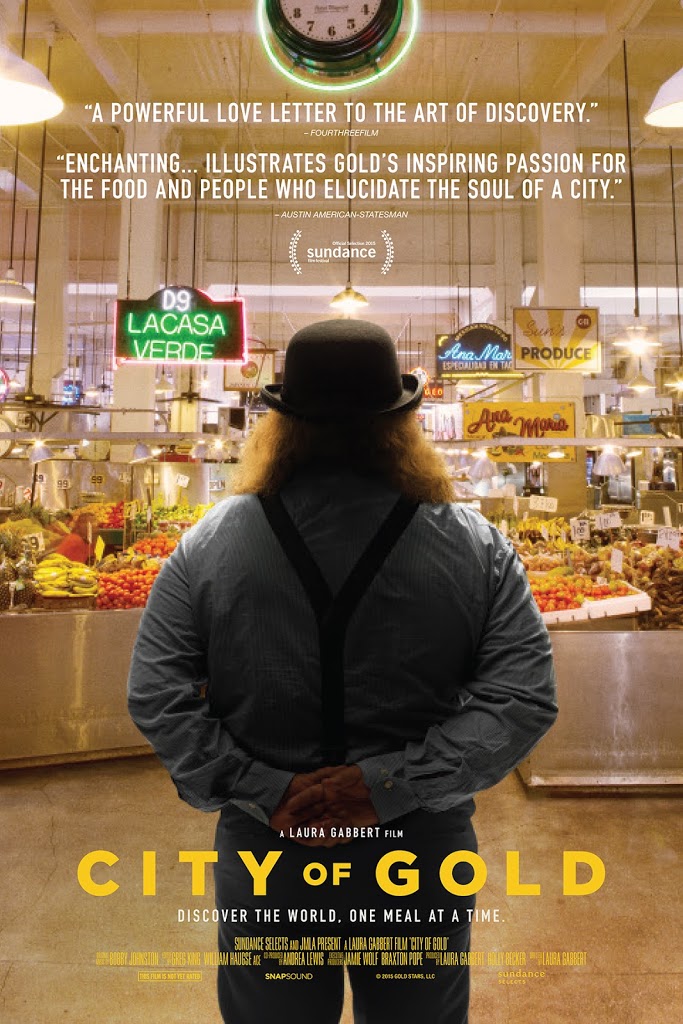
I was invited to a screening of the documentary film City of Gold about Pulitzer Prize-winning Los Angeles Times food writer Jonathan Gold, directed by Laura Gabbert. It was a mid-week event right around dinner time. Which means high level planning, texting, and coordinating by the tag team parental unit. It means somewhere between school pick-up, homework, piano and violin practice, and endless queries about when it’s ok to play Minecraft, there’s dinner to consider. It means preferably a one-pot meal – stove to table. Something that will satisfy and nourish. Something a six-year-old can pick at and deconstruct to the daily (hourly?) whims of her palate. Something for which a nine-year-old will happily lick her bowl clean. All of which translates to aash – a hearty Persian soup. Use up whatever is within reach kind of aash.

I take my seat in the intimate theater. The lights dim and Laura Gabbert’s lens invites us to ride shotgun along side Mr. Gold. He guides us through the streets of his beloved Los Angeles with ease, respect, curiosity and a local’s sense of love and authority. A true reflection of what has made him and his columns so adored by Angelenos and beyond. He weaves on and off our Escherian freeways in search of a taco truck, a hot dog stand, Szechuan, very spicy Thai, Oaxacan, fancy French fare, Ethiopian, grasshoppers with Ruth Reichl, and a brief stop at the always reliable and delicious Attari for a little taste of Iran.

What shines brightest in City of Gold, what resonated most deeply with me, what grabbed my heart and lodged a lump deep in my throat are the stories behind the food. Laura Gabbert touchingly captures Mr. Gold’s gift to shine a light on these stories. The people, the families, the struggles and successes, life in the diaspora, life in every corner of Los Angeles.

Mr. Gold’s dedicated pursuit of the next satisfying meal reveals the many colors of the mosaic that makes up Los Angeles. We are reminded that our communities are alive and bursting with all sorts of flavors, people and stories – we just need to venture out a little more east, south, north and west to discover them. To break bread with them.

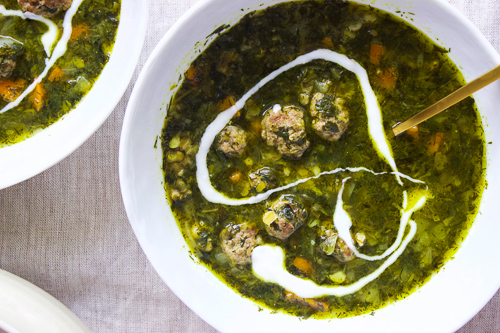
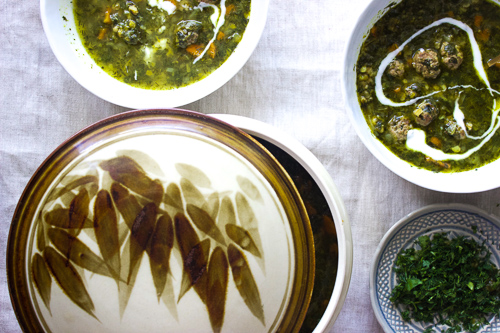
This aash is a reflection of the flavors and ingredients that have journeyed with me from east to west. A mix of flavors that bring comfort in their familiarity. There is the abundance of fresh greens so beloved in Iranian cooking, the chewy bite of Italian farro, a mix of creamy cannellini and mung beans, a whole leek – white and green parts, mini-meatballs mixed with fresh herbs and Parmesan (for added flavor and more importantly because that’s how my kids love them) and a couple of spoonfuls of yogurt to bring it all to life.

The true spirit of aash-making is not in how accurately you measure, or use these ingredients exactly as dictated. Aash is generous in spirit and very forgiving. If you don’t have mung beans on hand try lentils, or substitute rice or noodles for the farro. For a vegetarian option, leave out the meatballs. Don’t get too caught up on how big or small your bundle of greens is. Reach deep in the back crevices of your fridge and revive the forgotten and neglected. This is also a great dish to use the whey (from straining yogurt) sitting in your fridge door, politely waiting for its turn to be asked to the dance. If you don’t have whey, not a problem, just use water.This recipe can serve as a guide as your pantry, crisper and taste buds lead the way. From east, south, north and west.

At a time when there is so much talk about building walls to separate – Laura Gabbert and City of Gold quietly offer Jonathan Gold, an ambassador of sorts. A not so anonymous, suspenders and bowler hat-clad food critic – crossing bridges, and overpasses in his green pickup truck – connecting us to our neighbors. One dish at a time.

FARRO, MUNG BEAN, CANNELLINI AASH

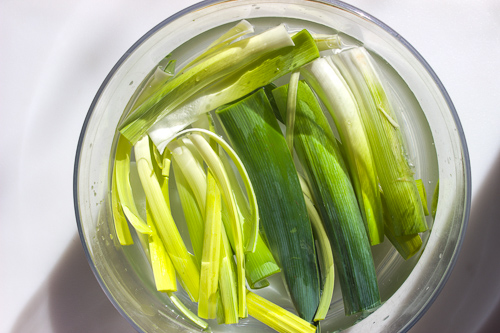
Notes: Cleaning and chopping bunches upon bunches of fresh green herbs can be time-consuming. Don’t get too caught up in the task. Chop off the thick stems (set aside to use in broths, if you like) and chop the more tender stems and leaves. I highly recommend pulsing the leek, green herbs and the green onion in a food processor to save time.

Serves 8

  • 4 tablespoons olive oil
  • 1 medium onion, finely chopped
  • 3 garlic cloves, chopped
  • 1 medium leek, white and green parts, finely chopped
  • 2 medium carrots, chopped
  • 4 large chard leaves and stems, leaves and stems chopped and set side separately
  • 1/2 teaspoon turmeric
  • 1 tablespoon dried mint
  • 3/4 cup semi-pearled farro
  • 1/4 cup cannellini beans, soaked overnight
  • 2 cups whey, (if using, otherwise use equal parts water)
    10 cups water
  • 1/4 cup mung beans, soaked overnight
  • 1 bunch parsley, chopped
  • 1 bunch cilantro,chopped
    1 bunch dill,chopped
  • 3 green onion, chopped
  • fine grain sea salt
  • ground black pepper

Meatballs

  • 1/4 of a medium onion, grated
  • 1 tablespoon chickpea flour, or bread crumbs
  • 1/3 cup finely grated Parmesan
  • 1 lb ground meat
  • 2 tablespoons chopped fresh herb mix, from above
  • 2 heaping tablespoons plain yogurt, plus more for serving
  • 1 teaspoon fine grain sea salt
  • 1/4 teaspoon ground black pepper

Mix the chopped parsley, cilantro and dill. Set aside 2 tablespoons of the mix for the meatballs.

Heat the oil in a large pot over medium. Add the onion and cook for 10 minutes until golden and fragrant. Add the garlic, the turmeric, dried mint (crush between your fingers to release its fragrance) 1/2 teaspoon salt, 1/4 teaspoon black pepper. Cook for 2 minutes, stirring. Add the leeks, carrots and chard stems, cook for 5-8 minutes, until slightly softened. Add the farro and cannellini beans, give a quick stir and add the whey (if using) and water. Bring to a boil, cover with the lid slightly ajar and simmer over medium heat for 20 minutes.

In the meantime make the meatballs. In a medium bowl mix together the grated onion, chickpea flour (or bread crumbs), and Parmesan. Add the meat, fresh herbs mix, salt and pepper. Mix well, massaging all ingredients into the meat. Form into mini-meatballs (I use a teaspoon to scoop up the meat) and set aside. You can make the meatballs ahead of time and refrigerate.

Add the mung beans, chard leaves, and green onion to the aash, simmer covered with lid ajar for 10-15  minutes, until beans soften. Add the fresh herbs and meatballs, and 2-1/2 teaspoons sea salt. Simmer covered with lid ajar for about 15 minutes, until meatballs have cooked through and beans and farro have softened.  Scoop out a couple of ladels full of the broth in a bowl and mix the yogurt with it. Pour back in the aash and stir. Taste and adjust all seasoning. Add more yogurt in this manner if desired.  Serve with extra yogurt on the side.

Uncategorized

Clinging to Freddie Mercury and a Pot of Rice – Zereshk Polo – Barberries and Rice

Zereshk – barberries – like memories – first need to be sorted through.  Scatter them on a plate as you would dried legumes, and with a discerning eye pick out the older, shriveled and darker looking ones.  Hang on to the bright crimson ones.  Occasionally you might come across a small stone, pebble, or something of the sort.  Give those the boot as well.  While you’re at it remove the little stems too.  Sometimes I skip this step.  Like other things in life it all depends on my patience level, and the all-too-demanding tick-tock of the clock.

It’s 1977, maybe 1978.  When you are very young the magnitude of every hour, day and month is never lost on you. You proudly announce your age by year, month, day, even minute.  Making sure no one mistakes the six-year-old you for the much younger five-and-a-half-year-old you. When later in life you look through the long lens of memory, the years meld into one.  And now you refrain from any unnecessary age announcements.

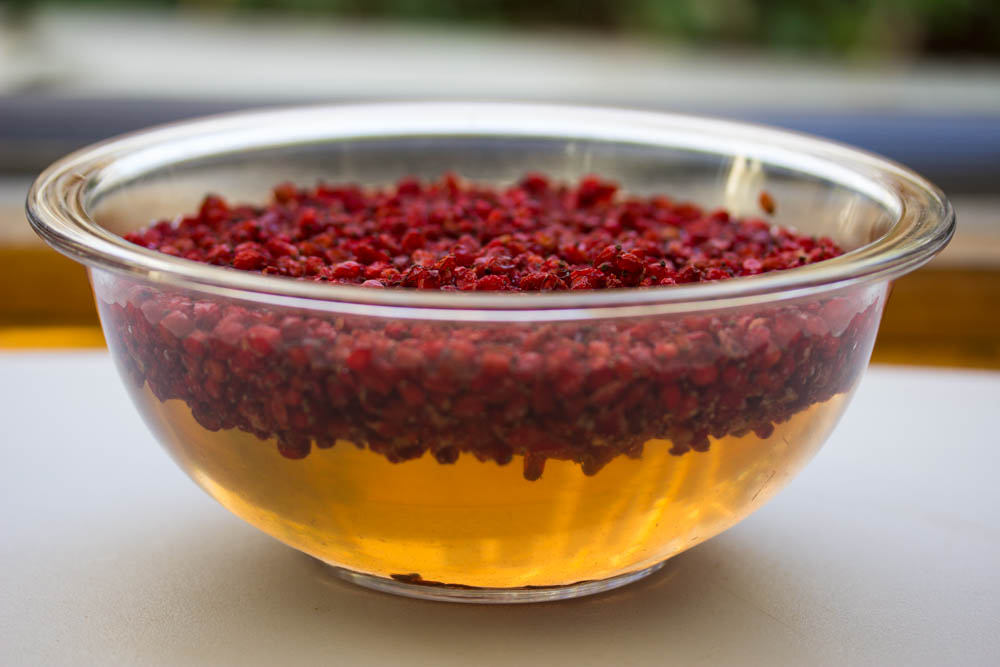
Next give the zereshk a bath.  Even on lazy days follow through with this step.  Place them in a bowl and fill with cold water.  Let them sit and soak for about 15 minutes. Observe as the ruby red jewels re-hydrate, plump up and rise to the top as all the sand settles to the bottom. Best to leave the dirt and detritus behind.  In life and cookery.  Reach in and gently lift up the barberries (you can use your hands or a very small mesh colander for this) without disturbing the sand that has settled on the bottom. Place the barberries in a small colander, give a quick rinse and set aside to drain.

My older brother Ramin and I take our positions at either end of the carpet adorning the family room floor.  A recurring game of koshti – wrestling face-off between siblings.  The sizzle of the onions hitting the hot butter catches me off-guard and within a few seconds the heady aroma of onions melting and caramelizing sneaks out of the kitchen. Winding its path beyond the piano (a constant reminder to practice), and stops short at the large living room windows.  There it lingers in awe of the first snowfall of the season settling on the window sills. Just in time for Yalda night  – the winter solstice. Overnight Tehran will be covered in a peaceful blanket of white. Hypnotized and distracted by the scents and sounds my eyes scan past Ramin, who is ready to charge, and fall upon our mother in the kitchen, rhythmically lifting the tart, jewel-like zereshk in and out of the bowl. I overhear our parents’ conversation. Like the onions, it sizzles and softens, casually weaving in and out of earshot. There’s talk of a possible trip to the mountains to enjoy the first snowfall. There’s also murmurs of unrest on the streets.  With a yek-doh-seh my brother and I charge at each other.  I give it all my little body has to give.  He lets me win.  He always lets me win.  A typical weekend.  It’s Tehran.  But it could be anywhere.

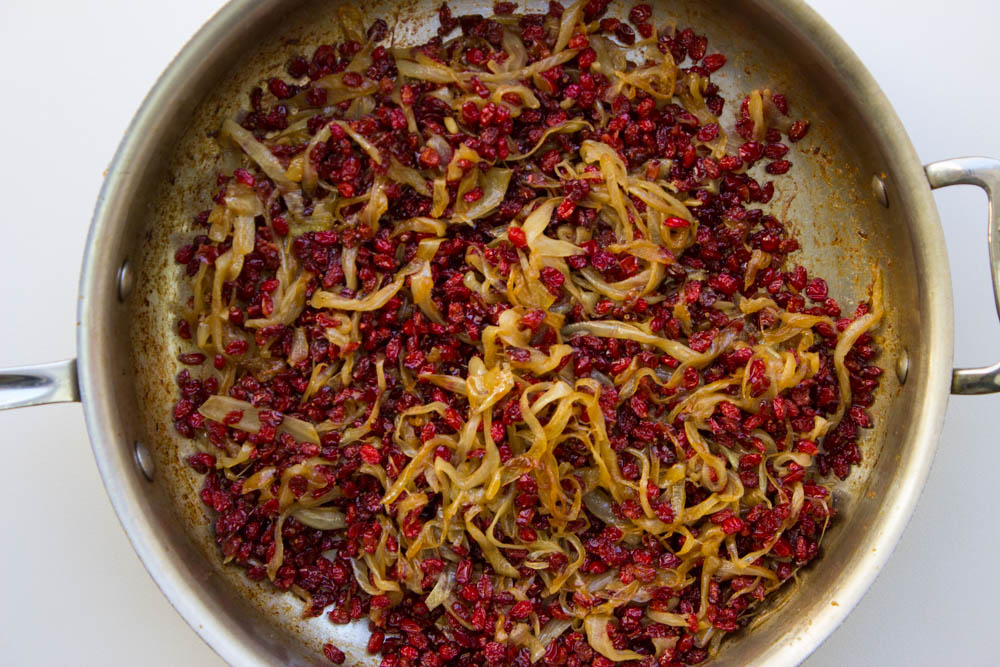
Caramelizing onions is a test in time, patience and heat control.  But where there is great effort, there is also great reward.  Most of the time.  When preparing Zereshk Polo I like to caramelize the onions in butter for a silkier, nuttier, and of course tastier, finish.  Start at a higher temperature and stir often.  At this point you’ll need to use all senses to determine when to turn down the heat.  Listen to the sizzle, stick your nose in there, and keep a close eye on those onions.  Play with your heat source and don’t get discouraged – it takes time.  Ultimately, after about 40 minutes the onions will shrink,  sweeten and turn into a sticky rich shade of brown – caramel like.  Some pieces turn darker and crunchier than others.  Add the barberries to the caramelized onion at the very end.  Barberries can burn very quickly so they only need a quick sauté, no more than 3-5 minutes.

It’s 1980, maybe 1981.  Snowfall in Rome is rare, but then again the past year or so has been anything but ordinary.  The murmurs of unrest turned into demonstrations, which turned into revolution, which turned into blackouts, sirens and bombs.   All that and so much more is now behind you.  What’s ahead is unknown, uncertain, unnerving.  But when you are young all that matters is what’s in front of you.  And on this particular day it’s a few flakes of snow ushering in a new season and gently dusting the eternal city.

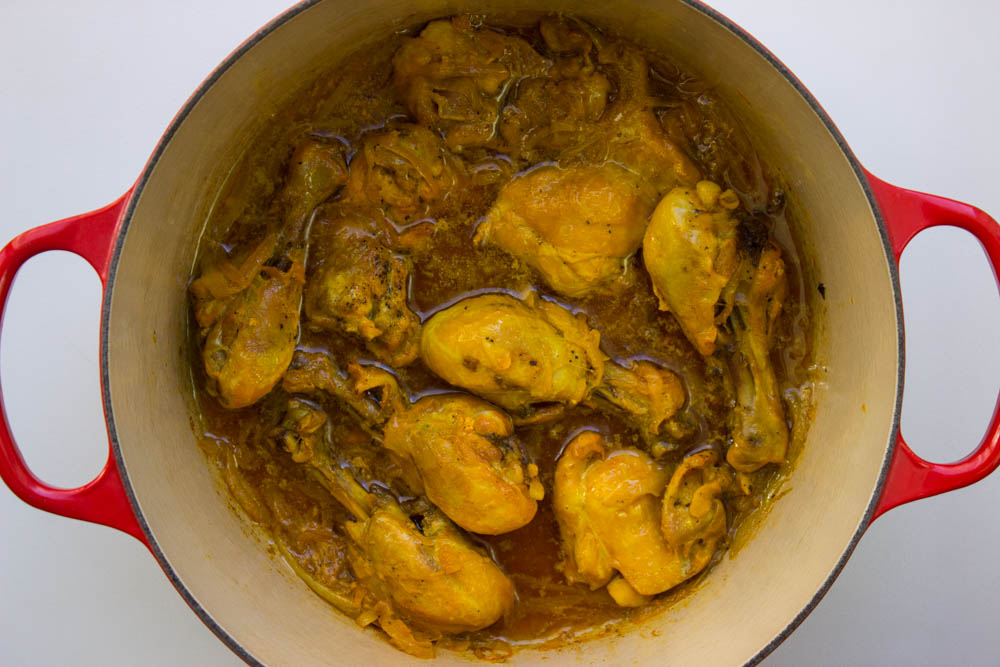
Gently simmering chicken in its own juices and saffron is one of the simplest and most satisfying dishes ever.  Even if you don’t scatter the chicken pieces in between the rice and barberries for the Zereshk Polo make this chicken and serve it with a side of plain rice, or roasted potatoes or scoop up with a warm piece of bread, like lavash or sangak.  I like to use skinless, boneless chicken (except for drumsticks that are on the bone).  If you prefer you can use thighs on the bone, with the skin on.  Just make sure to remove the skin before adding it to the rice.

Ramin instructs me to take my place at the other end of the living room, which also serves as the entrance, the family room, the dining room and my bedroom.  There’s no space to charge at one other. I’m told to just stand, listen, and have my life as I knew it altered forever.  My brother is now a full-fledged teenager and this is how teens speak.  As I wait for further instructions I glimpse Baba anxiously flip through the newspaper.

“Anything?” Maman asks.

Anything about all that was left behind.  Everyone that was left behind.  Anything about what lies ahead.

Anything.  Anything. Anything.

I hear the trepidation in her voice but I watch as her hand remains steady as she meticulously scatters the barberries, and the saffron chicken in between the rice.  With the future unknown all we can do is take charge of what is in front us.  She calls out that she’s put aside a few chicken pieces for us to snack on.  I especially like to gnaw on the drumsticks.  My brother declares the ubiquitous yek-doh-seh. He reaches over to the black cassette player and presses play.

Life alters.

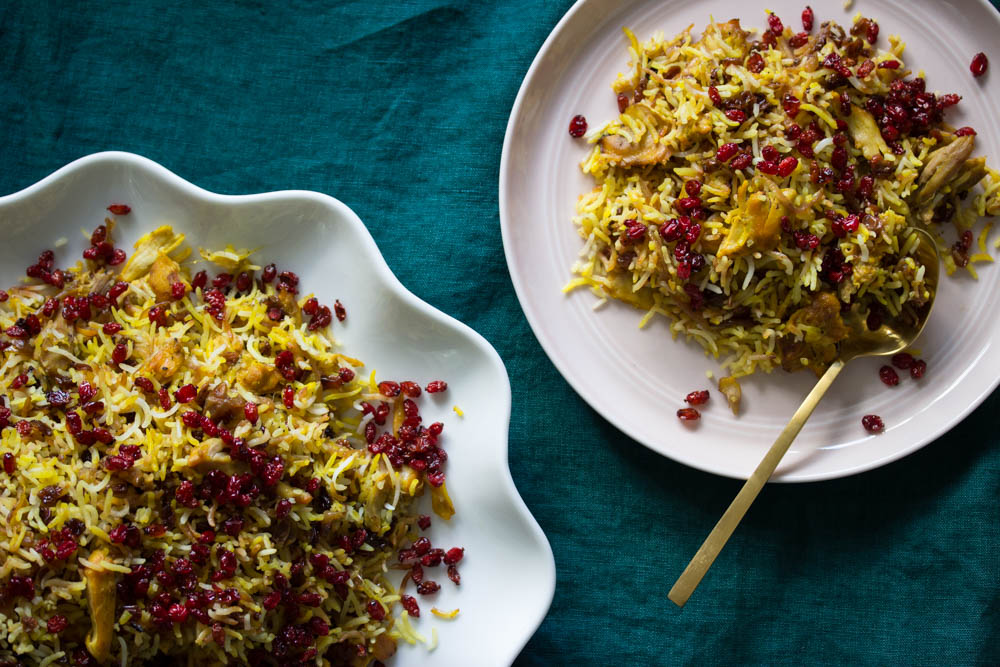
Just like Sabzi Polo, I prefer to make Zereshk Polo by layering the barberries, onions, and chicken in between layers of par-boiled rice and then steaming it all.  The barberries will bleed their crimson hue into the rice in this process so I like to set aside a couple of spatulas full of the barberries and onions to scatter over the entire dish when serving. Allowing the gems to shine.  You can always also make a pot of rice and add the chicken and barberries to it when serving.  But I find the rice absorbing the flavors and juices of the saffron chicken and onion/barberries mix to be essential in this dish.  It’s also the only way I was able convert my six-year-old into a Zereshk Polo lover.

It’s 1983, maybe 1984.  The unknown presented itself in the shape and form of Canada and you adapted.  That’s what happens when you’re young – you adapt. To the rain. To the lush green maple trees and brown squirrels.

To the questions, the assumptions, and presumptions.

Ramin tells me to sit down.  I do as I’m told.  It is apparent he has important information to share with me.  As I take a seat I watch Baba set the table.  Ramin tells me to focus and listen closely to what he is about to tell me.  I try to focus but am instantly distracted by the cloud of steam rising from behind him.  Maman lifts the towel covered lid to the rice pot and instantly the windows fog over.  For a brief moment I spy flakes of snow descending down on our rainy town of Vancouver.  A moment to be celebrated. The steam carries with it the scent of Iranian rice, ruby red barberries and saffron chicken.  The scent of home – wherever that may be.  The very scent that has enamored my newly made Canadian friends with our food and in return with us.  I quickly look back to Ramin and lock eyes with him, giving him all my attention.  The scent of Zereshk Polo circles us both. I close my eyes.  It’s Tehran, it’s Rome, it’s Vancouver.  There is a comfort, a safety in it all.

“Freddie Mercury is Persian” declares my brother with pride.

I open my eyes.  He smiles.  I smile back.  The scent of the rice and Ramin’s revelation have us both drunk with hope.  They are gifts.  Gifts to deflect all the mind-boggling questions, assumptions, presumptions and misunderstood notions of who we are and where we came from with the appropriation of a genuine rock star – a rock god – and a steaming pot of rice jeweled with tart, crimson berries.

It’s 2015, soon to be 2016.  Snow flakes are a fairy tale mystery in Los Angeles, as are drops of rain these days.  Turns out Freddie Mercury isn’t Persian.  It didn’t take us long to figure this out.  But it doesn’t matter.  He was Persian for us when we most needed him to be.  And after all these years I find myself once again reaching for Freddie and an unmistakable fragrant pot of Iranian rice.  To explain it all.

The questions, assumptions, and presumptions.

Everything and anything.

Anything.  Anything.  Anything.


Wishing you all a light filled, healthy and peaceful Shabeh Yalda – Winter Solstice 2015.  Please also enjoy these posts for Yalda night from fellow Persian food bloggers around the globe:

My Persian Kitchen, Family Spice  Lab Noon , Fae’s Twist & Tango , Honest & Tasty, My Caldron , Parisa’s Kitchen

ZERESHK POLO – BARBERRIES AND RICE

Notes:

  • For a more detailed guide to cooking Persian rice please see this post.
  • My preferred basmati rice at the moment is Royal Chef’s Choice. I purchase mine from my local Iranian market.
  • You can purchase dried barberries (zereshk) at Middle Eastern stores or online.  I have written more about zereshk here.
  • I add a very small amount of sugar to the barberries here to balance out their tartness.  I prefer them on the tart side.  Feel free to add as much sugar as you like.  But take note this is not meant to be a sweet dish!
  • The great thing about this dish is that the caramelized onion and the saffron chicken can be made ahead of time. I don’t like to add the barberries ahead because they can dry out.

Ingredients:

Serves 6-8

2 cups dried barberries (zereshk)
3 cups white basmati rice, washed and soaked in 2 cups cold water with 3 tablespoons  salt for at least 1 hour
2 large onions
6 tablespoons butter, divided
3 tablespoons olive oil
5 skinless chicken drumsticks
4 boneless/skinless chicken thighs
1/4 teaspoon ground saffron steeped in 2 tablespoons hot water, plus a small pinch
1 tablespoon sugar (optional)
salt
pepper

Scatter the barberries on a plate and look through.  Discard any older, shriveled, darker looking ones. Discard any small stones or pebbles.  If you have the time take the little stems off the barberries too.  Transfer the barberries to a small bowl and cover with cold water. Soak for 15 minutes. Lift the barberries out of the bowl with your hand or using a small mesh colander.  Taking carel not to disturb any of the sand and dirt that’s settled on the bottom.  Give a rinse and set aside to drain.

Finely slice 1 1/2 onions for caramelizing.  Slice the remaining half and set aside for the chicken.  In a medium pan melt 3 tablespoons butter over medium heat.  Add the onions you had set aside for caramelizing.  Turn up the heat to medium-high and saute for 10 minutes, stirring often. Turn down the heat to medium-low, sprinkle with a pinch of salt and caramelize, about 30 minutes.  Keep an eye on them.  Listen to the sizzle.  Stir often.  Play with your heat source.  Turn it up slightly if necessary and turn it back down if they look like they might be burning.  Ultimately, they will shrink to half their volume and take on a rich, silky caramel shade.  Add the barberries and sugar in the final 3-5 minutes.  Stir to incorporate, take off the heat and set aside.  In a separate small bowl set aside a couple of spatulas of this mixture to garnish the finished dish.

Wile the onions caramelize cook the chicken.  Heat the olive oil over medium heat in a large pot. Scatter the onions put aside for the chicken in one layer on top of the oil. Place the chicken on top of the onion, add 2 teaspoons salt, 1/4 teaspoon ground black pepper and pour the saffron water over the whole thing.  Make sure you get every last drop of saffron water.  Swirl more water into the glass to get it all out.  This is precious stuff! Give everything a stir. Cover and bring to a gentle boil.  Turn down the heat to low and simmer for 40 minutes.  Until the chicken is tender and cooked through.  When the chicken is done tear into pieces, discarding any bones and skin and set back in its juices. Set aside.

In a large pot bring 14 cups water and 1/4 cup kosher salt to a boil. Drain the rice and add to the pot. Stir ONE TIME very gently.  Return to a boil and keep a close eye on it.  Skim off any foam.  Test your rice after 4-6 minutes until the rice is al-dente.  Once al-dente drain the rice (I usually drain the rice at the 4-5 minute mark) and give a quick gentle rinse under cold tap water.  Drain the rice completely.

In a large non-stick pot melt 3 tablespoons butter over low heat.  Make sure the melted butter covers the entire surface of your pot and along the sides.  If not add more butter or 1 tablespoon olive oil accordingly.  Add a pinch of saffron and swirl around.  With a spatula add enough rice to fully cover the bottom of the pot. Using the back of the spatula or the back of a wooden spoon pack down the rice firmly. Add another layer of rice, then a layer of barberries, then another layer of rice, then a layer of chicken. Repeat, alternating layers in a pyramid shape. Your top layer should be a rice layer. Gently pour the juices from the chicken over the whole thing. Using the handle of a wooden spoon poke a couple of holes in the rice to allow the steam to escape.  Cover and turn up the heat to medium/high.  Cook for 10 minutes.  Don’t go anywhere!  The tahdig can burn very quickly.

Turn down the heat to medium.  Lift the lid and cover with a clean kitchen towel or a couple of layers of paper towel.  Place the lid firmly back on the pot and cook for 10 minutes.  Turn the heat down to low.  Place a heat diffuser (if using) under the pot and cook for 40 minutes.

When the rice is done gently lift the lid (without any condensation dripping back into the pot) and set aside. With a spatula gently scatter the rice mixture on a serving platter.  Make sure you don’t disturb the tahdig at the bottom of the pot.  Garnish the top with the reserved barberries mixture.  Gently scoop out the tahdig and serve on the side.

Enjoy with a side of mast-o khiar and sabzi khordan.  Listening to Queen while enjoying this dish is optional but recommended!

Appies

Pretend – A Sweet Pumpkin Borani – Jashneh Mehregan

 ♪ MUSIC WE’RE COOKING TO ♪

Luna, pretend, pretend the princess is on her way to the ball but she got lost.

Ok, but Soleil first pretend she is in her room practicing for the gymnastics competition and forgets she has to go to the ball.

But Luna pretend when she remembers she gets lost. Ok?

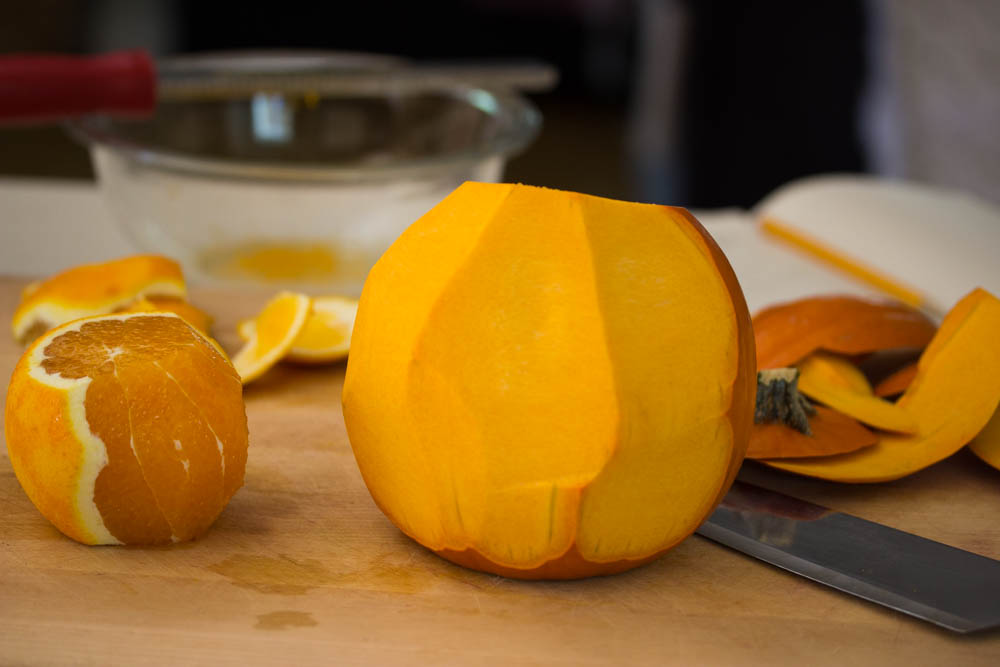
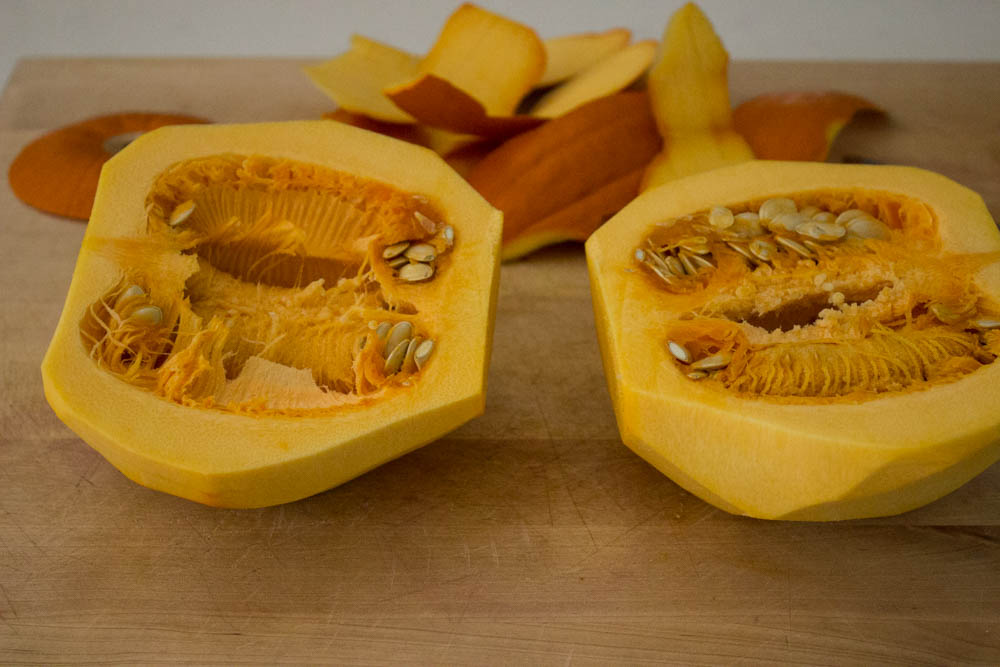
Set the pumpkin and orange on the cutting board.  Slice the tops and ends off each.  For stability, for support.  Use a sharp knife and cut downwards. Revealing the flesh. Be bold, be precise. Peel away the skin,the membrane, the rind. Let the curves of the fruit guide your way.

Mama, pumpkin is really a fruit because it has seeds. But we can pretend it’s a vegetable if you want.  Should we pretend, mama?

Pretend.

Pretend your last Mehregan wish echoed up through the hills and beyond the valleys.

Pretend she took heed of your murmurs, your whispers, and your cries. And the sky burst at the seams with a thundering bang and a rollicking roll.

Like the heart of young lovers on a hillside under California stars.

Every strike of lightening peeling away the skin, the membrane, the rind.  Revealing the flesh.  The curtain pulling back and revealing her.

The naked sky.  Drip, drip, dripping with rain.

Cut the pumpkin in half and reach in for the seeds  The stringy pulp refusing to let go.  Pretend you enjoy the mess of it all.  Hold a fistful of pumpkin seeds in one hand.  You should make use of it all.  Don’t waste anything.  Use everything.

Let go.

Watch them drop into the compost bin.  Think about how you could have rinsed them, dried them and roasted them.  But not today.  Maybe another day.  There will always be another day.

Pretend a cool Autumn’s breeze invites herself in.  And stays for a good long while. A much welcome, unexpected guest.

She runs her fingers through your hair and whispers sweet nothings in your ear.

Release the orange segments into a bowl.  Cool and slithery, slippery.  Bathing in orange blossom water.  Juices and all slipping freely though your fingers.

Wash your hands and peer out your sink window.  Pretend the leaves have turned.  Rust, amber, strawberry blonde.

Slice the pumpkin and dress it up for Mehregan.  The Autumn Festival.

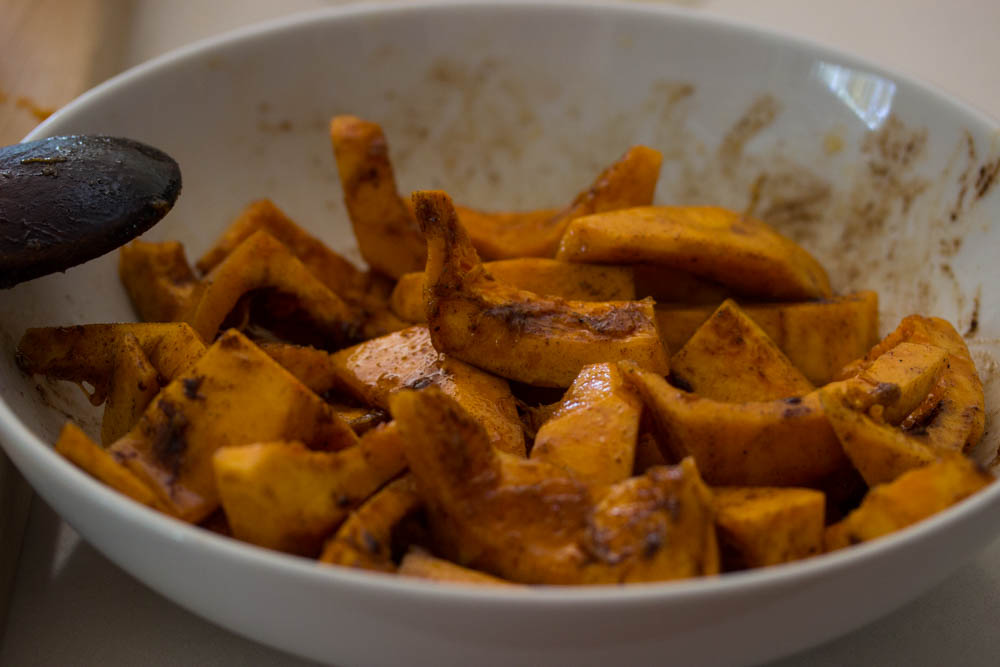
Pretend you relish the warmth exuding from your oven as the scent of cinnamon, cardamom, nutmeg, cloves, ginger and cumin waltz around your kitchen.  An Autumn Waltz.

A Mehregan overture.

A prelude to a celebration of friendship, light, love, and compassion.

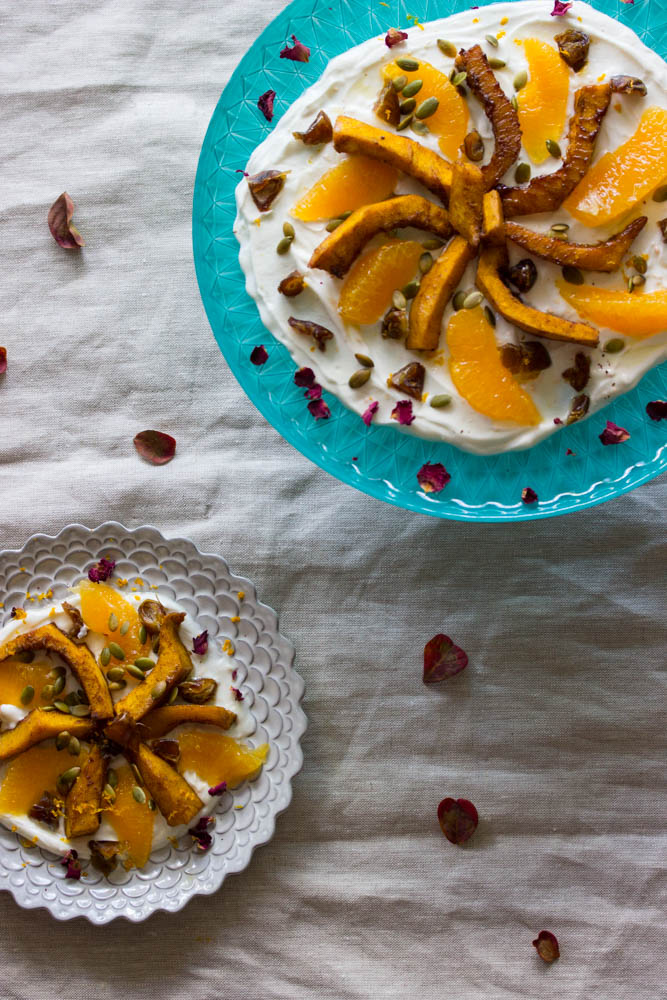
Spread the cool, thick yogurt over the roasted pumpkin, add the orange slices, juices and all.  Sprinkle all over with pumpkin seeds and sweet medjool dates.  Rust, amber, strawberry blonde.

A sweet pumpkin borani.  For comfort.  For Mehregan.

For when you need to pretend it’s Autumn under California skies.

I’m thrilled to be once again joining the following Persian food bloggers for a collaborative Mehregan post.  Enjoy!


SWEET PUMPKIN BORANI

I’ve really been enjoying this borani for breakfast.  But, it also makes a great side dish accompanying any meal.  I think it would be particularly festive at a Thanksgiving table.  I’ve layered the roasted pumpkin and orange segments over the yogurt in the photos, which makes for a pretty presentation.  But feel free to chop up the pumpkin in about 1 1/2 inch cubes and mix everything up with the yogurt.  Here’s a great guide to segmenting citrus.  I also prefer this borani as is, but if you would prefer it more sweet go ahead and drizzle with extra maple syrup when serving. Just keep in mind the dates sweeten things up quite a bit.  This is a great “transitional” dish.  When we say goodbye to summer and welcome fall.  Or in our case in Los Angeles when we’d like to pretend to do so.

Ingredients:

Serves 4-6

1 tablespoon raw, unsalted pumpkin seeds
1 large orange
1 cup strained Greek style yogurt
1/8 teaspoon orange blossom water
1 small sugar pumpkin, about 2 lbs/1kg
2 tablespoons melted ghee or olive oil or combination of
2 tablespoons maple syrup
1 teaspoon vanilla
1/2 teaspoon kosher salt
3/4 teaspoon cinnamon
1/4 teaspoon cardamom
1/4 teaspoon ginger powder
1/2 teaspoon nutmeg
1/4 teaspoon cumin
1/4 teaspoon cloves
5 medjool dates, chopped

Heat the oven to 375F.  Oven rack in the upper 1/3 position.

Line a large baking sheet with parchment paper.

Toast the pumpkin seeds in a small pan over medium heat.  Stir often (and never leave them out of your sight, they can burn very quickly!) until they release their oils and fragrance, about 5 minutes.  Set them aside to cool.

Place the yogurt in a medium sized bowl and zest the orange over the yogurt.  Stir to combine and put the yogurt in the fridge until ready to use.

Peel and segment the orange making sure you catch all the juices in a small bowl.  Add the orange blossom water.  Gently stir, cover and place in the fridge until ready to use.

Peel the pumpkin (as you did the orange) and discard the seeds and pulp.  (You can roast the pumpkin seeds if you’re in the mood) Cut the pumpkin in 1 inch slices or chop up the pumpkin in about 1 1/2 inch cubes.  This depends on how you would like to serve it.  Place the pumpkin in a big bowl and add the ghee or olive oil, the maple syrup and vanilla.  Stir to combine.  In a small bowl combine the salt and all the spices.  Sprinkle over the pumpkin, stir to combine.  Transfer the pumpkin to the baking sheet and roast for 20 minutes.  Tossing once halfway through.

Allow the pumpkin to cool slightly.  When cooled combine with the yogurt, orange segments and juices, pumpkin seeds and dates.  Drizzle with extra maple syrup if desired. Serve immediately.  For a prettier presentation you can spread the yogurt over a platter and layer all ingredients on top.

The borani will keep in the fridge for up to 3 days.

Luncheon

Grilled Lamb Testicles – Donbalan – Diplomacy and a Ladies Luncheon

Music we’re cooking to

The hunt for organic, grass-fed lamb testicles – donbalan – is complicated.

It takes time, patience, perseverance, and courage.

The quest for negotiating sensitive global issues, with potentially disastrous consequences, by means of diplomacy is complicated.

It takes time, patience, perseverance, and courage.

I’m not a big lamb eater.  On occasion, I do enjoy a sizzling, juicy grilled chop.  But it’s a meat I usually reserve for eating out, not one that I prepare at home.  And although lamb figures very prominently in Iranian cooking it was not a staple in our house.  My mother would complain of its sweet, gamy taste and smell. On the rare occasion we did prepare lamb it would be soaked and rinsed a few times in cold water to rid it of any excess blood and undesirable smells that was believed to come from the tail fat.
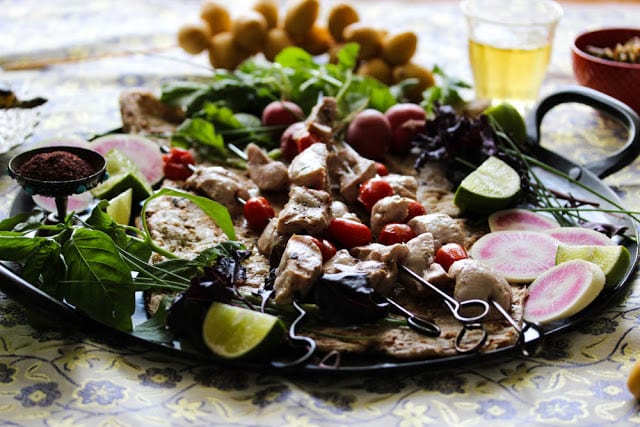
 

You set out on this quest by arming yourself with as much information as you can get your hands on.

They say knowledge is power. Whoever they may be.

Theoretically – ideally – diplomacy should and must always be the leading force.

The only force.

The alternative should and must be unimaginable.  A last resort they say.

Whoever they may be.

Preparing and eating lamb testicles has never ranked particularly high on my list.  But as is often the case with such things my obsession with donbalan began after a series of texts with my brother.  I thought myself quite clever and funny as I (at the time jokingly) inquired where I might be able to find organic grass-fed donbablan.  Because if there was ever a time that one might feel the need to consume grass-fed meat it would certainly be when eating lamb balls.  The jokes flew back and forth between us, as banter of the sort does between siblings, (hopefully giving the good folks at the NSA a much-needed chuckle.)  But, amidst our comedy routine the seed was planted. I was on a quest.

A donbalan quest.
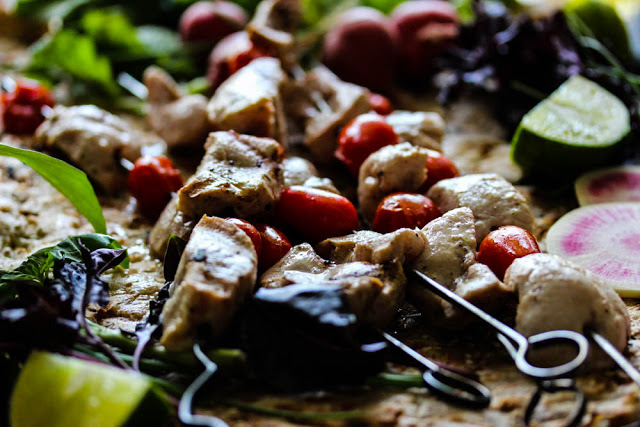
 

You mention you’ve had lamb balls on the mind for quite some time. As expected it’s met with howls, laughter, disgust, curiosity, jokes upon jokes and the occasional  stories and shared memories of a land far, far away.  A land where donbalan is served hot off a charcoal grill on the side of the street.  Street food as it would never be imagined, halfway across the world.  Sometimes wrapped snugly in a piece of warm bread.

Everyone has an opinion as to whether you should move forward with your quest   regardless if they’ve ever had a taste of your recent obsession or not.

Everyone always has an opinion.

There’s been quite a bit of talk about this far away land for some time now.  It’s far, far away so it’s easy to make grand proclamations regarding its future.  And as expected opinions abound as to what and how it should be dealt with.

Everyone always has an opinion.

It turns out that finding organic, grass-fed lamb testicles in Los Angeles is not an easy task.  I first hit up all the local butchers and markets.  The young butcher at my local Whole Foods has no idea what I’m talking about as I rattle off all the euphemisms for lamb testicles. I start off with the most common name: lamb fries, moving on to rocky mountain oysters, prairie oysters (even when it comes to testicles Canadians need to distinguish themselves from their neighbors to the south.)  My young butcher shakes his head no to each one. So I get straight to the point, I cup my hands for visual reference and ask for lamb testicles.  Baffled, he turns to the head butcher who kindly informs me that Whole Foods does not carry organic, grass-fed lamb testicles. I thank him in kind and move on with my $12 worth of NOT ultra-pasteurized bottle of milk.

Next I hit up the sparkling new and hip local nose-to-tail butchers, where I am informed that lamb testicles are a specialty item and not an in-demand cut among the general nose-to-tail consuming population, and since the health department has very strict laws on the sale of offal (and in particular testicles) it’s not easily accessible.  Perhaps these sparkly new shops should consider a slight change of name.  Nose To Tail (Except The Dangly Bits In Between).

My local Iranian market however, does carry donbalan.  But the Saran-wrapped set of balls staring back at me from behind the deli counter do not exactly meet my required organic, grass-fed criteria.  All my research informs me that offal, and testicles in particular, should be purchased as fresh as possible. And promptly prepared or frozen for later use.  Not wanting to put my always helpful and kind grocer on the spot, I don’t ask how old the testicles are and move on with my barbari bread and pomegranate molasses.
 

It’s the location of this particular cut of meat and all that it symbolizes that gives people pause. (Curious however that a chicken breast doesn’t seem to be an issue.) And so in almost every language it is referred to by a gentler, less direct name, a name it seems more indicative with the spirit and culture of the country.  Only in Persian and Arabic are they called exactly what they are.

“Because of the sexual connotation, testicles are almost always referred to by a different name except in the Arab world where they are simply called balls of sheep. The Italians call them gioielli (jewels) or animelle, while the French alternate between les joyeuses (the happy ones, in the feminine, and I guess one can understand why), animelles or amourettes (darling ones or little loves, confirming the opinion that the French know how to live). Amourettes is also the name given to spinal marrow. The Americans, puritanical as ever, refer to them as prairie or mountain oysters, also as Montana tendergroins, cowboy caviar, swinging beef, and calf fries (the latter two showing a less puritanical streak). Calf’s testicles are reputed to be a favourite of former US president George W Bush, and were apparently a staple on the menu when he was governor in Texas.”  Anissa Helou – An A to Z of Offal – The Guardian

Along your quest you discover that animal testicles are prepared and consumed on occasion on this side of the globe; however, offal in general is not very popular in North America (save for the reemergence of bone marrow at all the hot restaurants in town.) It’s the unknown, the misrepresented, the unfamiliar.  And the unknown, misrepresented and the unfamiliar can be scary.

It’s the history associated with this far, far away land, the history of the past 35 years in particular that gives people pause.  It’s the unknown, the misrepresented, the unfamiliar.  And the unknown, misrepresented and the unfamiliar can be scary.

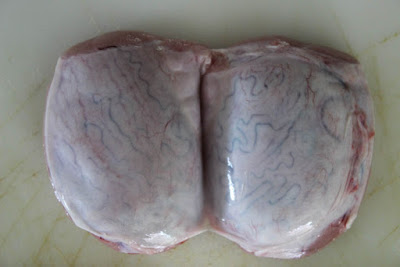
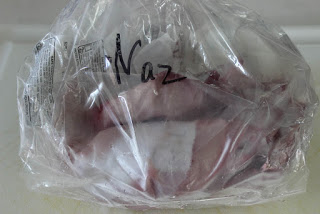
My donbalan quest finally comes to fruition where I should have looked first – at my local Farmer’s Market.  After some prodding about on the ever-useful world wide web I discover that Jimenez Family Farm sells grass-fed lamb and offal (true nose to tail) and I can pick it up at my Farmer’s Market.  After some time and a few tries (since the testicles need to be as fresh as possible delivery depends on availability) I receive an email from the lovely folks at Jimenez Farm to pick up my order the following day.  Giddy with anticipation I set off early the next morning, ice packs and my trusted rickety, squeaky-wheeled Framer’s Market cart in tow.  This trip has been months in the making and an assaulting, oppressive Los Angeles heat wave can’t stop me.  I head straight for the Jimenez Farm stand where I am greeted by the charismatic and knowledgeable Mr. Gustavo Jimenez.  He hands me 5 pairs of testicles and I behold them like the gioielli that they are.  Never having held lamb balls in my hands I remark that they appear smaller than I had imagined.  I’m not really sure what I had imagined.  Mr. Jimenez also reiterates what I had been told by other butchers.  The health department makes the sale of offal, and parts like testicles in particular, extremely difficult and this may be in part why the use and popularity of offal has declined so dramatically.
 

In the far, far away land the slaughter and consumption of an animal is considered sacred.  It is a gift and in turn no part of the animal should be wasted.  Such is the cultural belief echoed around many parts of the globe.

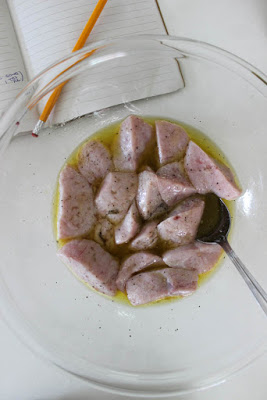
Once back home, I set three pairs of balls on the cutting board.  I stand above them, knife in hand. I try not to linger too long on the symbolism attached to this moment.  I stand simply where I stand most days and nights – at command central – at the kitchen island –  at my trusted cutting board with my preferred knife in hand.  I proceed as I might with a bunch of herbs or cloves of garlic. I swiftly separate each testicle.  Easy enough. The testicles are soft and a little slippery.  They feel more like chicken thighs off the bone.  They have a distinct sharp smell, much like lamb itself.  And yes, I have previously soaked and rinsed them in cold water. Cleanliness reigns supreme.  Each ball is covered in a thick outer skin.  And the skin needs to be removed.  I gently slip my finger under the skin (as one might when marinading a roast chicken) and slowly and carefully pull away at the skin, revealing a soft and delicate flesh.  I cut each testicle in half and simply marinade them with plenty of salt – though rich donbalan can be rather bland, so make sure to season them well – some olive oil, squeeze of a lemon and pepper. My go-to marinade for anything and everything.
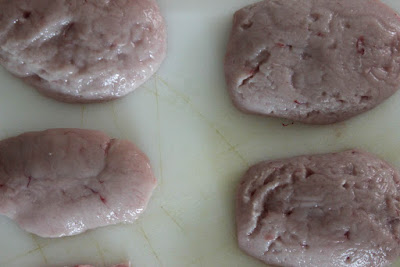
 

And as is customary with all foods from the far away land, donbalan is known for its many benefits.  Donbalan is considered to give you strength and courage and of course it is an aphrodisiac and thought to improve virility.

It dawns on me that I am about to grill about a pound of testicles.  And these kababs need to be eaten right away, hot off the grill.  No matter how much strength or courage I may be in need of, it would not be wise or possible for me to consume it all by myself.  So I send off a quick text to a couple of girlfriends who live close by and ask if they would like to join me for an impromptu luncheon of grilled lamb testicles.  And if that doesn’t win them over I also mention that we have AC.

Putting the kababs on the skewers proves a little challenging.  The meat is extremely tender and delicate so it is best to cut the kababs larger.  In my haste and excitement I forget to oil the hot grill so turning the very delicate kababs takes a little finesse.  I grill the kababs about 8 minutes on each side.  Enough to cook through but not too long to turn chewy and rubbery.
 

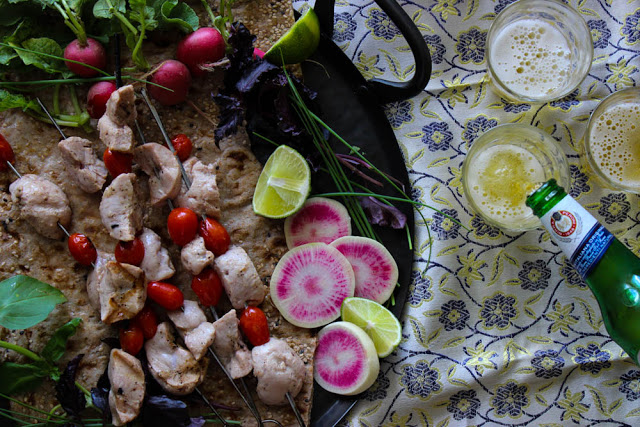
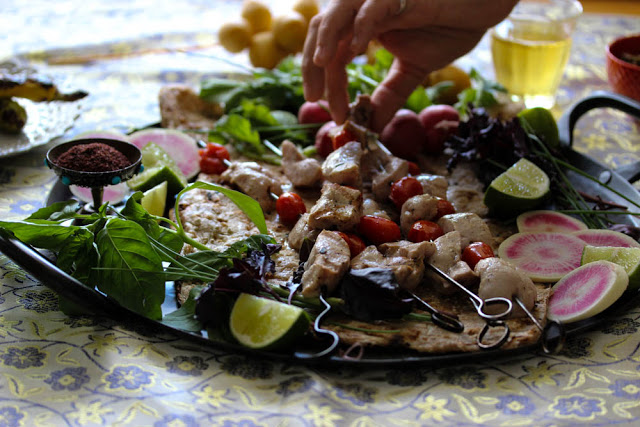
We gather around my kitchen table, an impromptu get together with good friends, good food and plenty of laughter. We set down the grilled donbalan, split the lone bottle of beer lingering in the door of the fridge and proceed with the feast.  All before school pick-up.

One of my girlfriends can’t bring herself to trying the testicles so I warm up a veggie burger for her.

In the far, far away land donbalan is often served as an appetizer accompanying a drink, with fresh herbs, and various pickled vegetables.

We sprinkle the donbalan with plenty of sumac and fresh lime and assemble a perfect loghmeh – bite: a piece of sumac sprinkled kabab wrapped snugly in a piece of sangak bread, with some torshi and khiar shoor – pickled vegetables – fresh basil and a bite of a crisp, cool radish. All flavors and textures bouncing off each other in harmony.  The essence of a Persian meal.

My other girlfriend proceeds to tell us about her Belgian home and the time her family grilled a whole lamb on the spit on a Belgian farm.  Nose to tail and all the dangly bits in between.

The donbalan is soft and rich.  It’s gamy as one would expect it to be, but not offensively so.  It reminds me of grilled liver, but much more delicate in texture.  More like a scallop in texture.  The use of sumac and accompanying pickles and herbs is essential in balancing out the richness.  It is not unlike any other rich tasting meat.  Juicy and tender.  And because it is so rich I think it is best suited as part of a tapa-style meal rather than a main course.

And so my quest comes full circle.  With a few texts exchanged back and forth, a comedy night’s worth of ball jokes, and plenty of gained wisdom, strength and courage.
 

It appears some decisions about the far, far away land are about to come to fruition.

A victory to some and a loss to others.

I offer all involved in this decision making a platter of grilled donbalan.

For strength and courage.

The strength and courage to move forward, to move beyond.

The strength and courage to get to know the unknown, the misrepresented, and the unfamiliar.

Because the alternative should be unimaginable.
 

DONBALAN – GRILLED LAMB TESTICLES

Notes:  – You’ll have to do some poking around to find butchers that sell lamb testicles, more commonly known as lamb’s fries.  Ask your local butchers, check Middle Eastern markets and check on-line to see if there are any farms that might deliver to your local Farmer’s Market.  In Southern California I recommend Jimenez Family Farm.

  • When dealing with offal and testicles in particular it is imperative that the meat be as fresh as possible. I felt particular about it being organic, grass-fed.  Use your own judgement when purchasing offal.
  • Testicles should be cooked the day they are purchased.  But you can also freeze them raw.
  • I  prefer to rinse them and then pat them dry before peeling.
  • You can always ask your butcher to peel them for you.
  • The kababs should be eaten hot right off the grill.

Ingredients:

Serves 4-6 as an appetizer/tapas style

3 pairs lamb testicles, roughly about 1 pound/434 grams, unpeeled
1 1/4 teaspoons sea salt
1/4 teaspoon ground black pepper
1/4 cup olive oil
juice of half a lime or lemon
sumac, to serve
fresh herbs, to serve
a variety of pickled vegetables, to serve
bread, to serve

Gently rinse the the testicles in cold water and pat them dry.  With a sharp knife split each pair in half.  Gently run your finger under the skin and gently pull away, peeling off the entire skin.  Cut each one in two length ways.

Place the meat in a medium sized bowl and add the salt, pepper, olive oil and lime or lemon juice.  Gently mix and allow to marinate for up to 30 minutes.

Prepare a hot grill.  Make sure your grates are well oiled.  Skewer the meat.  Grill the skewers, basting a few times with the marinade, about 8 minutes on each side.

Remove from the grill, squeeze fresh lime juice and sprinkle with plenty of sumac over the meat and serve hot off the grill.  Enjoy with your preferred refreshment, plenty of fresh herbs, pickled veggies, and bread.

Here’s to your strength and courage!