The hunt for organic, grass-fed lamb testicles – donbalan – is complicated.
It takes time, patience, perseverance, and courage.
The quest for negotiating sensitive global issues, with potentially disastrous consequences, by means of diplomacy is complicated.
It takes time, patience, perseverance, and courage.
I’m not a big lamb eater. On occasion, I do enjoy a sizzling, juicy grilled chop. But it’s a meat I usually reserve for eating out, not one that I prepare at home. And although lamb figures very prominently in Iranian cooking it was not a staple in our house. My mother would complain of its sweet, gamy taste and smell. On the rare occasion we did prepare lamb it would be soaked and rinsed a few times in cold water to rid it of any excess blood and undesirable smells that was believed to come from the tail fat.
You set out on this quest by arming yourself with as much information as you can get your hands on.
They say knowledge is power. Whoever they may be.
Theoretically – ideally – diplomacy should and must always be the leading force.
The only force.
The alternative should and must be unimaginable. A last resort they say.
Whoever they may be.
Preparing and eating lamb testicles has never ranked particularly high on my list. But as is often the case with such things my obsession with donbalan began after a series of texts with my brother. I thought myself quite clever and funny as I (at the time jokingly) inquired where I might be able to find organic grass-fed donbablan. Because if there was ever a time that one might feel the need to consume grass-fed meat it would certainly be when eating lamb balls. The jokes flew back and forth between us, as banter of the sort does between siblings, (hopefully giving the good folks at the NSA a much-needed chuckle.) But, amidst our comedy routine the seed was planted. I was on a quest.
A donbalan quest.
You mention you’ve had lamb balls on the mind for quite some time. As expected it’s met with howls, laughter, disgust, curiosity, jokes upon jokes and the occasional stories and shared memories of a land far, far away. A land where donbalan is served hot off a charcoal grill on the side of the street. Street food as it would never be imagined, halfway across the world. Sometimes wrapped snugly in a piece of warm bread.
Everyone has an opinion as to whether you should move forward with your quest regardless if they’ve ever had a taste of your recent obsession or not.
Everyone always has an opinion.
There’s been quite a bit of talk about this far away land for some time now. It’s far, far away so it’s easy to make grand proclamations regarding its future. And as expected opinions abound as to what and how it should be dealt with.
Everyone always has an opinion.
It turns out that finding organic, grass-fed lamb testicles in Los Angeles is not an easy task. I first hit up all the local butchers and markets. The young butcher at my local Whole Foods has no idea what I’m talking about as I rattle off all the euphemisms for lamb testicles. I start off with the most common name: lamb fries, moving on to rocky mountain oysters, prairie oysters (even when it comes to testicles Canadians need to distinguish themselves from their neighbors to the south.) My young butcher shakes his head no to each one. So I get straight to the point, I cup my hands for visual reference and ask for lamb testicles. Baffled, he turns to the head butcher who kindly informs me that Whole Foods does not carry organic, grass-fed lamb testicles. I thank him in kind and move on with my $12 worth of NOT ultra-pasteurized bottle of milk.
Next I hit up the sparkling new and hip local nose-to-tail butchers, where I am informed that lamb testicles are a specialty item and not an in-demand cut among the general nose-to-tail consuming population, and since the health department has very strict laws on the sale of offal (and in particular testicles) it’s not easily accessible. Perhaps these sparkly new shops should consider a slight change of name. Nose To Tail (Except The Dangly Bits In Between).
My local Iranian market however, does carry donbalan. But the Saran-wrapped set of balls staring back at me from behind the deli counter do not exactly meet my required organic, grass-fed criteria. All my research informs me that offal, and testicles in particular, should be purchased as fresh as possible. And promptly prepared or frozen for later use. Not wanting to put my always helpful and kind grocer on the spot, I don’t ask how old the testicles are and move on with my barbari bread and pomegranate molasses.
It’s the location of this particular cut of meat and all that it symbolizes that gives people pause. (Curious however that a chicken breast doesn’t seem to be an issue.) And so in almost every language it is referred to by a gentler, less direct name, a name it seems more indicative with the spirit and culture of the country. Only in Persian and Arabic are they called exactly what they are.
“Because of the sexual connotation, testicles are almost always referred to by a different name except in the Arab world where they are simply called balls of sheep. The Italians call them gioielli (jewels) or animelle, while the French alternate between les joyeuses (the happy ones, in the feminine, and I guess one can understand why), animelles or amourettes (darling ones or little loves, confirming the opinion that the French know how to live). Amourettes is also the name given to spinal marrow. The Americans, puritanical as ever, refer to them as prairie or mountain oysters, also as Montana tendergroins, cowboy caviar, swinging beef, and calf fries (the latter two showing a less puritanical streak). Calf’s testicles are reputed to be a favourite of former US president George W Bush, and were apparently a staple on the menu when he was governor in Texas.” Anissa Helou – An A to Z of Offal – The Guardian
Along your quest you discover that animal testicles are prepared and consumed on occasion on this side of the globe; however, offal in general is not very popular in North America (save for the reemergence of bone marrow at all the hot restaurants in town.) It’s the unknown, the misrepresented, the unfamiliar. And the unknown, misrepresented and the unfamiliar can be scary.
It’s the history associated with this far, far away land, the history of the past 35 years in particular that gives people pause. It’s the unknown, the misrepresented, the unfamiliar. And the unknown, misrepresented and the unfamiliar can be scary.
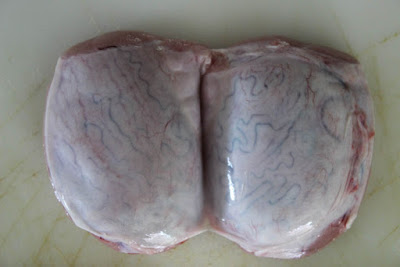
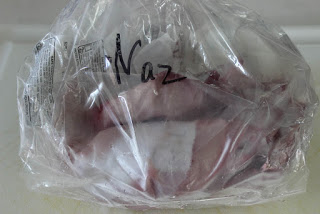
My donbalan quest finally comes to fruition where I should have looked first – at my local Farmer’s Market. After some prodding about on the ever-useful world wide web I discover that Jimenez Family Farm sells grass-fed lamb and offal (true nose to tail) and I can pick it up at my Farmer’s Market. After some time and a few tries (since the testicles need to be as fresh as possible delivery depends on availability) I receive an email from the lovely folks at Jimenez Farm to pick up my order the following day. Giddy with anticipation I set off early the next morning, ice packs and my trusted rickety, squeaky-wheeled Framer’s Market cart in tow. This trip has been months in the making and an assaulting, oppressive Los Angeles heat wave can’t stop me. I head straight for the Jimenez Farm stand where I am greeted by the charismatic and knowledgeable Mr. Gustavo Jimenez. He hands me 5 pairs of testicles and I behold them like the gioielli that they are. Never having held lamb balls in my hands I remark that they appear smaller than I had imagined. I’m not really sure what I had imagined. Mr. Jimenez also reiterates what I had been told by other butchers. The health department makes the sale of offal, and parts like testicles in particular, extremely difficult and this may be in part why the use and popularity of offal has declined so dramatically.
In the far, far away land the slaughter and consumption of an animal is considered sacred. It is a gift and in turn no part of the animal should be wasted. Such is the cultural belief echoed around many parts of the globe.
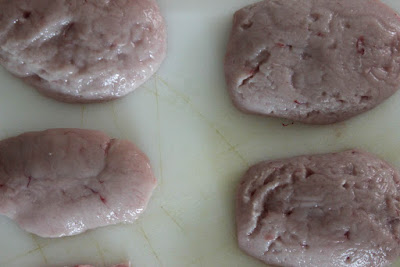
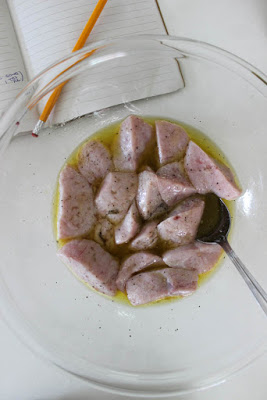
Once back home, I set three pairs of balls on the cutting board. I stand above them, knife in hand. I try not to linger too long on the symbolism attached to this moment. I stand simply where I stand most days and nights – at command central – at the kitchen island – at my trusted cutting board with my preferred knife in hand. I proceed as I might with a bunch of herbs or cloves of garlic. I swiftly separate each testicle. Easy enough. The testicles are soft and a little slippery. They feel more like chicken thighs off the bone. They have a distinct sharp smell, much like lamb itself. And yes, I have previously soaked and rinsed them in cold water. Cleanliness reigns supreme. Each ball is covered in a thick outer skin. And the skin needs to be removed. I gently slip my finger under the skin (as one might when marinading a roast chicken) and slowly and carefully pull away at the skin, revealing a soft and delicate flesh. I cut each testicle in half and simply marinade them with plenty of salt – though rich donbalan can be rather bland, so make sure to season them well – some olive oil, squeeze of a lemon and pepper. My go-to marinade for anything and everything.
And as is customary with all foods from the far away land, donbalan is known for its many benefits. Donbalan is considered to give you strength and courage and of course it is an aphrodisiac and thought to improve virility.
It dawns on me that I am about to grill about a pound of testicles. And these kababs need to be eaten right away, hot off the grill. No matter how much strength or courage I may be in need of, it would not be wise or possible for me to consume it all by myself. So I send off a quick text to a couple of girlfriends who live close by and ask if they would like to join me for an impromptu luncheon of grilled lamb testicles. And if that doesn’t win them over I also mention that we have AC.
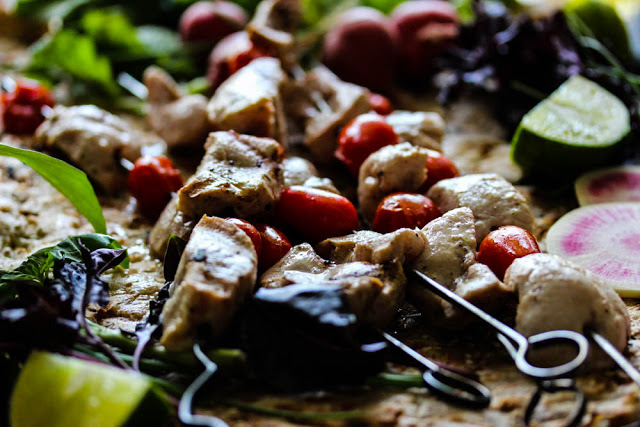
Putting the kababs on the skewers proves a little challenging. The meat is extremely tender and delicate so it is best to cut the kababs larger. In my haste and excitement I forget to oil the hot grill so turning the very delicate kababs takes a little finesse. I grill the kababs about 8 minutes on each side. Enough to cook through but not too long to turn chewy and rubbery.
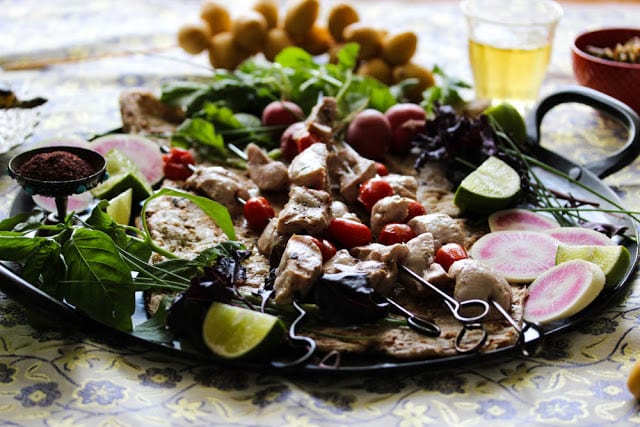
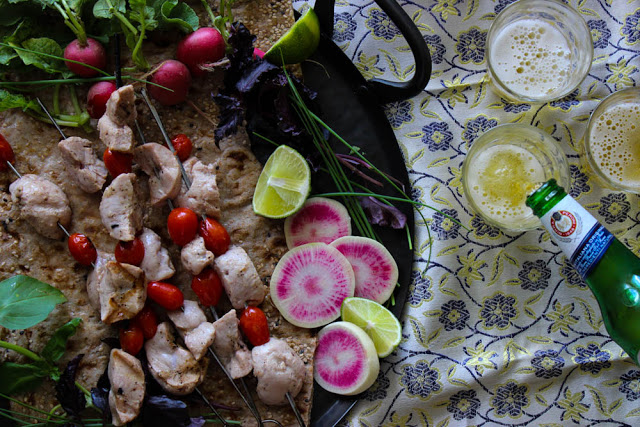
We gather around my kitchen table, an impromptu get together with good friends, good food and plenty of laughter. We set down the grilled donbalan, split the lone bottle of beer lingering in the door of the fridge and proceed with the feast. All before school pick-up.
One of my girlfriends can’t bring herself to trying the testicles so I warm up a veggie burger for her.
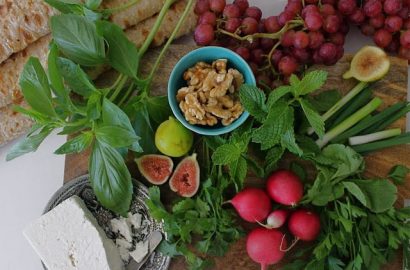
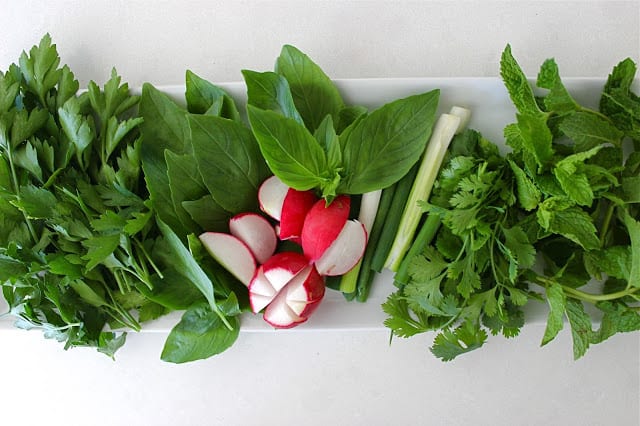
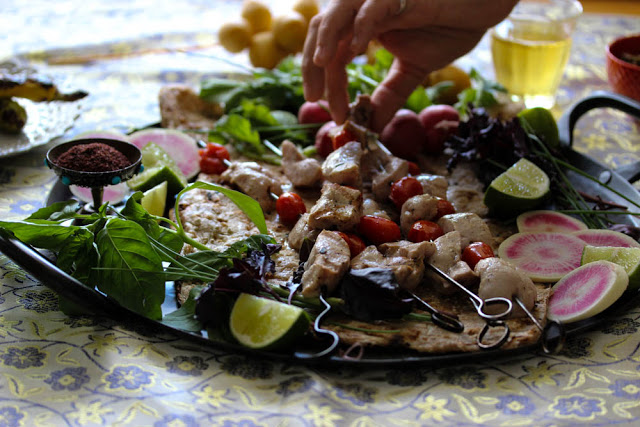
In the far, far away land donbalan is often served as an appetizer accompanying a drink, with fresh herbs, and various pickled vegetables.
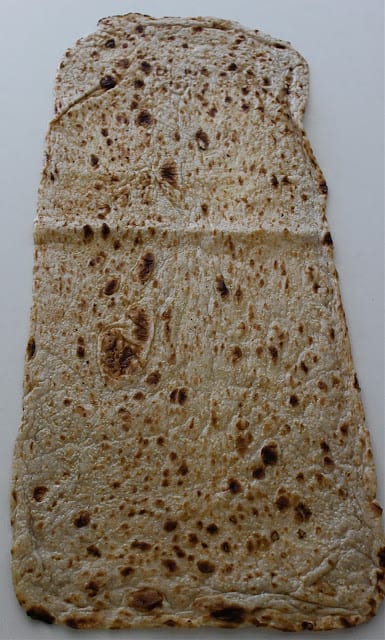
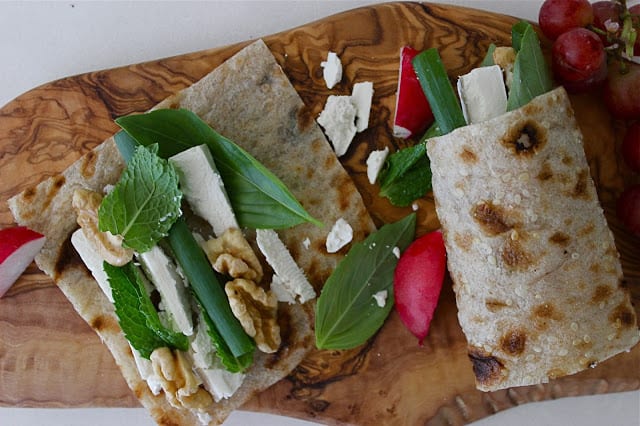
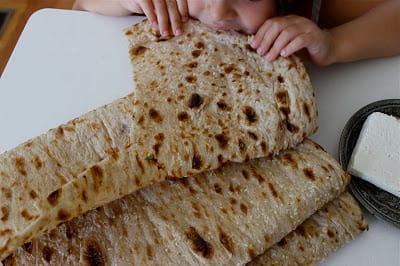
We sprinkle the donbalan with plenty of sumac and fresh lime and assemble a perfect loghmeh – bite: a piece of sumac sprinkled kabab wrapped snugly in a piece of sangak bread, with some torshi and khiar shoor – pickled vegetables – fresh basil and a bite of a crisp, cool radish. All flavors and textures bouncing off each other in harmony. The essence of a Persian meal.
My other girlfriend proceeds to tell us about her Belgian home and the time her family grilled a whole lamb on the spit on a Belgian farm. Nose to tail and all the dangly bits in between.
The donbalan is soft and rich. It’s gamy as one would expect it to be, but not offensively so. It reminds me of grilled liver, but much more delicate in texture. More like a scallop in texture. The use of sumac and accompanying pickles and herbs is essential in balancing out the richness. It is not unlike any other rich tasting meat. Juicy and tender. And because it is so rich I think it is best suited as part of a tapa-style meal rather than a main course.
And so my quest comes full circle. With a few texts exchanged back and forth, a comedy night’s worth of ball jokes, and plenty of gained wisdom, strength and courage.
It appears some decisions about the far, far away land are about to come to fruition.
A victory to some and a loss to others.
I offer all involved in this decision making a platter of grilled donbalan.
For strength and courage.
The strength and courage to move forward, to move beyond.
The strength and courage to get to know the unknown, the misrepresented, and the unfamiliar.
Because the alternative should be unimaginable.
DONBALAN – GRILLED LAMB TESTICLES
Notes: – You’ll have to do some poking around to find butchers that sell lamb testicles, more commonly known as lamb’s fries. Ask your local butchers, check Middle Eastern markets and check on-line to see if there are any farms that might deliver to your local Farmer’s Market. In Southern California I recommend Jimenez Family Farm.
- When dealing with offal and testicles in particular it is imperative that the meat be as fresh as possible. I felt particular about it being organic, grass-fed. Use your own judgement when purchasing offal.
- Testicles should be cooked the day they are purchased. But you can also freeze them raw.
- I prefer to rinse them and then pat them dry before peeling.
- You can always ask your butcher to peel them for you.
- The kababs should be eaten hot right off the grill.
Ingredients:
Serves 4-6 as an appetizer/tapas style
3 pairs lamb testicles, roughly about 1 pound/434 grams, unpeeled
1 1/4 teaspoons sea salt
1/4 teaspoon ground black pepper
1/4 cup olive oil
juice of half a lime or lemon
sumac, to serve
fresh herbs, to serve
a variety of pickled vegetables, to serve
bread, to serve
Gently rinse the the testicles in cold water and pat them dry. With a sharp knife split each pair in half. Gently run your finger under the skin and gently pull away, peeling off the entire skin. Cut each one in two length ways.
Place the meat in a medium sized bowl and add the salt, pepper, olive oil and lime or lemon juice. Gently mix and allow to marinate for up to 30 minutes.
Prepare a hot grill. Make sure your grates are well oiled. Skewer the meat. Grill the skewers, basting a few times with the marinade, about 8 minutes on each side.
Remove from the grill, squeeze fresh lime juice and sprinkle with plenty of sumac over the meat and serve hot off the grill. Enjoy with your preferred refreshment, plenty of fresh herbs, pickled veggies, and bread.
Here’s to your strength and courage!